
International
January 28, 2026
Boycott or Breakdown? Why Pakistan Can’t Afford to Skip the T20 World Cup in India
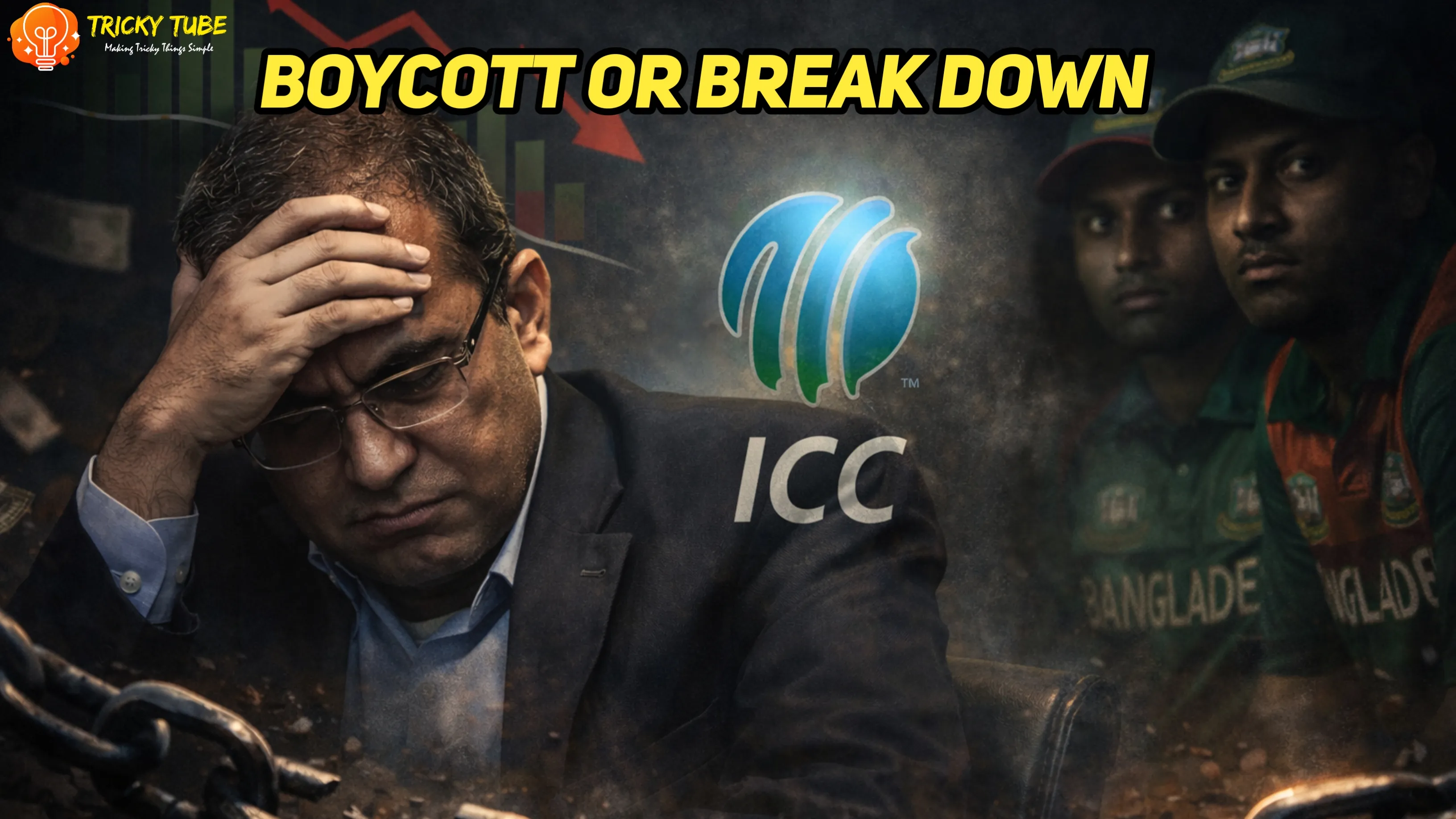
What happens when politics collides with cricket’s money engine? The ICC’s stern warning to Pakistan over a possible T20 World Cup boycott could reshape Asian cricket forever. Here’s the full story, implications, and what’s really at stake.
TrickyTube’s Quick Summary
Pakistan has been warned by the ICC that boycotting the T20 World Cup in India could lead to severe sanctions, financial losses, and global isolation. With PCB already under financial stress, a boycott seems more like political posturing than a realistic option.
What if one political decision ended up isolating an entire cricketing nation from the world? That’s not a hypothetical anymore—it’s the exact scenario Pakistan is staring at right now.
This issue has gained serious attention after a detailed analysis surfaced highlighting how the International Cricket Council has quietly but firmly drawn a red line for Pakistan. The warning is not symbolic or routine—it carries the weight of real consequences that could disrupt Pakistan’s position in global cricket. What initially looked like a political stance is now being viewed as a high-risk gamble, one that could cost Pakistan far more than a single tournament.
This isn’t just about one tournament. It’s about money, power, geopolitics, and survival in modern international cricket.
The ICC’s Warning: More Than Just Words
According to reports, the ICC has made it clear that if Pakistan withdraws from the upcoming ICC T20 World Cup hosted by India, the fallout will be severe. The possible sanctions reportedly include:
- Suspension or long-term damage to bilateral series with top teams like Australia and South Africa
- Exclusion from the Asia Cup, one of the most lucrative tournaments for Asian boards
- Restrictions or even jeopardy around the Pakistan Super League (PSL)
- Loss of influence within ICC decision-making circles
In today’s cricket ecosystem, where revenue decides relevance, these are not symbolic punishments. They are existential threats.
Bangladesh’s Exit and Pakistan’s “Solidarity” Signal
The situation escalated after Bangladesh officially pulled out of the T20 World Cup in India, citing security concerns. They were swiftly replaced by Scotland—a move that sent a clear signal: the tournament will go on, with or without you. Soon after, Pakistan Cricket Board chairman Mohsin Naqvi hinted that Pakistan might also consider withdrawing, allegedly in solidarity with Bangladesh. On the surface, this looks like a safety-based decision. But scratch a little deeper, and the narrative starts to crack.
Are Security Concerns Really the Issue?
Here’s where things get uncomfortable. According to various news reports and analysis these “security concerns” are less about safety and more about politics. India is currently the financial backbone of world cricket—hosting ICC events there generates massive broadcast and sponsorship revenue.
Damaging or delegitimising a tournament in India directly hits the sport’s biggest money engine. What makes the argument stronger is the contradiction:
- Bangladesh was willing to send its players to India for the IPL
- Pakistani players, coaches, and officials have toured India safely in the past
- No fresh intelligence inputs have suggested a new or elevated risk This raises an obvious question: If India is safe for leagues and bilateral travel, why suddenly unsafe for an ICC event?
PCB’s Financial Reality: A Weak Position to Take Risks
Perhaps the most shocking part of the discussion is the financial state of the Pakistan Cricket Board (PCB). The PCB is reportedly under such financial stress that:
- Domestic match fees were slashed from 100,000 Pakistani Rupees to just 100 Rupees per match
- Cost-cutting has become aggressive and unavoidable
- Revenue streams are already shrinking In this situation, inviting ICC sanctions would be like pulling the plug on life support. Opinion: From a purely economic standpoint, Pakistan cricket cannot survive isolation. Ideological posturing might play well politically, but financially, it’s a disaster waiting to happen.
What Happens If Sanctions Actually Hit?
If the ICC follows through, Pakistan could face:
- Near-total isolation from top-tier international cricket
- Loss of broadcast revenue
- Sponsors pulling out due to reduced visibility
- PSL losing international players and global viewership
- A generation of Pakistani cricketers missing out on elite exposure At that point, the damage wouldn’t be reversible in one or two years. It would take a decade to recover credibility and financial stability.
This is why, despite the noise, many experts believe Pakistan will eventually participate in the tournament—perhaps after symbolic resistance.
The Bigger Picture: Cricket Is No Longer Just a Game
Modern cricket is a business, and the ICC runs it like one. Tournaments hosted in India:
- Fund smaller cricket boards
- Support grassroots development worldwide
- Keep the global calendar financially viable A boycott isn’t just a protest—it’s a direct attack on that system. And the ICC, unsurprisingly, is unwilling to tolerate it. Implication: Any board that challenges the economic structure of world cricket risks being pushed to the margins—regardless of history or fan base.
Will Pakistan Actually Boycott?
Highly unlikely. The risks are too high, the financial condition too fragile, and the potential losses too devastating. What we are seeing right now looks more like political signalling and pressure tactics, not a final decision. In the end, cricket logic will overpower political optics—because survival leaves little room for symbolism.
FAQs
Why is Pakistan considering a T20 World Cup boycott?
Officially, due to security concerns and solidarity with Bangladesh, but analysts believe political motives play a larger role.
What sanctions can ICC impose on Pakistan?
Loss of bilateral series, exclusion from Asia Cup, restrictions on PSL, and reduced global participation.
Is India unsafe for international cricket teams?
There is no recent evidence to suggest elevated security risks, especially since multiple international events and leagues are held safely in India.
Will Pakistan actually boycott the tournament?
Most experts believe Pakistan will eventually participate to avoid financial and sporting isolation.