
International
January 21, 2026
Trump retaliate with a 200% tariff threat on French wine after Macron rejects His 'Board Of Peace' and Leaked Private Texts
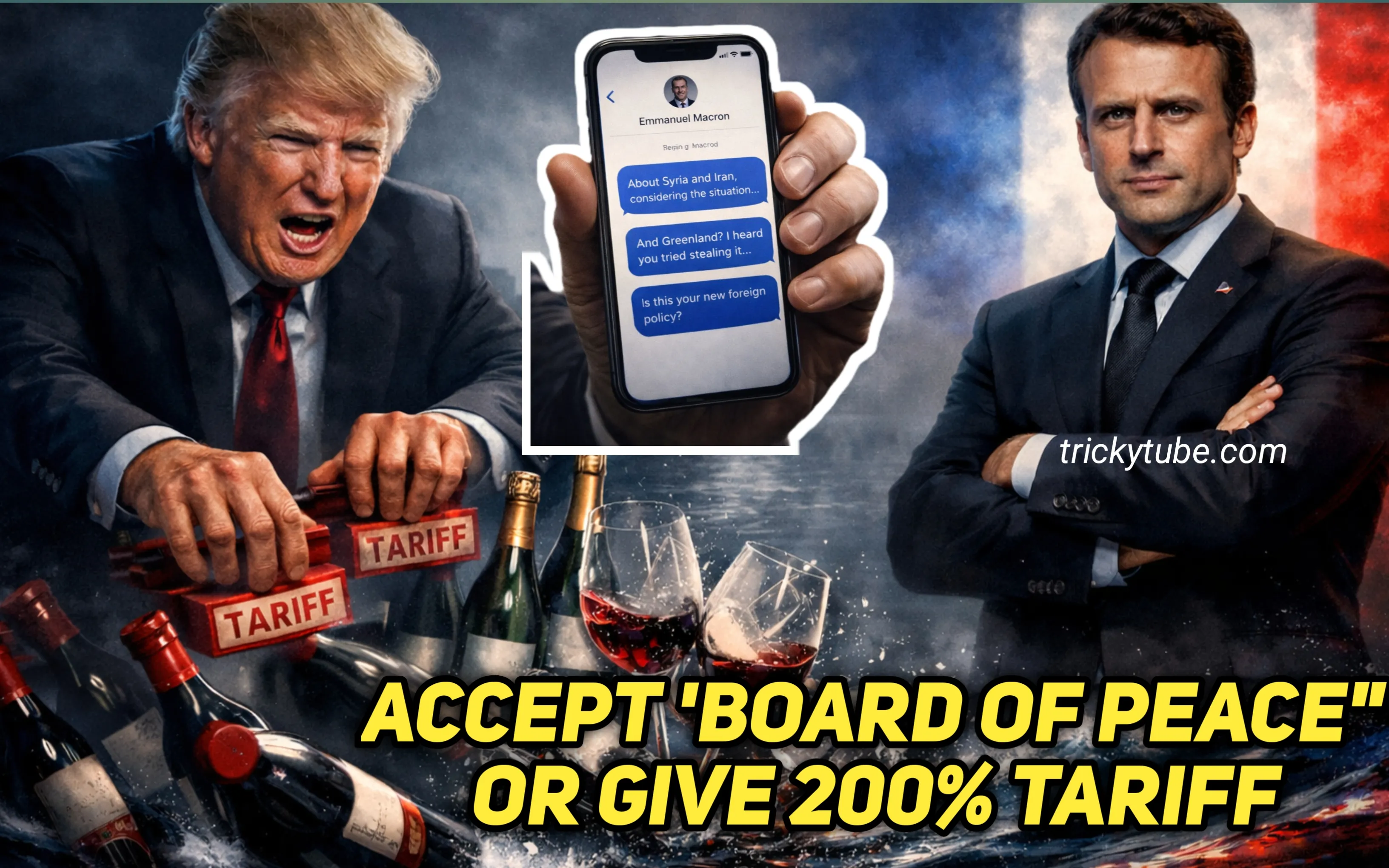
A 200% tariff threat on French wine exposed a deeper clash between Trump and Macron-one over power, pride, and the future of global diplomacy.
TrickyTube’s Quick Summary
- Trump proposed a U.S.-centric “Board of Peace” as an alternative to the UN
- Macron rejected it, citing legitimacy and multilateral principles
- Trump retaliated with a 200% tariff threat on French wine and champagne
- Europe united behind France
- The clash highlights trade weaponization, weakening multilateralism, and personality-driven foreign policy
What happens when global diplomacy turns personal-and trade becomes a weapon? That was the uncomfortable question hanging in the air when Donald Trump reportedly threatened a 200% tariff on French wine and champagne, jolting not just Paris but the entire European political ecosystem. What looked like an aggressive trade move was actually something deeper: a clash of egos, ideologies, and competing visions of global order-one that Emmanuel Macron refused to bow to.
The Spark: A Private Message That Went Public
The controversy didn’t begin with tariffs. It began with trust-broken. Trump publicly shared a private message sent by Macron, an act that stunned diplomatic circles. In that message, Macron reportedly discussed sensitive global issues like Syria, Iran, and even questioned Trump’s ambitions around Greenland. Leaking such communication isn’t just unusual; it violates long-standing diplomatic norms. The subtext was clear: frustration had crossed into retaliation. This public disclosure transformed a policy disagreement into a personal confrontation, and from that moment, escalation was almost inevitable.
The “Board of Peace”: Power, Money, and Control
At the heart of the standoff was Trump’s proposal for a so-called “Board of Peace.” Initially framed as a mechanism to oversee Gaza’s reconstruction, the idea soon expanded into something far more ambitious-an elite, permanent body positioned as an alternative to the United Nations. The catch? Membership reportedly required a $1 billion contribution, instantly turning global peacekeeping into a pay-to-play club. Unsurprisingly, critics saw it as U.S.-centric, dominated by Trump’s agenda, and lacking democratic legitimacy-especially when compared to institutions like the United Nations. Macron’s response was firm and unapologetic: France would not join.
Why Macron Said “No”-And Why It Mattered
Macron’s refusal wasn’t symbolic; it was structural. He argued that:
- The Board undermined existing multilateral institutions
- It lacked international legitimacy
- It risked concentrating power in one country’s hands Instead, Macron pushed for reform within established platforms-like the G7 and discussions at Davos-rather than abandoning them altogether. This wasn’t just defiance. It was a declaration that global order cannot be auctioned.
Why Target French Wine and Champagne?
Trump’s tariff threat wasn’t random-it was surgical.
Economic Impact
The U.S. imports billions of dollars worth of French wine annually. A 200% tariff would effectively triple retail prices, pricing many bottles out of the American market overnight.
Cultural Symbolism
Wine and champagne aren’t just exports-they’re France’s identity. Targeting them strikes an emotional and political nerve at home.
Political Pressure
By hurting a sector deeply tied to French pride and employment, Trump aimed to create domestic pressure on Macron, hoping economic pain would force political compliance. In short, this was trade warfare designed for maximum visibility and psychological impact.
Europe Pushes Back
The European response was swift. The European Union made it clear: a tariff on France is a tariff on Europe. Retaliatory measures were openly discussed, reinforcing the idea that unilateral threats would meet collective resistance. Macron, meanwhile, chose the global stage to respond.
Macron’s Davos Moment
At Davos, Macron didn’t name Trump directly-but the message was unmistakable. He spoke of choosing:
- Rule of law over brutality
- Respect over bullying
- Multilateral cooperation over unilateral intimidation This wasn’t rhetoric for applause. It was a philosophical rebuttal to personality-driven foreign policy-and a reminder that leadership is about institutions, not impulses.
The Bigger Picture: Three Dangerous Global Trends
Trade as a Political Weapon
Tariffs are no longer just economic tools—they’re leverage for political obedience.
Crisis of Multilateralism
Established institutions are under attack, not from failure alone, but from leaders who see constraints as inconveniences.
Ego-Driven Diplomacy
When foreign policy becomes personal, national interests risk being sacrificed for individual pride.
[!info] Opinion: If this trend continues, global stability will increasingly depend not on treaties-but on temperaments. That’s a dangerous gamble.
FAQs
Why did Trump threaten tariffs on French wine?
To pressure France after Macron rejected Trump’s proposed “Board of Peace.”
What is the Board of Peace?
A Trump-proposed elite body, requiring massive financial contributions, positioned as an alternative to the UN.
How did Macron respond?
He rejected the proposal and publicly defended multilateral cooperation and rule-based order.
Why is this issue important globally?
It shows how trade tools are being weaponized and how global institutions are under strain.