
Geography
March 11, 2026
Why 80 Million Japanese Live in One Narrow Corridor: The Geography Behind Japan’s Taiheiyo Belt
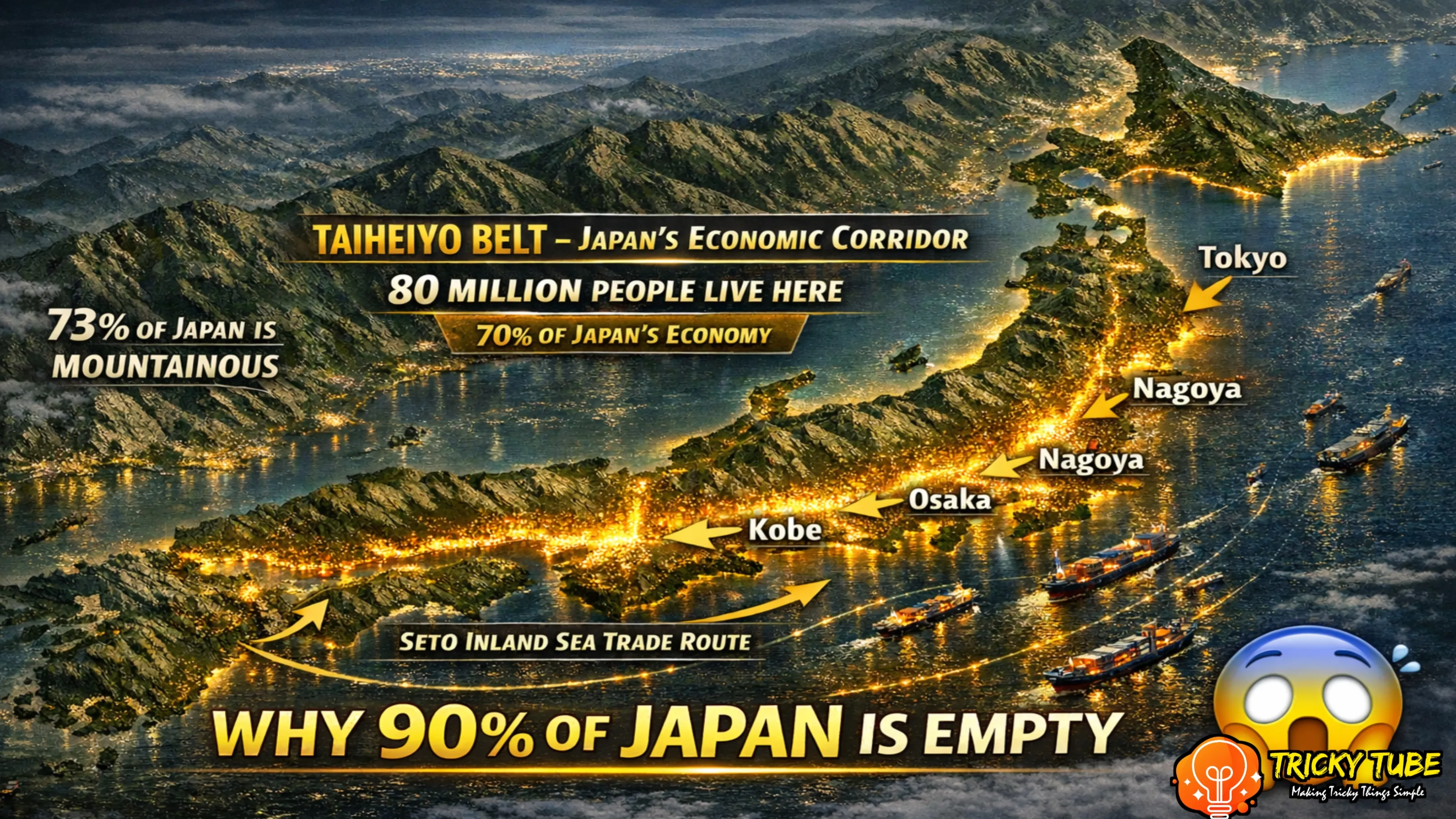
Why does most of Japan’s population live in a thin strip of land while 90% of the country remains sparsely populated? The answer lies in geography, climate, history, and trade routes that shaped modern Japan.
TrickyTube’s Quick Summary
- 90% of Japan’s land is sparsely populated due to mountainous terrain.
- Around 80 million people live in the Taiheiyo Belt, a 1,200 km corridor.
- The region produces 70% of Japan’s economy.
- Major plains like Kanto, Nobi, and Kinai provide rare flat land.
- Natural harbors and the Seto Inland Sea trade network boosted development.
- A warmer climate and historical policies strengthened population concentration.
Why 80 Million Japanese Live in One Narrow Corridor: The Geography Behind Japan’s Taiheiyo Belt
What if I told you that most of Japan is almost empty, while tens of millions of people are squeezed into a single narrow strip of land?
It sounds surprising, but that’s the unusual human geography of Japan. Despite being one of the world’s most developed countries, around 90% of Japan’s land area is sparsely populated, while nearly two-thirds of the country’s population lives inside a long coastal corridor known as the Taiheiyo Belt.
This region stretches roughly 1,200 kilometers along Japan’s Pacific coast, connecting major cities like Tokyo, Nagoya, Osaka, and Kobe. More than 80 million people live in this corridor, and it generates nearly 70% of Japan’s economic output.
But why did such a powerful country end up concentrating most of its population in such a narrow region?
The answer lies in a fascinating mix of geography, climate, natural harbors, and historical decisions.
A Country Dominated by Mountains
The biggest reason behind Japan’s population pattern is simple: most of the country is mountainous.
Nearly 73% of Japan’s land is covered by mountains, leaving very little space for large cities, agriculture, or infrastructure. Much of this rugged terrain is difficult to build on and prone to landslides and earthquakes.
As a result, Japan’s population naturally concentrated in the few areas where flat land exists — coastal plains.
The Taiheiyo Belt includes Japan’s three largest plains:
- Kanto Plain – home to Tokyo, the largest metropolitan area in the world
- Nobi Plain – where Nagoya developed into an industrial powerhouse
- Kinai Plain – the historic heartland containing Osaka, Kyoto, and Kobe
These plains provided the rare combination of flat land, fertile soil, and access to the sea, making them ideal locations for large cities.
Natural Harbors That Built Trade Empires
Another major reason for the Taiheiyo Belt’s dominance is its exceptional natural harbors.
The Pacific side of Japan contains several deep, well-protected bays, including Tokyo Bay and Osaka Bay. These natural harbors became perfect locations for ports and shipping centers.
For a country heavily dependent on international trade, these ports were crucial.
Over time, industries naturally grew around these coastal areas. Factories, shipyards, logistics hubs, and export industries began clustering near ports, further reinforcing population growth in the same region.
Once industries settle in one area, people follow — creating a powerful economic gravity effect that continues today.
The Seto Inland Sea: Japan’s Ancient Trade Highway
Between the main islands of Honshu, Shikoku, and Kyushu lies the Seto Inland Sea, one of Japan’s most strategically important waterways.
This calm, sheltered sea acted like a massive internal shipping lane, long before modern highways and railways existed.
During pre-industrial times, transporting goods over mountains was extremely difficult. But ships could easily move rice, textiles, tools, and other products across the Inland Sea.
Cities along this route grew rapidly because they were connected by water-based trade networks. Over centuries, this maritime corridor helped cement the Taiheiyo Belt as Japan’s primary economic region.
A Warmer and More Comfortable Climate
Climate also played a major role.
The Pacific side of Japan benefits from the Kuroshio Current, a warm ocean current flowing northward from the tropics. This current brings milder winters and more stable weather to the region.
On the opposite side of the country, facing the Sea of Japan, conditions are very different. Cold winds from Siberia pick up moisture over the sea and dump enormous amounts of snow on Japan’s western mountains.
Some regions there receive several meters of snow every winter, earning the nickname “snow country.”
Naturally, people preferred settling in areas with less extreme winters and easier transportation conditions.
History That Locked the Pattern in Place
Geography may have started the trend, but history locked it in permanently.
During the Tokugawa Shogunate (1603–1868), Japan adopted a policy called Sankin-kōtai, or “alternate attendance.” Under this system, regional lords were required to regularly travel to the capital, Edo (modern-day Tokyo).
This policy forced the construction of major roads, towns, and infrastructure along the routes connecting Japan’s major cities.
Many of these roads ran directly through what would later become the Taiheiyo Belt.
Over time, economic activity clustered along these routes, reinforcing the region’s dominance even further.
Living with Risk: Earthquakes and Tsunamis
Ironically, the Taiheiyo Belt is also one of Japan’s most disaster-prone regions.
The Pacific coast sits near several tectonic plate boundaries, making it vulnerable to earthquakes, tsunamis, and volcanic activity.
Yet despite these risks, the region’s economic advantages, transportation networks, and historical momentum have kept it as Japan’s core population center for centuries.
In many ways, Japan’s geography forced difficult choices: live in safer but isolated mountains, or live on the coast where opportunity exists.
Most people chose opportunity.
FAQs
Why is most of Japan uninhabited?
Because nearly three-quarters of Japan is mountainous, making large-scale urban development difficult.
What is the Taiheiyo Belt?
It is a densely populated economic corridor along Japan’s Pacific coast where most of the country’s industries and cities are located.
Why did Japan develop along the Pacific coast?
Natural harbors, warmer climate, major plains, and historical trade routes made the Pacific side more suitable for large settlements.
How many people live in the Taiheiyo Belt?
Approximately 80 million people, nearly two-thirds of Japan’s population.