
International
January 25, 2026
When Allies Drift Apart: How Trump’s America Pushed Europe Closer to India as INDISPENSABLE PARTNER
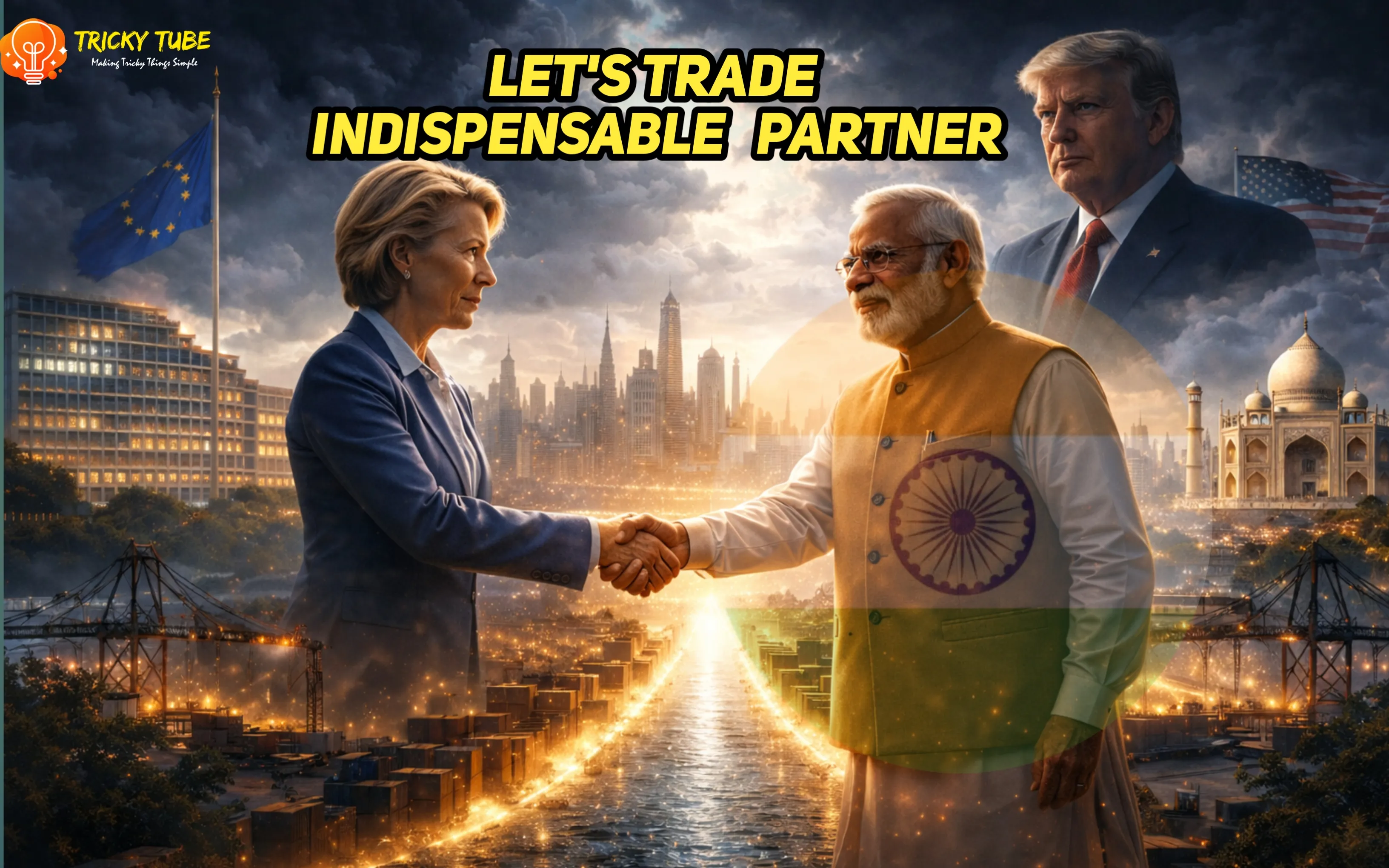
As US–EU relations deteriorate under Donald Trump’s aggressive foreign policy, Europe freezes trade talks with US and turns toward India as an indispensable partner. This geopolitical shift could reshape global power, trade, and diplomacy.
TrickyTube’s Quick Summary
Europe freezes trade talks with the US after Trump’s aggressive diplomacy, signaling a breakdown in trust. At the same time, the EU embraces India as a crucial long-term partner, potentially reshaping global trade and geopolitics in a multi-polar world.
What happens when your closest ally starts treating you like a rival? For Europe, that question is no longer theoretical. Under Donald Trump, the once-stable relationship between the European Union and the United States has entered its most uncomfortable phase in decades-while India quietly emerges as Europe’s most valuable new partner. This is not just about trade deals or tariffs. It’s about pride, power, and the future of the global order.
Europe Freezes the US Trade Dream
The EU’s decision to suspend its trade engagement with US sent a loud and clear signal: Europe is done being pushed around. Trump’s rhetoric-especially his controversial tone around Greenland-was seen in Brussels as crossing a red line. Yes, money matters. Economies run on trade, investment, and access to markets. But for Europe, this issue goes beyond economics. Trump’s approach was not seen as though negotiation-it was perceived as pressure, even intimidation something European leaders were unwilling to accept.
Is the European Union Headed for Internal Cracks?
An uncomfortable truth sits beneath this transatlantic standoff. The EU itself is not monolithic. Some member states still lean instinctively toward US, while others want Europe to assert strategic autonomy. This internal tug-of-war raises a serious question: Can the EU remain unified if global pressure keeps increasing? If pro-US and sovereignty-first camps continue drifting apart, fragmentation is not impossible. While a complete breakup may sound dramatic today, history reminds us that political unions often fracture slowly-and then suddenly.
India: From Emerging Partner to Indispensable Power
While bridges burn with US, Europe is busy building new ones with India . In a defining moment, Ursula von der Leyen declared India an “indispensable partner” for Europe. That’s not diplomatic fluff-it’s strategic language. The proposed EU–India mega trade deal would:
- Connect 2 billion people (1.4 billion from India and 600 million from Europe)
- Represent nearly 25% of global GDP
- Give Europe a first-mover advantage in one of the fastest-growing economies on Earth For Europe, this isn’t diversification-it’s future-proofing.
Why Europe Is Betting Big on India
India offers something few countries can match simultaneously:
- A massive consumer market
- Rapid economic growth
- Democratic institutions
- Strategic independence Unlike China, India doesn’t trigger the same security anxieties in European capitals. Unlike the US, it doesn’t come with unpredictable policy swings driven by domestic politics.
[!NOTE] My take: Europe isn’t just choosing India because of Trump. It’s choosing India because the 21st century’s growth story increasingly runs through India not the US.
Trump’s “Might Is Right” Worldview
Under Trump, foreign policy stopped looking like diplomacy and started resembling a power test. Rules mattered less, relationships became purely transactional, and influence was measured by how much pressure a country could apply rather than how much trust it commanded. This kind of approach can work in the short run. It can force quick concessions and create headlines. But over time, it quietly damages something far more valuable-credibility. When partners begin to feel that agreements depend on mood rather than principles, they stop relying on them altogether. That is exactly where Europe found itself. Instead of doubling down on uncertainty, it chose to diversify. Strengthening ties with India was not an emotional reaction; it was a strategic adjustment in response to an increasingly unpredictable partner.
India’s Quiet Geopolitical Win
Ironically, India gains without firing a single diplomatic shot. As US–EU relations cool, Europe looks elsewhere-and India stands ready. Stronger EU–India ties also ripple outward:
- Reduced European dependence on the US
- More balanced global power centers
- Greater diplomatic space for India with Russia and China India doesn’t need to oppose anyone openly. It simply benefits from being reliable in a world where reliability is becoming rare.
The Bigger Picture
This moment marks a subtle but profound shift. The post–Cold War assumption-that the US and Europe will always move in lockstep-is no longer guaranteed. Instead, we’re entering a multi-polar era, where partnerships are flexible, interest-driven, and constantly recalibrated. India’s rise from “important player” to “indispensable partner” is one of the clearest signs of that transition.
FAQs
Why did the EU suspend its trade deal with the US?
Because Trump’s rhetoric and pressure tactics were seen as disrespectful and against Europe’s sense of sovereignty.
Why is India so important to Europe now?
India offers scale, growth, stability, and strategic independence—making it an ideal long-term partner.
Will the EU really break apart?
Not immediately, but internal divisions are deepening and could grow under sustained external pressure.
Does India benefit from US–EU tensions?
Yes. Indirectly, India gains stronger partnerships and greater global influence.