
International
January 28, 2026
When a Superpower Draws Red Lines: The Hidden Cost of America’s 100% Tariff Threat on Canada
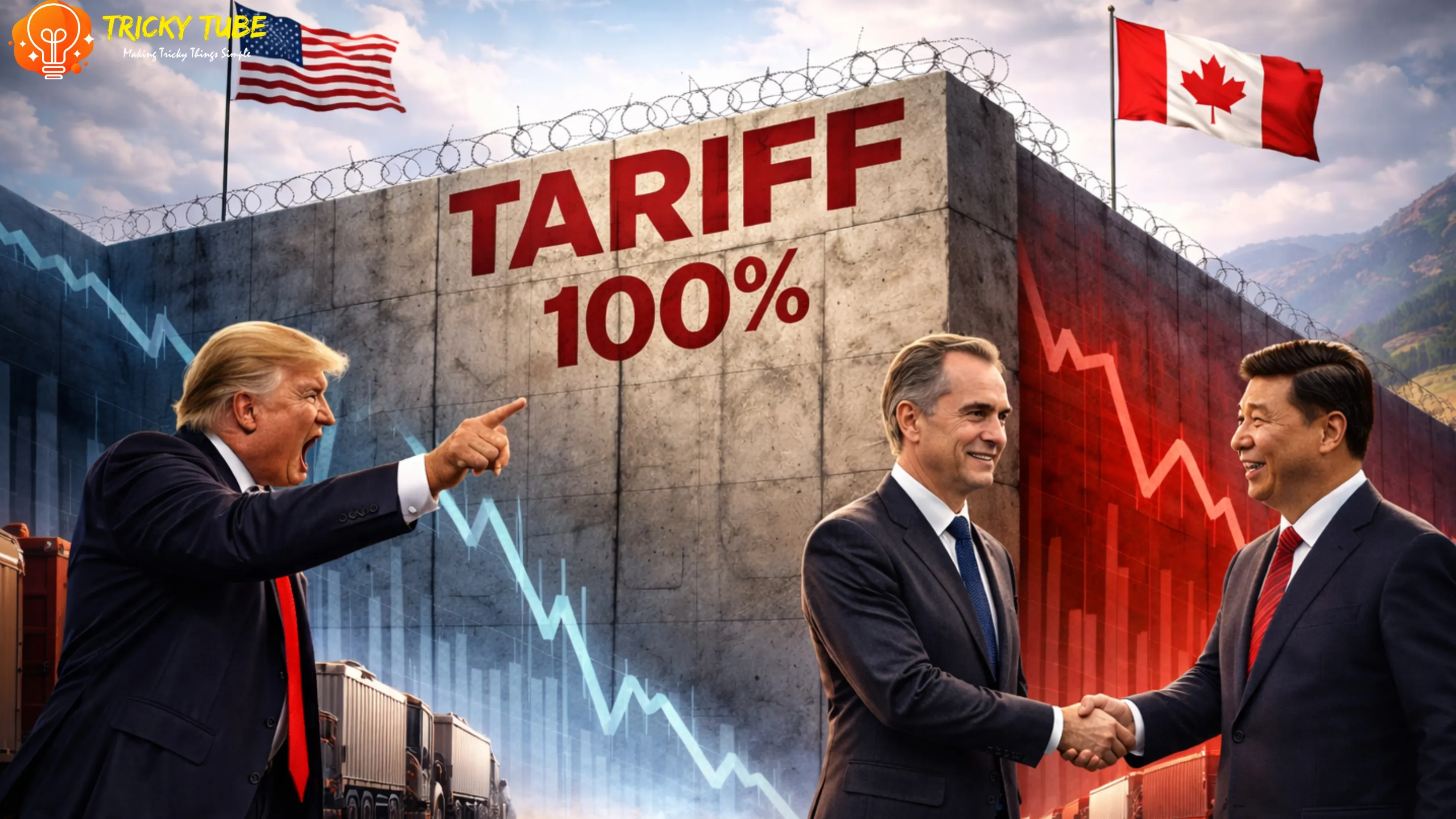
A sudden 100% tariff threat from the United States has exposed how vulnerable even developed nations can become when trade dependency turns into leverage. Canada’s dilemma offers a powerful warning for the rest of the world.
TrickyTube’s Quick Summary
A proposed 100% tariff by the United States on Canadian goods has reignited debates around economic sovereignty, trade dependency, and geopolitical pressure. The episode highlights how excessive reliance on a single trading partner can limit a nation’s freedom—and why diversification is no longer optional in global trade.
What If Your Biggest Trading Partner Decides to Punish You for Acting Independently? That question is no longer theoretical.
A dramatic threat from the United States to impose a 100% tariff on Canadian goods has sent shockwaves through global trade circles. The message behind it is far more unsettling than the tariff number itself: economic dependence can quietly turn into political control. Canada, one of the world’s wealthiest and most stable economies, suddenly finds itself cornered—not because of war, debt, or crisis, but because it dared to expand its trade horizons beyond US’s comfort zone.
From Trade Partnership to Power Play
For decades, the U.S.–Canada relationship has been marketed as one of the world’s most cooperative economic partnerships. Free trade agreements, integrated supply chains, and geographic proximity created the impression of equality. But moments like these reveal the uncomfortable truth: when power imbalance exists, trade rules are never just about economics.
The tariff threat reportedly came after Canada explored deeper trade engagement with China and other non-U.S. partners. Initially, there was little visible objection. Then, almost overnight, the tone shifted—from tolerance to outright warning.
A 100% tariff is not negotiation. It’s a pressure tactic.
The Geography Trap: Why Canada Has Fewer Options Than It Appears
On paper, Canada looks unstoppable—vast landmass, rich natural resources, advanced technology, and a skilled workforce. Yet structurally, its economy is deeply exposed. Nearly two-thirds of Canadian exports go to the United States, and most of Canada’s population lives extremely close to the U.S. border. This concentration wasn’t built for resilience; it was built for convenience. That convenience is now proving costly. When such a large share of your exports depends on one market, any political shift in that market becomes an economic shock at home. Diversification sounds ideal—but rebuilding trade routes is far harder than signing a new agreement.
“Buy Canadian”: Patriotism or Economic Self-Defense?
In response to growing uncertainty, Canadian leaders have urged citizens and businesses to prioritize domestic products—from steel to technology. This isn’t nationalism for optics. It’s damage control. Encouraging internal demand is one of the few tools available when external pressure rises. But here’s the uncomfortable part: internal consumption alone cannot replace a market as massive as the United States. The “Buy Canadian” push may soften the blow, but it cannot fully shield export-driven industries if punitive tariffs actually materialize.
The Bigger Lesson: Sovereignty Isn’t Just Political
Economic sovereignty is as important as political sovereignty. A country may have its own flag, parliament, and constitution—but if its economy is overly reliant on a single foreign market, its decision-making space quietly shrinks. Trade dependency doesn’t announce itself as a threat. It feels efficient, profitable, even logical—until it’s used as leverage. That’s exactly what Canada is confronting now.
Why This Matters Beyond Canada
This is not just a North American issue. It’s a global warning. In an era where tariffs, sanctions, and trade restrictions are routinely used as geopolitical tools, no country—developed or developing—is immune. The assumption that “friendly nations won’t weaponize trade” is increasingly outdated. Policy can change with elections, leaders, or shifting global alliances. Economic safety today requires preparation for political unpredictability tomorrow.
Implications for India and Emerging Economies
For countries like India, the Canadian situation offers a rare, real-time case study. India’s trade basket is broader, and its domestic market is far stronger. Yet even then, over-concentration with specific regions or blocs carries long-term risks. The strategic takeaway is clear:
- Diversify export destinations
- Strengthen ties with multiple economic blocs
- Avoid building critical industries around a single external market Economic growth without diversification may look impressive—but it leaves a nation exposed when global power equations change.
Opinion: Trade Wars Don’t Start With Tariffs—They Start With Dependency Here’s the hard truth: The tariff threat itself is not the core problem. The vulnerability existed long before the threat was made. Trade wars rarely erupt suddenly. They exploit weaknesses that were ignored during years of stability. Canada’s experience shows that the real cost of dependency isn’t paid during good times—but during moments of disagreement.
FAQs
Has the 100% tariff been officially implemented?
No. As of now, it remains a threat, but even threats can disrupt markets, investments, and long-term planning.
Why is a 100% tariff such a big deal?
A tariff of that size effectively prices goods out of the market, making exports commercially unviable.
Can Canada quickly shift its exports elsewhere?
Not easily. Trade infrastructure, agreements, and supply chains take years to realign.
Is this unique to Canada?
No. Similar pressure tactics have been used globally, especially when economic power imbalances exist.
What’s the biggest lesson here?
Economic independence isn’t about isolation—it’s about options.