
Education
January 27, 2026
UGC’s 2026 Anti-Discrimination Rules: A Turning Point or Another Paper Reform for Indian Campuses?
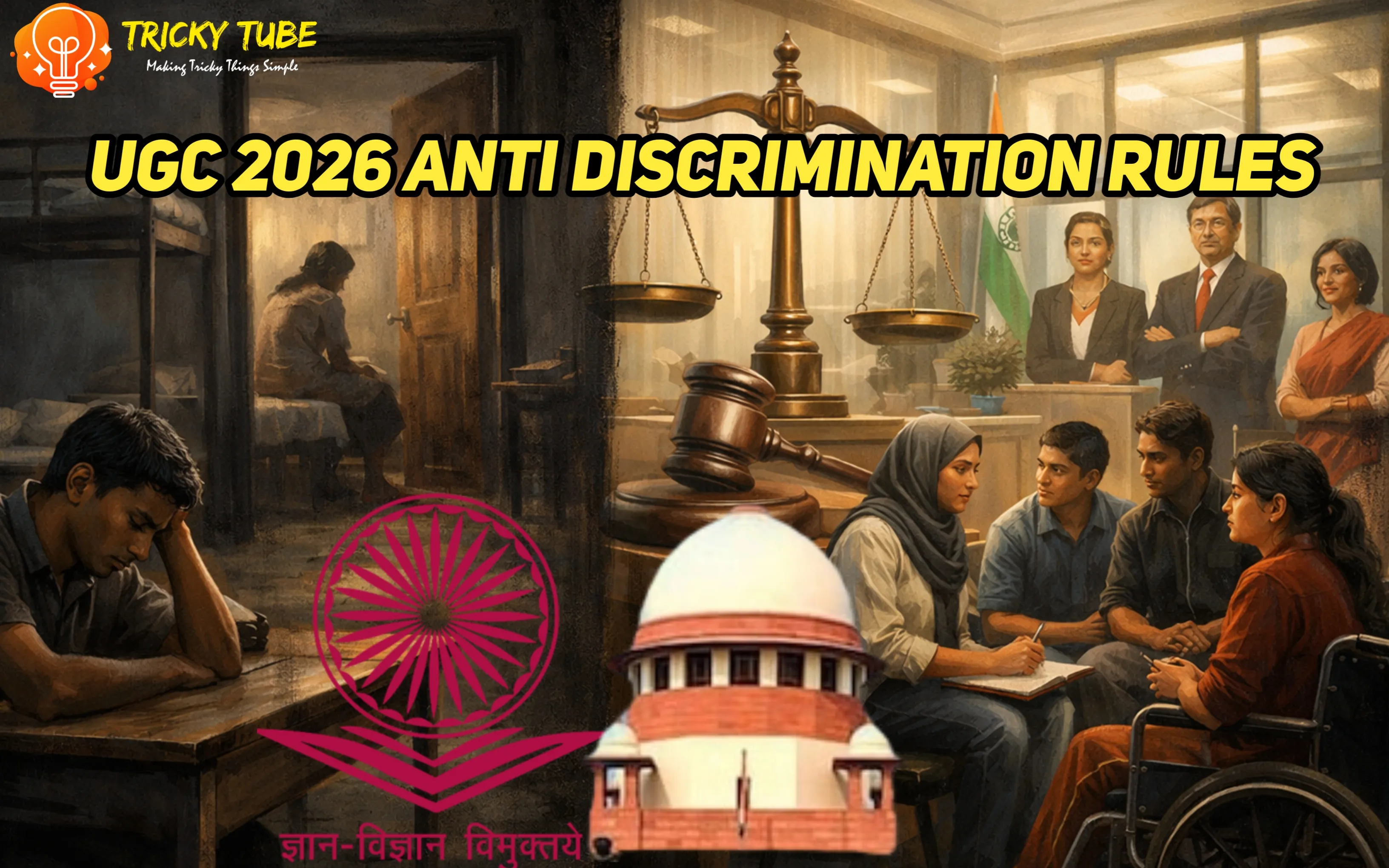
For decades, caste-based discrimination in Indian universities survived behind closed doors—whispered, denied, and rarely punished. With the UGC’s 2026 anti-discrimination regulations, that silence is being legally challenged. But will these rules finally change campus realities, or will they collapse under weak implementation?
TrickyTube’s Quick Summary
UGC’s 2026 anti-discrimination regulations replace the weak 2012 advisory with legally binding rules. They mandate Equal Opportunity Centres, diverse grievance committees, a 24/7 helpline, and clear appeal mechanisms. Institutional heads are personally accountable, with penalties ranging from funding cuts to de-recognition. While praised for accountability, concerns remain about implementation and misuse.
What if discrimination in Indian universities was no longer treated as an “internal matter,” but as a punishable institutional failure?
That is the uncomfortable question raised by the University Grants Commission’s (UGC) new 2026 Anti-Discrimination Regulations, a legally binding framework that replaces the long-criticized 2012 advisory system. For the first time, caste-based discrimination in higher education is not just acknowledged—it comes with enforceable consequences.
Why the Old System Failed
India’s Constitution guarantees equality, dignity, and equal access to education. Yet, for years, students from Scheduled Castes (SC), Scheduled Tribes (ST), Other Backward Classes (OBC), and other marginalized groups reported experiences that directly violated these principles—social isolation in hostels, biased grading, exclusion from research opportunities, and subtle yet persistent academic discrimination.
According to several report between the last five years alone, more than 15,000 complaints were reported from 74 universities and over 11,500 colleges across India. Despite these alarming numbers, the UGC’s 2012 advisory framework failed to act as a deterrent. Why?
Because it lacked teeth.
There were no clear penalties, no strict timelines, and no legal obligation for institutions to act decisively. Discrimination remained vaguely defined, grievance committees functioned irregularly, and complaints often disappeared into administrative silence. This systemic failure eventually invited judicial scrutiny.
Supreme Court Pressure Changed the Game
The Supreme Court of India openly criticized the UGC’s weak grievance redressal mechanisms, questioning how constitutional rights could be protected without accountability. The Court demanded a stronger, enforceable regulatory framework—one that moved beyond symbolic guidelines. The result is the UGC Regulations, 2026—not an advisory, but a binding legal mandate applicable to all higher education institutions, public or private, across India.
What the 2026 Regulations Actually Do
The new rules rest on three pillars: Prevention, Protection, and Accountability.
At the institutional level, every college and university must now establish an Equal Opportunity Centre (EOC). Unlike earlier token cells, these centres are designed as active support systems—providing academic, social, and psychological assistance to students who experience discrimination. Under each EOC, a Core Grievance Handling Committee is mandatory. Importantly, its composition must reflect diversity: representation from SC, ST, OBC communities, women, and persons with disabilities. This structural inclusion is meant to reduce bias within the complaint-handling process itself. Another notable feature is the 24/7 Equity Helpline, enabling students to seek confidential support without fear of immediate retaliation—something student activists have long demanded. If a complainant is dissatisfied with how their case is resolved, the regulations introduce a 30-day appeal window to approach an independent Ombudsman. This escalation path directly addresses one of the biggest flaws of the older framework—complaints dying at the institutional level.
Personal Accountability: The Real Shift
Perhaps the most disruptive change is where responsibility now lies.
Under the 2026 regulations, Heads of Institutions—Vice-Chancellors and Principals—are personally accountable for compliance. They must submit periodic reports to the University Grants Commission, ensuring that anti-discrimination mechanisms are not merely created, but actively functioning. Non-compliance carries serious consequences:
- Withdrawal of UGC funding
- Ban on launching new academic courses
- Suspension of online and distance education programmes
- In extreme cases, de-recognition of the institution This is a significant departure from the past, where institutional negligence rarely affected leadership directly.
The Political and Public Debate
Unsurprisingly, the regulations have sparked intense debate.
Supporters argue that caste discrimination in higher education is not incidental—it is structural. Without enforceable rules, marginalized students remain vulnerable within hierarchies that quietly reproduce inequality. From this perspective, the 2026 regulations represent long-overdue institutional accountability. Critics, however, raise concerns about over-bureaucratization and the potential misuse of complaint mechanisms. Some fear that vague interpretations of discrimination could lead to administrative paralysis or false accusations, placing undue pressure on faculty and management. The government, responding to protests and resignations, has defended the rules, stating that safeguards exist to prevent misuse and that genuine complaints must not be dismissed due to hypothetical risks.
My Take: Law Is Only Half the Battle
Here’s the uncomfortable truth—regulations alone do not dismantle prejudice.
The 2026 rules are strong on paper, arguably the strongest India has seen in the education sector. But their success depends entirely on institutional intent. An Equal Opportunity Centre that exists only to satisfy compliance will fail its purpose. A grievance committee that prioritizes reputation management over justice will reproduce the same old silence.
That said, personal accountability changes incentives. When leadership knows that inaction has consequences, denial becomes costly. In that sense, the regulations shift the balance of power—away from institutional convenience and toward student rights.
The real test will not be in policy documents, but in how universities respond when the first uncomfortable cases emerge.
FAQs
Are the UGC 2026 regulations mandatory for private universities?
Yes. The regulations apply to all higher education institutions under UGC’s jurisdiction, public and private.
What happens if a university ignores a discrimination complaint?
Non-compliance can lead to funding withdrawal, bans on new courses, suspension of online programmes, or even de-recognition.
Can students appeal if they are unhappy with the internal resolution?
Yes. Students have a 30-day window to approach an Ombudsman.
Are these rules limited to caste-based discrimination?
While caste discrimination is central, the framework also covers gender, disability, and other forms of structural exclusion.