
International
January 25, 2026
Trump, Greenland & the Arctic U-Turn: From Tariff Threats to a Mysterious “Deal Framework”
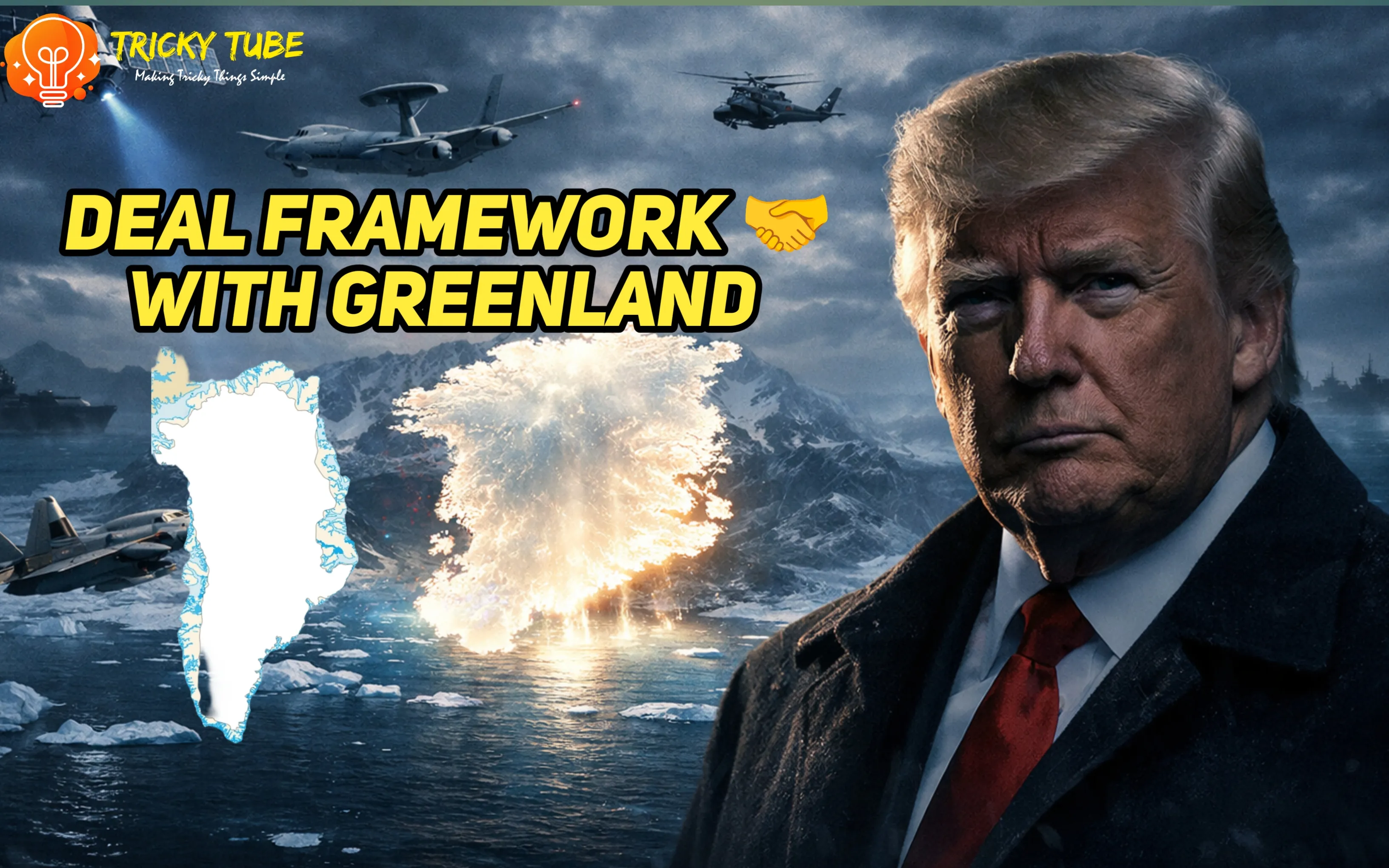
Donald Trump’s sudden U-turn on Greenland shocks Europe and NATO. From tariff threats to a vague Arctic “Deal framework,” this article breaks down what really happened, why Greenland matters, and what it means for the US, Europe, India, and the future of Arctic geopolitics
TrickyTube’s Quick Summary
- Trump threatened tariffs on European allies over Greenland
- Europe pushed back through NATO coordination
- Tariffs triggered trade tensions
- At Davos, Trump suddenly announced a vague “deal framework”
- No public agreement, but likely expanded US and NATO Arctic cooperation
- Greenland’s sovereignty remains unchanged
- The Arctic is shifting from cooperation to competition
What happens when a superpower threatens its own allies-and then suddenly backs off within minutes? The world gets a reminder that geopolitics today is no longer about clear treaties and signed papers, but about pressure, posture, and power projection. Donald Trump’s sudden reversal on Greenland-linked tariffs is a textbook example of how global diplomacy is increasingly driven by shock tactics rather than stability. What began as an aggressive move against European allies quickly turned into an announcement of a vague “deal framework” on Greenland and Arctic cooperation. No documents. No signatures. Just a statement-and a lot of unanswered questions.
Trump’s Hardline Opening: Greenland as a Strategic Prize
Donald Trump has never hidden his fascination with Greenland. Long before returning to the presidency, he openly floated the idea of buying Greenland, framing it as a strategic necessity rather than a diplomatic fantasy. Once back in office, that idea hardened into policy. Trump’s argument was blunt: the United States provides security in the Arctic, and Greenland-rich in untapped resources and strategically located-sits at the center of future global competition. From US perspective, the Arctic is no longer a frozen backwater. It’s a high-stakes chessboard where Russia and China are aggressively expanding influence. Trump positioned the US as Greenland’s primary shield against this pressure, implying that American protection came with expectations. That framing alone was enough to unsettle Europe.
Europe Pushes Back-and Trump Escalates
European NATO members didn’t stay quiet. In response to Trump’s assertive posture, they increased joint activity in Greenland under a coordinated NATO initiative often described as a show of Arctic endurance and unity. Trump’s response was swift-and explosive. He threatened 10% tariffs on eight European NATO countries, with a clear warning: if they didn’t fall in line, tariffs would jump to 25% within months. The message was unmistakable-strategic cooperation would now come with economic consequences. to read in detail click here This crossed a red line in Europe. European leaders saw the move not just as economic coercion, but as political arm-twisting within an alliance built on mutual trust. The European Parliament reacted by suspending progress on a key US-EU trade agreement, signaling that Trump’s tactics could backfire fast. At this point, the standoff looked real, public, and dangerous.
Davos Shock: The Sudden U-Turn
Then came Davos. At the World Economic Forum, Trump delivered a characteristically bold speech. He emphasized American economic dominance, framed Greenland as essential to NATO’s future, and doubled down on the idea that Arctic security equals global security. And then-almost immediately-everything changed. Minutes after projecting strength, Trump announced that the US and NATO had reached a “framework for a future deal” on Greenland and Arctic cooperation. No tariff talk. No threats. Just a pivot. For observers, the speed of the reversal was almost as shocking as the original escalation.
The “Deal Framework”: What’s Really Inside?
Here’s the key issue: there is no public deal. No document has been released. No legal text shared. No binding commitments announced. What exists is a political understanding-intentionally vague, strategically flexible. Based on available signals, the framework likely includes:
- Expanded NATO surveillance and coordination across the Arctic region
- Greater US operational freedom at the Thule Air Base in Greenland, a critical missile-defense and early-warning hub
- Unified resistance to Russian militarization in the Arctic
- Stricter scrutiny of Chinese investments in Arctic infrastructure and resources In short, the US gets more room to operate, NATO stays aligned, and Europe avoids a trade war. But ambiguity is the point.
What the Deal Does Not Do
Equally important is what Trump’s framework avoids:
- Greenland remains sovereign under Denmark
- No purchase, transfer, or ownership change
- No legally binding treaty that could trigger parliamentary scrutiny This allows all sides to claim victory without committing to specifics. From Trump’s perspective, it preserves leverage. From Europe’s side, it avoids escalation. For Greenland, it delays tough questions about autonomy and militarization.
Why Greenland and the Arctic Suddenly Matter So Much
The Arctic is transforming-fast. Melting ice is opening new global shipping routes, reducing travel time between Asia, Europe, and North America. Beneath the ice lie rare earth minerals, energy reserves, and strategic raw materials critical for future technologies. At the same time, military activity is rising. Russia has expanded Arctic bases. China calls itself a “near-Arctic state.” What was once a cooperative zone is now a competitive frontier. This is why Greenland matters-not for its population, but for its position.
In my opinion, Trump understands this shift better than many traditional diplomats. Where he goes wrong is execution. Shock tactics may force short-term compliance, but they also accelerate mistrust within alliances that the US ultimately depends on.
Why India Should Care
For Indian readers, this isn’t distant drama. The Arctic’s evolution directly impacts global trade routes, energy markets, and great-power competition-all of which affect India’s economic and strategic calculations. As the world moves toward multipolar competition, India must watch how alliances strain and adapt under pressure. The Greenland episode is a preview of future geopolitics: loud threats, fast reversals, and deals that exist more in headlines than in law.
FAQ
Did Trump actually plan to buy Greenland?
He publicly expressed interest, but the current framework does not include any transfer of sovereignty.
Is there a signed US-NATO deal on Greenland?
No. There is no public or legally binding agreement—only a political framework.
Why is Greenland so important strategically?
Its location, resources, and military relevance make it central to Arctic security.
How does this affect global trade?
Arctic shipping routes could reshape global logistics, impacting major economies including India.