
National
March 18, 2026
Tourist Visa Ya Terror Plot? NIA Busts Shocking Ukraine-Myanmar Nexus in India
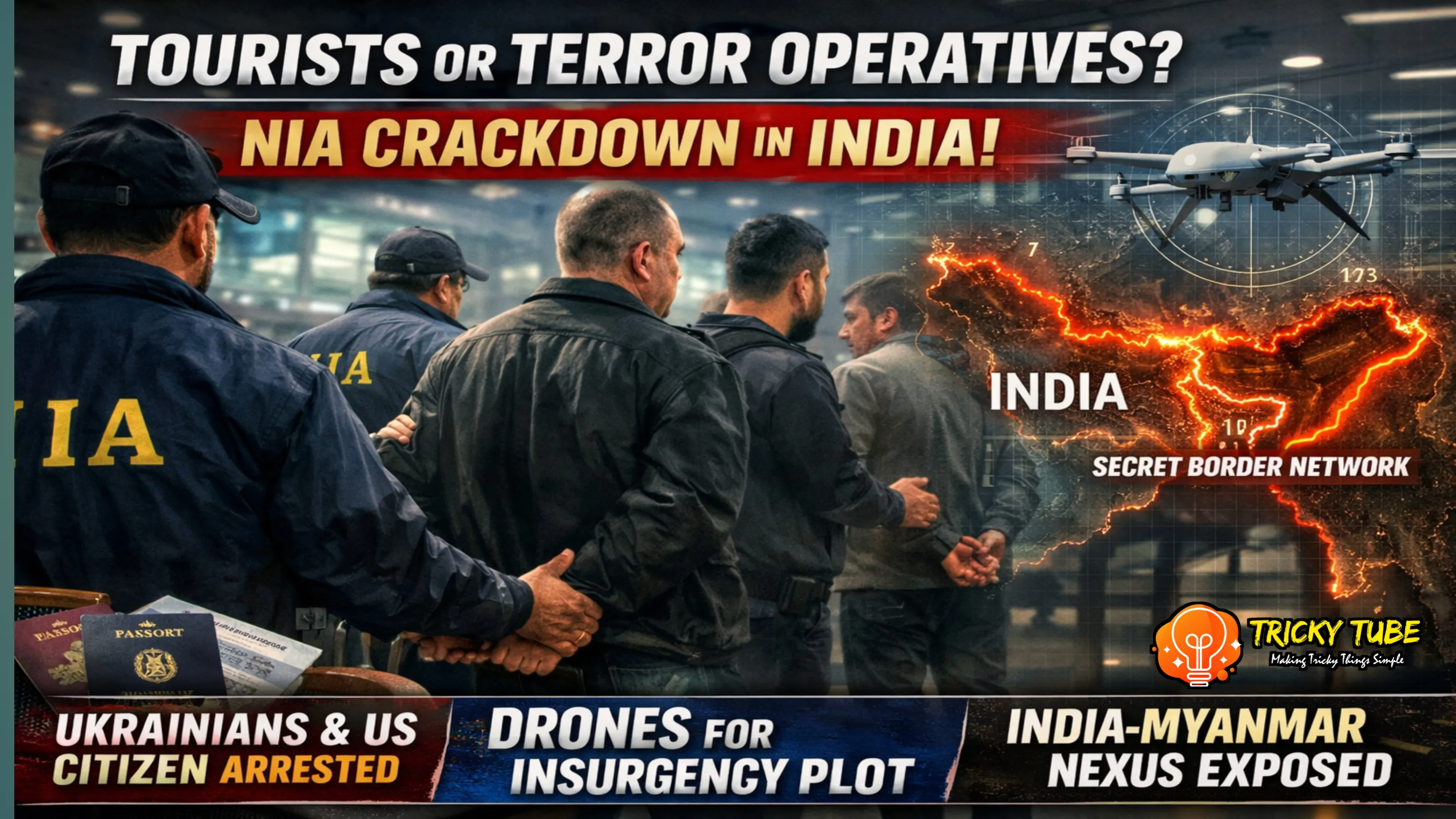
What looked like a routine tourist entry has now exposed a deep international terror network. India’s NIA arrests foreign nationals linked to drone warfare, Myanmar insurgency, and Northeast security risks—raising serious questions about visa policies and national security.
TrickyTube’s Quick Summary
- 6 Ukrainians + 1 US citizen arrested by NIA
- Entered India on tourist visas
- Used India as base for Myanmar insurgency support
- Advanced drones being smuggled for warfare use
- Nexus between foreign operatives, Myanmar militias & NE insurgents
- Ukraine protests, US stays neutral
- Raises serious concerns about India’s security gaps
What if the next major security threat to India walks in… on a tourist visa?
Sounds unreal, right? But that’s exactly what this latest investigation by India’s **National Investigation Agency (NIA) **seems to suggest-and honestly, it’s more alarming than it looks on the surface.
In a major crackdown, the NIA has arrested six Ukrainian nationals and one US citizen who were allegedly planning terror-related activities. At first glance, they appeared to be regular foreign tourists. But behind that facade, investigators claim, was a carefully structured international network with connections stretching from Europe to Myanmar-and even touching sensitive regions of India’s Northeast.
A Hidden International Web
According to the investigation, these individuals didn’t just randomly land in India. They reportedly entered using tourist visas, which immediately raises a big red flag. Why would foreign nationals involved in such serious operations choose India as their base?
The answer lies in geography and opportunity.
India, especially its Northeastern states like Mizoram, shares porous borders with Myanmar. This region has long been sensitive due to insurgency issues and cross-border movement. The accused allegedly exploited these vulnerabilities to create a transnational corridor-using India as a safe transit and coordination hub.
And here’s where things get even more intense.
Drone Warfare: A New Age Threat
One of the most shocking aspects of this case is the use of advanced drone technology. The group was reportedly sourcing drones from Europe and attempting to smuggle them into Myanmar.
Now this isn’t just about surveillance drones for hobby use. These were allegedly intended for combat and reconnaissance, potentially aiding armed militias operating in conflict zones.
This signals a worrying shift. Terror and insurgency operations are no longer limited to traditional weapons. With drones, even small groups can carry out high-impact operations with precision.
My take: This is exactly where India (and even global agencies) need to step up-because drone warfare is becoming the new frontier of asymmetric conflict.
The “Triangle Nexus” That Changes Everything
Investigators have also pointed towards a triangular nexus involving:
- Foreign operatives (like the arrested individuals)
- Armed militias in Myanmar
- Insurgent groups in India’s Northeast
This isn’t just a random connection-it suggests coordination.
Such a structure means resources, intelligence, and logistics could be flowing across borders seamlessly. And if that’s true, it’s not just a law-and-order issue anymore-it becomes a strategic security concern.
Because once such networks establish themselves, dismantling them becomes exponentially harder.
India’s Weak Spot: Open Systems
Let’s be honest-India’s openness has always been one of its strengths. But in this case, it may have turned into a vulnerability.
The accused allegedly misused:
- Tourist visa access
- Loosely monitored border regions
- Internal movement freedom
Particularly in states like Mizoram, where border management is complex due to terrain and local dynamics, such misuse becomes easier.
Personal opinion: India might now have to rethink its visa screening processes—not to restrict tourism, but to enhance intelligence-based filtering.
Diplomatic Fallout Begins
As expected, the arrests have triggered international reactions.
Ukraine has reportedly strongly protested, demanding the immediate release of its citizens. They’ve also accused India of violating diplomatic norms by not providing prior notification.
On the other hand, the United States has taken a more neutral stance. While acknowledging the arrest of its citizen, it has refrained from making strong statements, citing privacy concerns.
This contrast is interesting.
It shows how geopolitics plays out even in security matters. While one country pushes aggressively, another chooses caution—possibly waiting for more verified details.
Bigger Implications
This case is not just about seven individuals.
It raises larger questions:
- How secure are India’s entry systems?
- Are global terror networks shifting towards indirect operational bases?
- And most importantly—are we prepared for next-gen warfare tactics like drones?
Because if such networks are indeed operating silently, this could just be the tip of the iceberg.
FAQs
Q1. Why were these foreign nationals arrested in India?
They were allegedly involved in planning terror-related activities and supporting insurgent operations in Myanmar.
Q2. What role did drones play in this case?
The group was reportedly procuring advanced drones from Europe for surveillance and combat purposes.
Q3. Why is India’s Northeast important in this case?
Due to its porous borders with Myanmar, the region was used as a transit route for operations.
Q4. How did Ukraine react to the arrests?
Ukraine protested strongly and demanded the release of its citizens, citing diplomatic concerns.
Q5. Is India’s visa system under question now?
Yes, the case highlights potential loopholes in tourist visa monitoring and border security.