
MYSTERY
March 12, 2026
Titanic Disaster Explained: How the “Unsinkable” Ship Sank on Its First Voyage
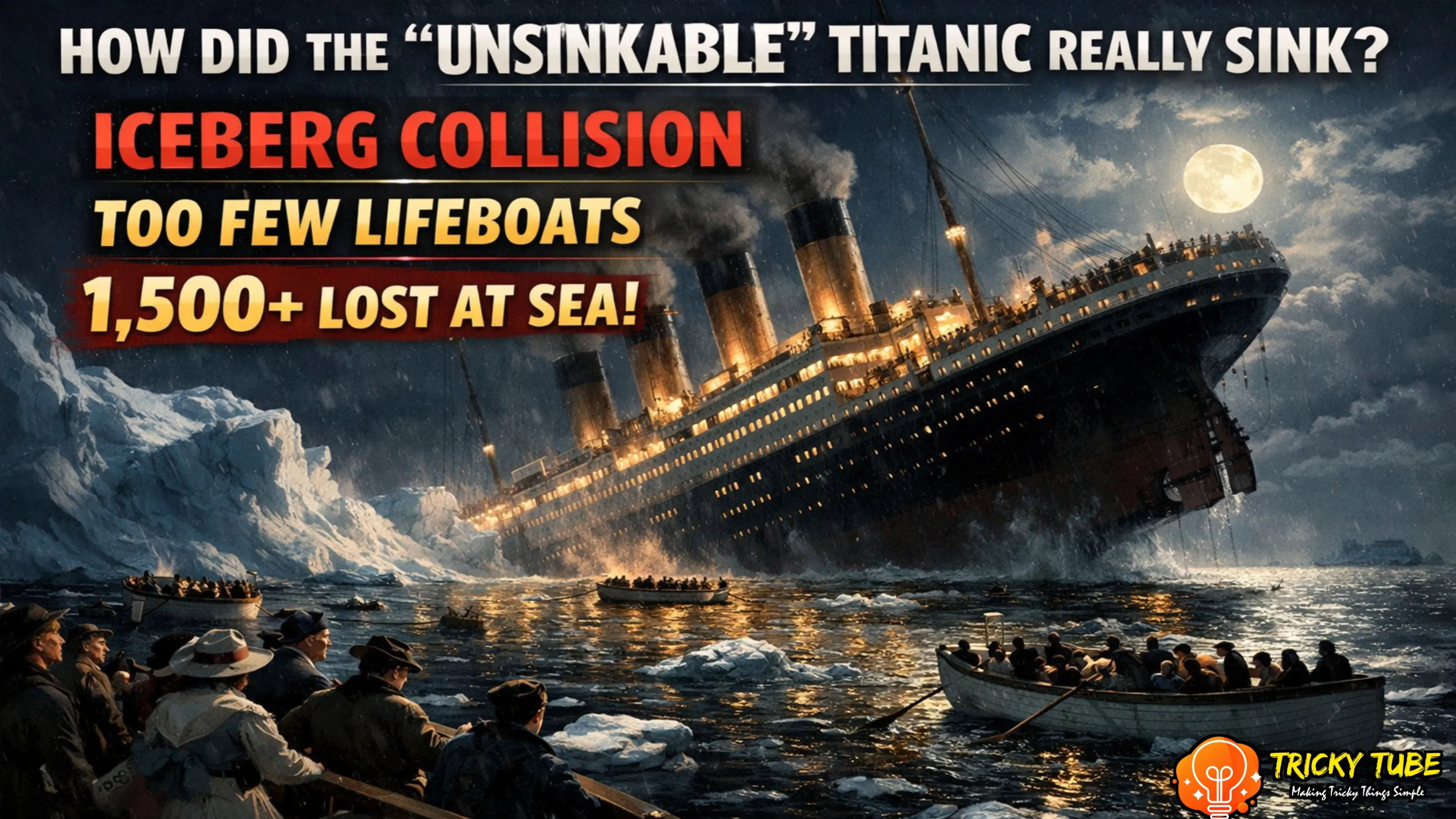
The RMS Titanic was once called unsinkable, yet it sank on its very first voyage in April 1912. Here’s the real story of warnings ignored, fatal decisions, and the disaster that changed maritime safety forever.
Titanic Disaster: How the World’s “Unsinkable” Ship Met Its Fate
TrickyTube’s Quick Summary
- RMS Titanic sank on April 15, 1912, during its maiden voyage.
- The ship hit an iceberg at 11:40 PM on April 14.
- Six watertight compartments were breached, exceeding the safety limit.
- Titanic had lifeboats for only half the passengers.
- The ship broke apart and sank at 2:20 AM.
- 705 people survived, while over 1,500 died.
- The disaster led to major maritime safety reforms.
What happens when human confidence outruns reality?
In April 1912, the RMS Titanic—then the largest and most luxurious ship ever built—set sail on what was supposed to be a historic journey. Instead, it became one of the deadliest maritime disasters in history. The tragedy of the Titanic wasn’t just caused by an iceberg; it was the result of a dangerous mix of overconfidence, ignored warnings, and critical human mistakes.
The Titanic’s story still fascinates the world more than a century later, not only because of the scale of the disaster but also because of the lessons it left behind.
The Ship That Was Supposed to Be Unsinkable
When the Titanic launched, it was presented as a marvel of modern engineering. Built by the White Star Line, the massive ocean liner was designed with advanced safety features, including 16 watertight compartments meant to keep the ship afloat even if some sections were flooded.
Because of this design, many people believed the ship was virtually unsinkable. Newspapers promoted it as the safest vessel ever created. Passengers—ranging from wealthy elites to hopeful immigrants—boarded the ship with complete confidence.
But that confidence would soon prove dangerously misplaced.
Ignored Iceberg Warnings
As Titanic crossed the North Atlantic toward New York, multiple ships in the region began sending wireless warnings about heavy ice fields and drifting icebergs.
Under normal circumstances, such warnings would prompt ships to slow down or alter course. However, Titanic continued moving at near full speed through the icy waters.
Why?
Several reasons played a role. The weather was calm, the sea unusually still, and visibility seemed clear. More importantly, there was a strong belief among the crew and management that the Titanic’s design made it capable of surviving almost any scenario.
Looking back, this decision to maintain high speed through an iceberg zone was one of the most critical mistakes of the entire voyage.
The Moment of Impact
Late on the night of April 14, 1912, disaster finally struck.
At 11:40 PM, lookout officers spotted a massive iceberg directly in Titanic’s path. The crew immediately attempted an evasive maneuver, but the ship was simply too large and moving too fast to turn in time.
Instead of a dramatic head-on crash, the iceberg scraped along the starboard side of the ship, ripping open sections of the hull below the waterline.
The damage proved catastrophic.
The Titanic’s safety design allowed it to stay afloat if up to four watertight compartments were breached. But the iceberg damaged six compartments, sealing the ship’s fate within minutes.
Water began pouring into the lower decks, slowly but relentlessly.
A Fatal Shortage of Lifeboats
As the reality of the situation became clear, the crew began preparing lifeboats. But another major flaw in the ship’s planning quickly emerged.
The Titanic carried only 20 lifeboats, enough for roughly half the people on board.
At the time, maritime regulations were outdated and based on ship size categories rather than passenger capacity. Titanic technically met the legal requirement, but it was nowhere near enough for the more than 2,200 passengers and crew aboard.
Even worse, early lifeboats were launched half-empty because many passengers initially refused to board them. The ship still appeared stable, and few believed it would actually sink.
By the time panic set in, it was already too late.
The Final Hours of Titanic
Over the next two hours, the situation deteriorated rapidly.
Water filled the ship’s compartments, gradually forcing the bow lower into the ocean. As the front sank deeper, the immense stress on the hull caused the ship to break apart into two sections.
At approximately 2:20 AM on April 15, the Titanic disappeared beneath the freezing waters of the North Atlantic.
The temperature of the water was close to −2°C (28°F). Anyone who fell into it had only minutes before hypothermia set in.
The screams of hundreds of people in the water echoed across the dark ocean before fading into silence.
Rescue Arrives Too Late
The distress signals sent by Titanic were eventually received by nearby ships.
The RMS Carpathia raced through the icy waters and arrived at the disaster site hours later. By the time it reached the area, the Titanic was already gone.
Carpathia managed to rescue 705 survivors from the lifeboats.
But more than 1,500 people lost their lives, making it one of the deadliest maritime disasters of the early 20th century.
How the Titanic Disaster Changed Maritime Safety
The sinking of the Titanic shocked the world and triggered major changes in international maritime law.
New regulations required ships to carry enough lifeboats for everyone on board, a rule that seems obvious today but wasn’t mandatory before 1912.
Additionally, governments created the International Ice Patrol, an organization that monitors iceberg movements in the North Atlantic to prevent similar disasters.
Ships were also required to maintain 24-hour radio communication, ensuring distress signals would never be missed again.
In many ways, the Titanic disaster reshaped modern maritime safety.
The Wreck and Its Slow Disappearance
For decades, the exact location of the Titanic remained a mystery.
That changed in 1985, when oceanographer Robert Ballard finally discovered the wreck nearly 3,800 meters below the Atlantic Ocean.
The ship’s remains were remarkably preserved, but scientists later discovered something surprising: specialized bacteria were slowly consuming the metal structure.
Today, experts believe the wreck may eventually disintegrate completely, meaning future generations might never see it again.
A Tragedy That Still Echoes Today
More than a century later, the Titanic continues to capture the world’s imagination. Movies, books, and documentaries keep the story alive.
But beyond the fascination lies a deeper lesson.
The Titanic tragedy reminds us that technology alone cannot eliminate risk. Overconfidence, ignored warnings, and delayed action can turn even the greatest achievements into disasters.
And perhaps that is why the story of Titanic still feels so powerful today.
FAQs
Why was Titanic called unsinkable?
The ship had advanced safety features and watertight compartments that led many to believe it could survive severe damage.
How many people died in the Titanic disaster?
More than 1,500 passengers and crew members lost their lives.
How long did Titanic take to sink?
The ship sank approximately 2 hours and 40 minutes after hitting the iceberg.
When was the Titanic wreck discovered?
The wreck was discovered in 1985 by Robert Ballard.
Is the Titanic wreck still intact?
Parts of it remain, but bacteria are slowly breaking down the metal structure.