
Geography
March 12, 2026
The Longest Drivable Route on Earth: A 14,000 km Journey From Portugal to Russia
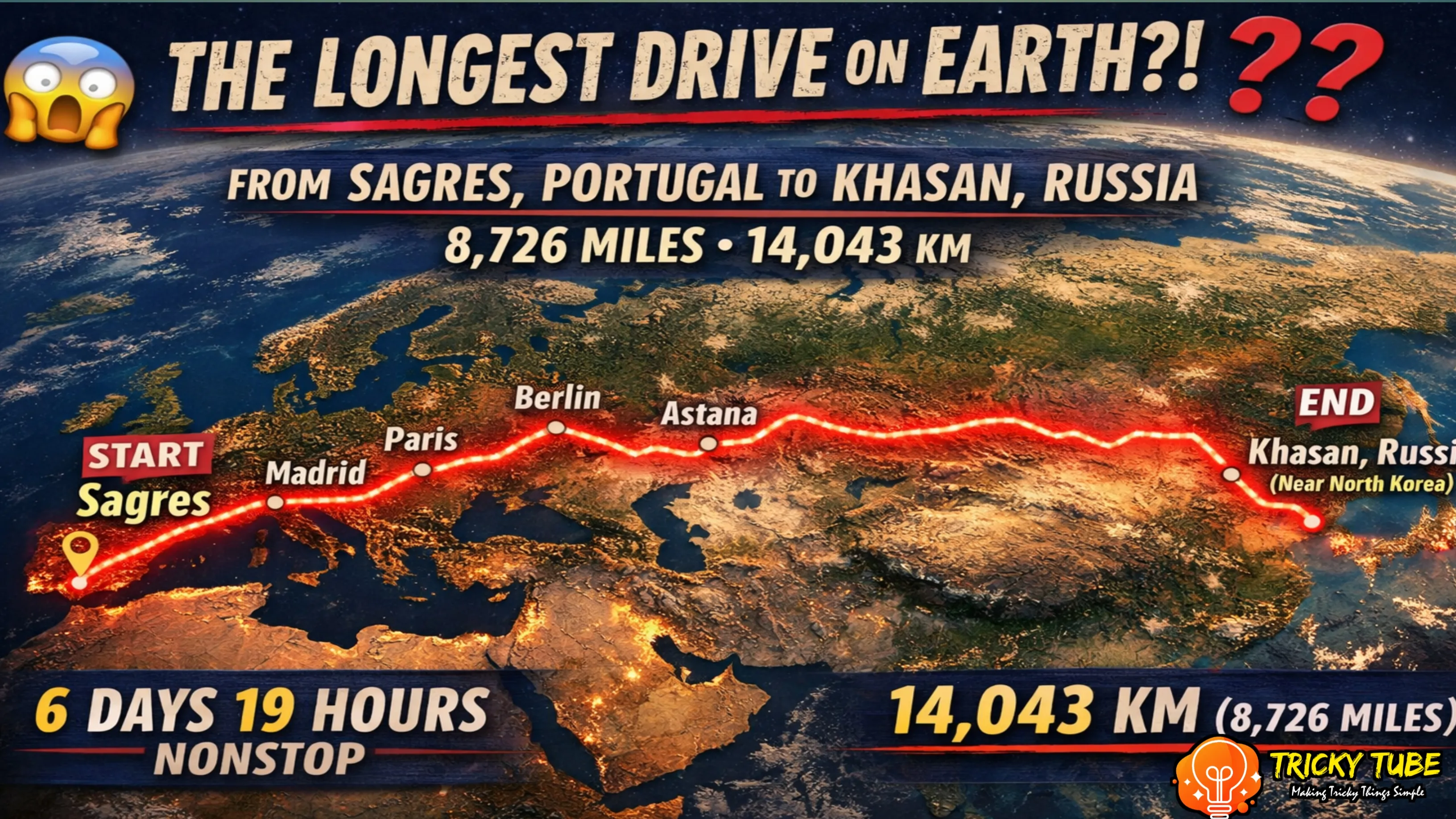
What if you started driving in western Europe and simply never stopped until you reached the edge of North Korea? Surprisingly, the longest continuous drivable route on Earth stretches over 14,000 km across two continents, revealing how geography, infrastructure, and geopolitics shape the world’s road networks.
The Longest Road Trip on Earth: From Portugal to the Edge of North Korea
TrickyTube’s Quick Summary
- The longest drivable route on Earth stretches 14,043 km (8,726 miles).
- It runs from Sagres, Portugal to Khasan, Russia near North Korea.
- Driving nonstop would take about 6 days and 19 hours.
- Global road systems are divided due to obstacles like the Darién Gap and oceans.
- The continuous route exists entirely within the Europe-Asia road network.
What’s the longest distance you could possibly drive on Earth without flying or sailing?
Not a road trip across one country. Not even across one continent. The answer is far bigger: a journey stretching from the Atlantic coast of Portugal all the way to Russia’s far eastern border near North Korea.
At first glance, it might seem obvious that the longest drive would involve crossing multiple continents. But when researchers actually tried to calculate the longest continuous drivable path on the planet, the answer turned out to be more surprising than expected.
The route measures roughly 8,726 miles (about 14,043 kilometers) and takes nearly six days and nineteen hours of nonstop driving. And perhaps the most fascinating part is that it reveals how fragmented the world’s road systems actually are.
A World Divided by Geography
Earth may look interconnected on maps, but road networks tell a very different story.
There are four major continental road systems on the planet. However, only one of them is truly large and continuous enough to support a mega-journey like this.
Europe, Asia, and Africa – A Partial Network
Europe, Asia, and Africa appear to form one giant landmass known as Afro-Eurasia. In theory, you could imagine driving across all three continents.
But reality complicates things.
The Suez Canal separates Africa from Asia, cutting through Egypt and breaking the land connection. Fortunately, modern infrastructure solved this problem through bridges and road crossings, meaning vehicles can still technically travel across these continents.
However, logistical issues like ferry routes, border restrictions, and limited infrastructure prevent a fully optimized long-distance driving route from stretching across the entire Afro-Eurasian landmass.
The Americas – Broken by the Darién Gap
North and South America appear connected on a map, but there is one infamous obstacle: the Darién Gap.
This remote region sits between Panama and Colombia, and it is essentially a 160-kilometer stretch of dense jungle, swamps, and mountains with no roads at all.
Because of its extreme terrain and environmental protection concerns, no highway has ever been built there.
The famous Pan-American Highway, which runs from Alaska to Argentina, actually stops at the Darién Gap, forcing travelers to ship vehicles across the region by boat or plane.
This means that a truly continuous drive across the entire American continent simply isn’t possible.
Australia – Completely Isolated
Australia has a well-developed national highway network and massive road distances. However, the continent is completely isolated from other road systems.
You can drive thousands of kilometers across Australia, but eventually, every route ends at the ocean.
Because of this isolation, Australia cannot be part of the longest continuous road journey on Earth.
The Surprising Winner: Europe to East Asia
After analyzing global road networks and removing routes that rely on ferries or disconnected highways, researchers discovered that the longest uninterrupted drive actually exists entirely within the Europe-Asia road network.
The journey begins in Sagres, Portugal, a small coastal town located at the southwestern tip of Europe.
From there, the route travels across an extraordinary list of countries, including:
- Portugal
- Spain
- France
- Germany
- Poland
- Belarus
- Russia
And it continues across the massive expanse of Siberia, eventually reaching the small Russian town of Khasan, located near the borders of China and North Korea.
The Numbers Behind the Journey
Here’s what makes this route truly mind-blowing:
- Total Distance: 8,726 miles (14,043 km)
- Estimated Driving Time: 6 days and 19 hours nonstop
- Continents Crossed: Europe and Asia
- Countries Traversed: Multiple, depending on the route variation
To put that into perspective, the distance is roughly equivalent to driving across the United States more than four times.
And because the route spans from Western Europe to the Pacific edge of Russia, travelers would pass through dozens of climates, cultures, languages, and landscapes along the way.
You’d begin near the Atlantic Ocean cliffs of Portugal, cross the bustling highways of Europe, then spend days driving through the endless forests, mountains, and frozen plains of Siberia.
It’s essentially a mini world tour on four wheels.
Why This Route Is So Fascinating
What makes this journey interesting isn’t just the distance. It highlights how human infrastructure shapes our ability to move across the planet.
Despite modern technology, global road systems are still surprisingly fragmented. Natural barriers like jungles, oceans, and canals continue to break up what might otherwise be a single connected network.
In fact, if a highway were ever built through the Darién Gap, the longest drivable route on Earth would likely shift dramatically, possibly connecting the entire American continent into a massive road system.
But for now, the record belongs to the Portugal-to-Russia route across Eurasia.
FAQs
What is the longest drivable road trip in the world?
The longest continuous driving route on Earth runs from Sagres, Portugal to Khasan, Russia, covering about 14,043 km (8,726 miles).
How long would it take to drive the entire route?
Driving nonstop would take approximately 6 days and 19 hours, although real travel would take much longer with stops.
Why can’t you drive from North America to South America?
Because of the Darién Gap, a dangerous jungle region between Panama and Colombia where no roads exist.
Can you drive across Europe and Asia?
Yes. A connected highway network allows vehicles to travel across both continents.