
International
January 26, 2026
Second-Tier or First Mover? Why India’s AI Strategy Is Making the World Uncomfortable
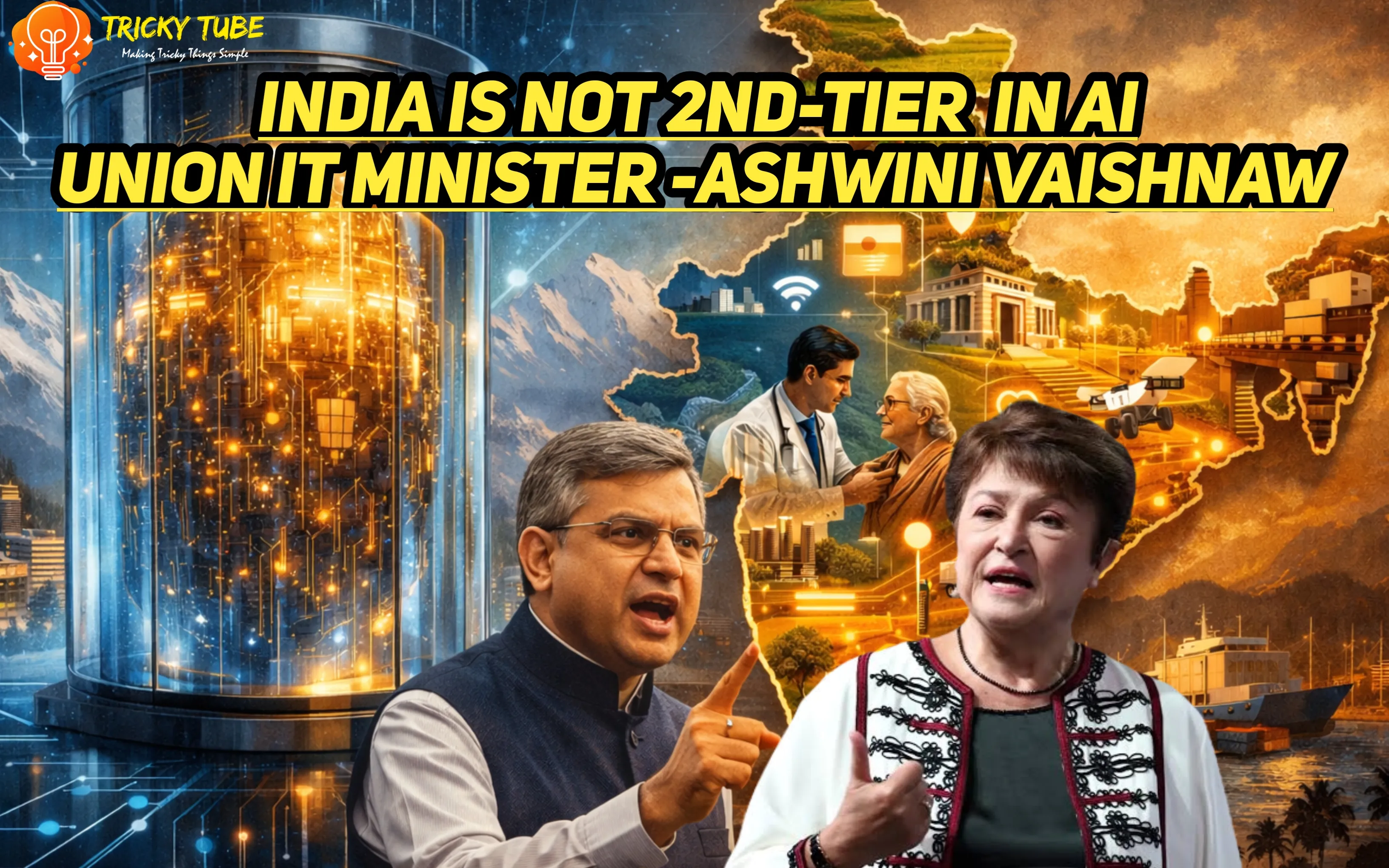
When the IMF chief casually called India a “second-tier” AI country at Davos, it sounded like a downgrade. In reality, it exposed a deeper global misunderstanding: is AI leadership about who builds the biggest models—or who changes the most lives? India’s answer may redefine the AI race itself.
TrickyTube’s Quick Summary
- IMF’s Davos remark framed AI leadership around model size and compute dominance
- India rejected that definition, emphasizing mass deployment and inclusion
- The five-layer AI stack focuses on applications, efficiency, access, and sustainability
- The real debate is about who benefits from AI—not who controls it
- India is positioning itself as a scalable AI model for the Global South
At Davos India was not downgraded-it was misread
At the World Economic Forum in Davos, a seemingly throwaway remark by Kristalina Georgieva, the chief of the International Monetary Fund, set off an unusually sharp reaction back in India. Labeling India as a “second-tier” country in Artificial Intelligence wasn’t just a classification—it felt like a verdict. And verdicts, especially from global financial institutions, tend to stick. But this time, India didn’t quietly absorb the label. Instead, Union IT Minister Ashwini Vaishnaw pushed back—hard. His response wasn’t emotional, defensive, or nationalistic. It was structural. Technical. And frankly, a little uncomfortable for the West. Because it questioned the very definition of AI leadership.
The Western scoreboard: who built the biggest brain?
From the IMF and much of the Western policy ecosystem, AI leadership is measured using a familiar checklist:
- Size of frontier models
- Dominance of private Big Tech labs
- Control over advanced semiconductors
- Concentration of compute power in a handful of countries This worldview assumes that bigger models = smarter nations. If you don’t train trillion-parameter systems or own the latest GPUs, you’re automatically placed in a lower tier. That logic works well for countries with deep capital pools, monopolistic tech giants, and near-total control over semiconductor supply chains. It is also, arguably, an exclusive club by design.
Here’s the uncomfortable question: If AI only exists inside a few labs and balance sheets, is it really a general-purpose technology—or just a luxury product?
India’s counter-argument: AI that actually shows up in daily life
India’s response flips the metric entirely. According to Vaishnaw, AI is not a trophy technology. It’s infrastructure. Like electricity or the internet, its real value comes from adoption at scale, not lab prestige.
India’s focus, therefore, is not on “vanity models” but on mass deployment—AI that touches governance, healthcare, agriculture, logistics, and financial inclusion. This is where India’s thinking diverges sharply from the Davos consensus. In simple terms: The West asks: How big is your model? India asks: How many people does your AI actually help?
That difference is not cosmetic. It’s philosophical.
The five-layer AI stack India is betting on
Instead of chasing one giant breakthrough, India is building an interconnected five-layer AI stack, designed for population-scale use.
Application Layer
This is where AI meets real life—crop advisory systems, healthcare diagnostics, logistics optimisation, and governance tools. Crucially, these applications ride on India’s existing digital public platforms, allowing deployment at national scale rather than pilot-project scale.
Model Layer
India is deliberately avoiding the “bigger is always better” trap. The emphasis is on mid-sized, efficient, domain-specific models—especially for Indian languages and local contexts. These models may not trend on global AI leaderboards, but they are cheaper, faster, and easier to deploy.
Chip Layer
Recognising hardware dependency as a strategic vulnerability, India is pushing semiconductor design, AI accelerators, and global partnerships. The goal isn’t immediate self-sufficiency—it’s reduced strategic dependence.
Infrastructure Layer
AI needs compute, but it also needs access. India’s approach focuses on shared GPU access for startups, researchers, and public institutions, anchored to national digital infrastructure rather than siloed corporate data centers.
Energy Layer
This is the most overlooked piece globally. AI is energy-hungry. India’s emphasis on power-efficient models and sustainable data centers suggests a longer-term view—especially critical for climate-stressed economies. Together, this stack doesn’t look flashy. It looks practical. And that may be precisely why it’s being underestimated.
Why this debate is bigger than India vs IMF
This isn’t really about rankings or bruised egos at Davos. It’s about who defines technological leadership in the 21st century.
India is effectively arguing that AI’s economic value comes not from exclusivity but from diffusion. Not from a few companies extracting rents, but from millions of small productivity gains across society. There’s also a geopolitical layer. By positioning itself as an AI voice for the Global South, India is challenging a system where technological rules are written by a few rich nations—and imposed on everyone else. That’s not a small challenge. And it explains why the pushback felt sharp.
My take: the world may be using the wrong scoreboard
Calling India “second-tier” only makes sense if you believe AI is a sport played by a handful of teams in Silicon Valley and a few Chinese labs.
If, instead, you believe AI is a general-purpose technology whose success depends on adoption, affordability, and trust—then India may actually be ahead of the curve.
The irony? By the time the world realises this, the “second-tier” label may look deeply outdated.
FAQ
Did the IMF officially downgrade India’s AI status?
No. The remark reflected a perspective, not a formal classification—but perceptions matter.
Why doesn’t India focus on building the largest AI models?
Because large models are expensive, energy-intensive, and benefit limited users. India prioritizes scalable impact.
What makes India’s AI strategy different globally?
Its focus on digital public infrastructure and population-scale deployment.
Is India anti-frontier AI research?
Not at all. The strategy is balanced—frontier research exists, but it isn’t the sole benchmark.
Why does this matter for ordinary citizens?
Because AI’s real power lies in everyday use—healthcare, farming, governance—not just lab demos.