
International
January 24, 2026
Post Greenland Trump Shifts Attention to Diego Garcia in the Indian Ocean-Impact on India
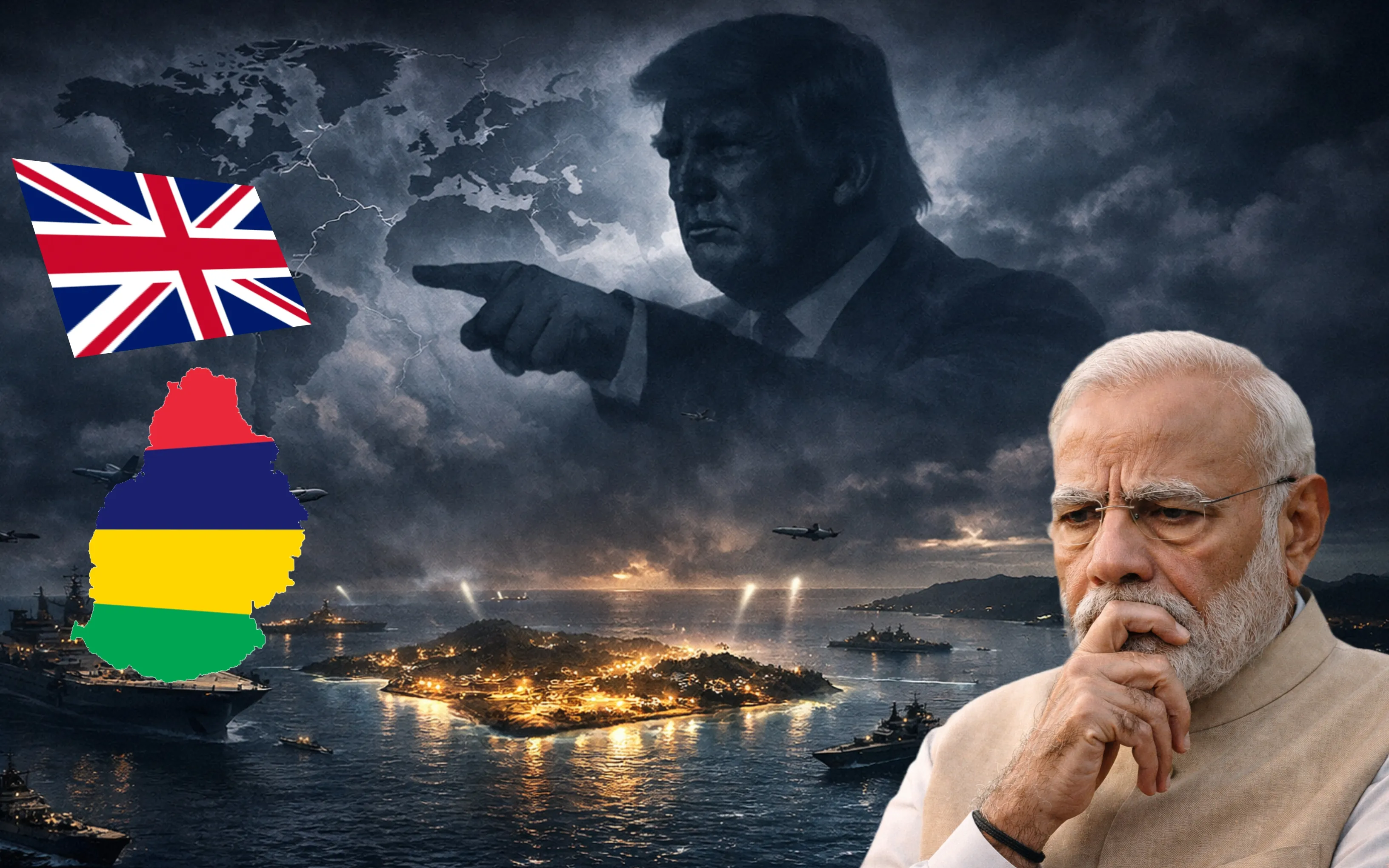
What if international law suddenly stopped mattering? What if global borders were no longer negotiated, but taken? From Greenland to Diego Garcia, the world may be quietly sliding into an era where power speaks louder than principles and India could be directly affected.
TrickyTube’s Quick Summary
Global politics is shifting from rule-based order to power-based action. US interest in Greenland and resistance to returning Diego Garcia show that strategic dominance now outweighs international law. For India, this means rising uncertainty in the Indian Ocean and the urgent need to protect its strategic interests.
For decades, we were told that the world runs on rules, treaties, and international law. But what if that was just a polite illusion? What if global politics is slowly returning to its oldest rule: might is right? Recent discussions around Donald Trump, Greenland, and the strategically explosive island of Diego Garcia suggest something uncomfortable: powerful nations may no longer feel the need to justify their actions. They may simply act. This isn’t just about islands. This is about how the global order is changing—and why India cannot afford to look away.
Greenland: Not Just Ice, But Influence
When news first surfaced that the United States was interested in Greenland, many laughed it off as political theatre. But beneath the jokes was a hard strategic truth. Greenland sits at the heart of Arctic geopolitics. Control over it means influence over Arctic shipping lanes, military radar coverage, and future resource extraction. Reports suggesting that United States could even consider forceful options alarmed Greenland’s leadership, with public warnings made to citizens about protecting sovereignty. This wasn’t about buying land-it was about sending a signal: rules are flexible when power demands it. And that signal didn’t stop in the Arctic.
Diego Garcia: The Unsinkable Power Platform
Thousands of kilometres away, in the Indian Ocean, lies Diego Garcia-arguably one of the most strategically valuable military locations on Earth. Part of the Chagos Archipelago, Diego Garcia hosts a massive US-UK military base. From here, long-range bombers can strike across Asia, Africa, and the Middle East. Naval logistics, satellite tracking, pre-positioned weapons-this single island gives the United States extraordinary reach. Historically, Diego Garcia played a decisive role in the Gulf War, Afghanistan, and Iraq. It is not an exaggeration to call it an unsinkable aircraft carrier. And that’s exactly why it matters so much now.
A Dark Past That Never Ended
What often gets buried beneath strategic maps is human cost. In the 1960s and 70s, the native inhabitants of the Chagos islands-the Chagossians-were forcibly removed to make way for military installations. Families were uprooted, livelihoods destroyed, and an entire community erased from its homeland. This displacement is widely recognised as a serious human rights abuse.
Legally, the situation is even clearer.
The International Court of Justice and the UN General Assembly have ruled that Britain’s control over the Chagos Archipelago is illegal and that sovereignty should return to Mauritius.
On paper, international law is crystal clear.
In reality? Power complicates everything.
The UK–Mauritius Deal: A Fragile Compromise
In 2025, Britain and Mauritius attempted a diplomatic fix. Under the agreement:
- Sovereignty over the Chagos Archipelago would return to Mauritius
- Diego Garcia would be leased back to the UK (and effectively the US) for 99 years
- Displaced Chagossians could return to most islands (excluding Diego Garcia)
- No foreign military presence would be allowed on other islands It was a rare attempt to balance legality, strategy, and morality. But not everyone approved.
Trump’s Objection: Weakness Is the Enemy
Donald Trump reportedly slammed the deal as “total weakness” and “great stupidity.” His argument was blunt: returning surrounding islands shows vulnerability, especially to rivals like China and Russia. The fear? That Mauritius-despite assurances-could one day allow Chinese influence into the region, threatening Diego Garcia’s security. Here’s the uncomfortable implication: international rulings don’t matter if they interfere with military dominance. This is not just Trump being Trump. This reflects a deeper shift in how power thinks.
Why India Should Be Worried
India is not a spectator in this story. India has consistently backed Mauritius’s sovereignty claim, invested in the region, and sees Mauritius as a trusted partner. India also remembers history-Diego Garcia was used by the US against Indian interests during the 1971 Indo-Pak war. From India’s perspective, a permanently occupied Diego Garcia controlled entirely by external powers raises serious concerns:
- Reduced strategic space in the Indian Ocean
- Increased foreign military footprint near Indian waters
- Uncertainty about the reliability of Western agreements If agreements can be overturned because a leader feels they are weak, what does that say about future promises?
A World Slipping Backwards? (My Take)
Here’s the hard truth: the world may be quietly abandoning the idea that law restrains power. Greenland, Diego Garcia, Ukraine, Gaza-different regions, same pattern. Strategic assets matter more than treaties. Geography matters more than justice. And while this might look like strength in the short term, it creates long-term instability. When rules stop applying to the strong, the weak stop believing in them altogether. For India, this is a warning bell. Strategic autonomy, regional partnerships, and naval capability are no longer optional-they’re essential.
What Comes Next
If Diego Garcia is permanently locked into a power-first framework, expect:
- Greater militarisation of the Indian Ocean
- Increased US-China competition near India’s periphery
- Pressure on India to choose sides rather than balance them This is not tomorrow’s crisis. It’s today’s reality forming quietly.
FAQ
Why is Diego Garcia so important?
Because it allows military reach across Asia, Africa, and the Middle East from a single base.
Who legally owns the Chagos Archipelago?
International law recognises Mauritius as the rightful sovereign.
Why did Trump oppose the UK–Mauritius deal?
He believes returning territory signals weakness and could invite Chinese influence.
How does this affect India?
It increases foreign military dominance near India and raises doubts about long-term security assurances.
Is international law losing relevance?
Legally no-but politically, power is increasingly overriding it.