
International
January 30, 2026
India Just Slashed Car Import Duties — Is This a Masterstroke or a Risky Gamble?
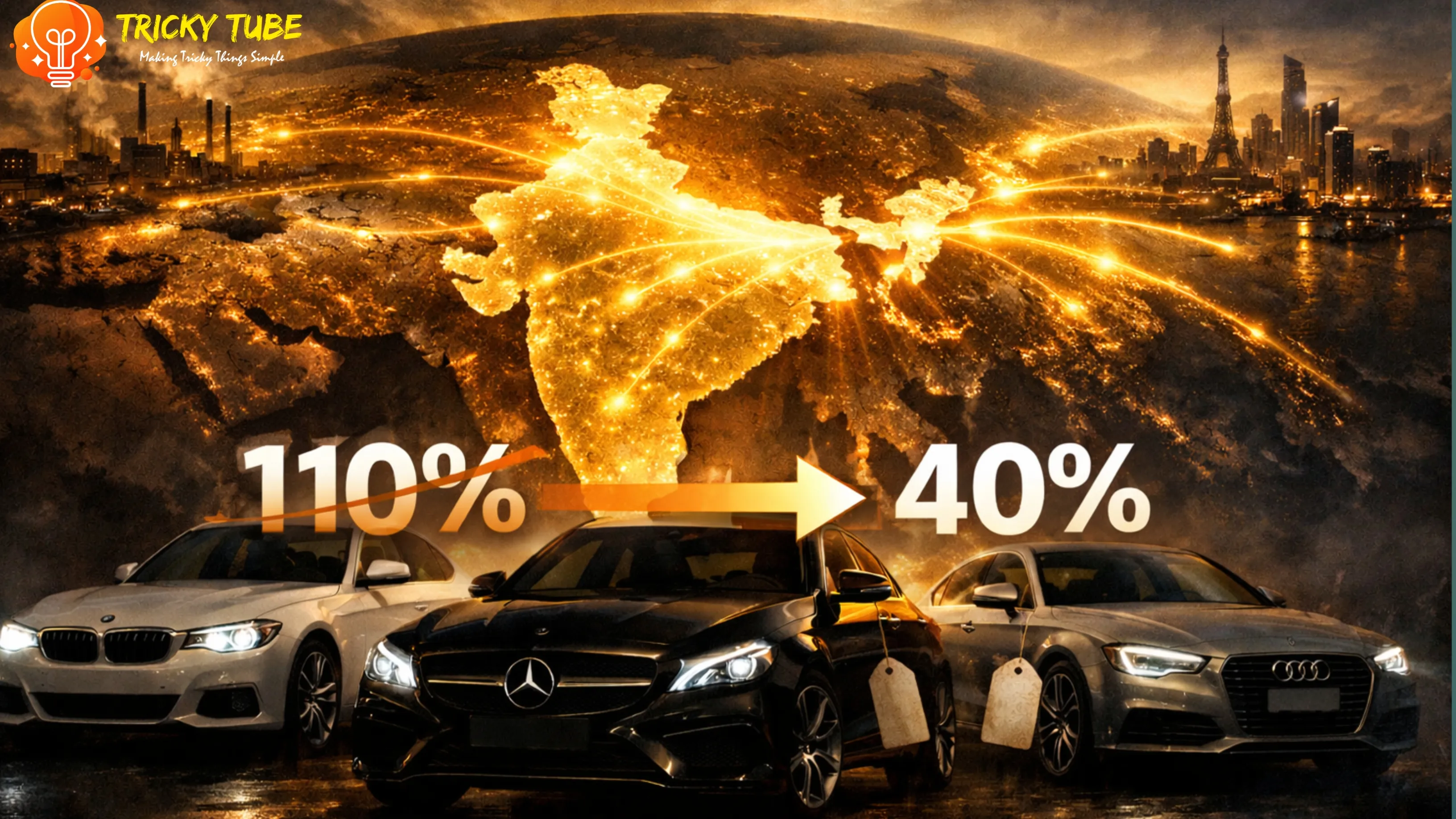
After two decades of deadlock, India and the European Union have finally cracked one of the toughest trade negotiations in recent history. The India–EU Free Trade Agreement isn’t just another diplomatic headline—it directly hits your wallet, the auto industry, and India’s long-term economic positioning. From cheaper luxury cars to big geopolitical signals, this deal quietly reshapes the rules of the game.
TrickyTube’s Quick Summary
India slashed European car import duties from 110% to 40% to unlock a long-pending EU trade deal. Luxury cars may get ₹10–25 lakh cheaper, EVs remain protected, and domestic manufacturers get safeguards. The real story isn’t cars—it’s India positioning itself as a global trade and manufacturing alternative to China.
The Deal That Took 20 Years — And Changed Everything Overnight Imagine negotiating something for 20 years—governments change, economies rise and fall, global crises come and go—and then finally saying yes. That’s exactly what happened with the India–European Union Free Trade Agreement (FTA).
At the heart of the conversation is one bold move: India agreed to slash import tariffs on European cars from a massive 110% to 40%.
On the surface, this looks like great news for car lovers. But underneath, this decision reveals far more about India’s economic priorities, strategic trade-offs, and where the country wants to stand in a rapidly fragmenting global economy. This isn’t just about cars. It’s about leverage.
Why Did India Agree to Lower Car Tariffs at All?
For decades, high import duties acted like a protective wall around India’s auto industry. The logic was simple: if imported cars are too expensive, global manufacturers are forced to manufacture locally, create jobs, and invest in India. So why dilute that protection now? Because trade negotiations are never about a single sector. India wanted something bigger from Europe—preferential access for industries where it is already globally competitive:
- Pharmaceuticals
- Textiles and apparel
- IT services and digital exports For the EU, cars were non-negotiable. European automakers see India as one of the last major untapped premium auto markets. Lowering tariffs on cars became the price India paid to unlock broader market access for its exporters. In simple terms: Cars were the bargaining chip.
What This Means for Car Buyers in India
Let’s get to the part everyone’s curious about. Luxury and premium European brands are expected to become significantly cheaper in India. Analysts estimate price drops ranging anywhere from ₹10 lakh to ₹25 lakh, depending on the model. Brands likely to benefit the most include:
- BMW
- Mercedes-Benz
- Audi
- Skoda
- Volvo
- Jaguar Land Rover For Indian consumers who were previously priced out of this segment, the FTA could finally make these cars feel attainable, not aspirational. That said, this won’t turn luxury cars into mass-market vehicles. They’ll still be premium—but less punishingly expensive.
Is India Sacrificing Its Domestic Auto Industry? Not Quite
This is where the deal gets more nuanced. The government hasn’t thrown the doors wide open. Instead, it has built guardrails to ensure controlled liberalization:
1.Tariff-Rate Quotas (TRQs)
Only a fixed number of cars can be imported at reduced duties. Beyond that, higher tariffs apply.
2.Strict Rules of Origin
This prevents third-country manufacturers from routing cars through Europe just to exploit lower tariffs.
3.Mass-Market Cars Are Excluded
The tariff cuts mainly apply to high-end vehicles, ensuring Indian manufacturers in the affordable segment don’t face sudden import pressure. From a policy standpoint, this looks less like surrender and more like calculated exposure.
Why Electric Vehicles Are Kept Out (For Now)
One of the smartest—and most controversial—parts of the agreement is what it doesn’t include. Electric vehicles (EVs) are excluded from tariff reductions for at least five years.
This is a clear signal: India wants time. The domestic EV ecosystem is still young—batteries, charging infrastructure, supply chains, and local manufacturing are all in early stages. Allowing cheap European EV imports right now could crush Indian startups before they find their footing. By delaying EV liberalization, India is effectively saying: “Let us build first. Then we’ll compete.” In my opinion, this is a rare case of trade policy showing long-term thinking rather than short-term optics.
The Important Picture: Cars Are Just the Surface Story
Zoom out, and the India–EU FTA looks far more strategic than it appears.
Diversifying Trade Partners
India is reducing over-dependence on any single economic bloc.
Positioning as a China Alternative
For Europe, India represents a stable, democratic manufacturing and services hub at a time when supply chains are shifting away from China.
Signaling Openness to Investment
A deal of this scale tells global investors that India is serious about integration, not isolation. This agreement quietly places India at the center of a new global trade realignment.
What Could Go Wrong? The Risks Are Real
No deal is without downsides. There’s genuine concern that over time, even controlled imports could pressure domestic manufacturers to compete on margins they’re not ready for. Job displacement fears, especially in auto ancillaries, aren’t imaginary. But here’s the uncomfortable truth: shielding industries forever also kills competitiveness. The real test will be whether Indian manufacturers use this window to innovate, upgrade, and scale, or lobby for more protection.
Final Take: A Strategic Bet, Not a Giveaway
This FTA is not about making luxury cars cheaper—though that’s the most visible outcome. It’s about India betting that:
- Its export strengths will outweigh import pressures
- Its industries can compete globally with the right pacing
- Strategic openness is better than economic isolation Whether this gamble pays off depends on execution, not headlines.
FAQs
Will all cars become cheaper in India?
No. Only select premium European cars fall under the reduced tariff structure.
Are electric vehicles included in the tariff cuts?
No. EVs are excluded for at least five years to protect India’s domestic EV industry.
Will this hurt Indian car manufacturers?
There may be pressure, but safeguards like quotas and exclusions limit immediate impact.
Why did the EU push so hard for car tariff reductions?
India is one of the fastest-growing premium auto markets globally.
Is this deal good for India in the long run?
If managed well, yes—especially for exports, investment, and global positioning.