
International
January 27, 2026
India Is Losing Its Future to Dirty Air — And It’s Costing More Than Any Trade War
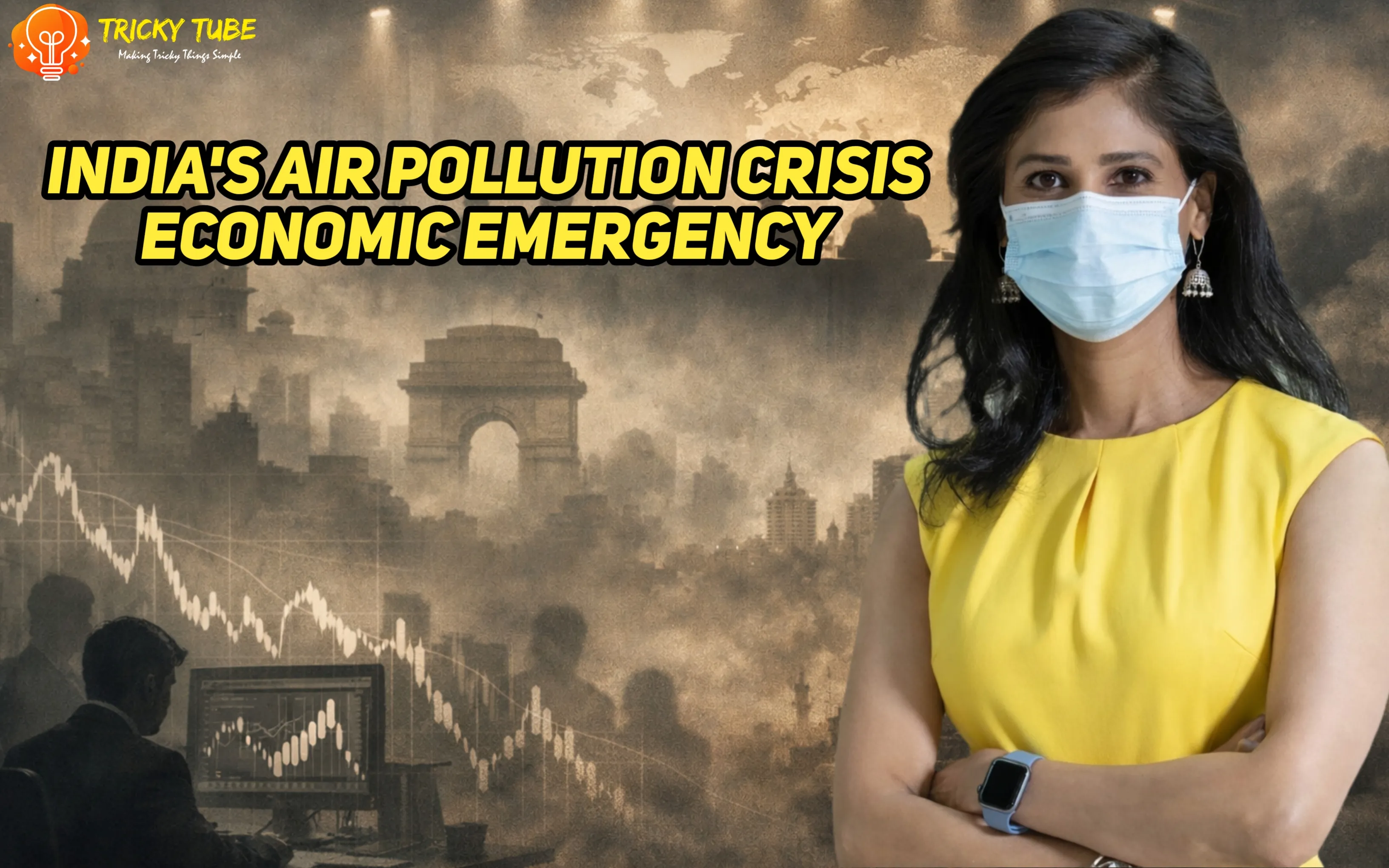
India’s air pollution crisis is no longer just an environmental issue—it’s a silent economic emergency. With nearly 9.5% of GDP lost every year, dirty air is killing productivity, talent, and global confidence in Brand India. Here’s why clean air is now an economic necessity.
TrickyTube’s Quick Summary
India’s air pollution crisis is now a major economic threat, costing nearly 9.5% of GDP annually. Beyond healthcare costs, it destroys productivity, talent, and global confidence in Brand India. Unlike tariffs, pollution is an internal crisis that weakens human capital. Clean air is no longer optional—it’s economic survival.
What if India’s biggest economic threat isn’t global tariffs, oil prices, or geopolitics—but the air we breathe? That’s the uncomfortable warning coming from Davos, echoed by economists, global institutions, and now backed by cold, brutal numbers. India’s air pollution crisis has quietly crossed a line. It is no longer an environmental concern or a public health footnote. It has become a full-blown economic emergency.
At the recent discussions around the World Economic Forum, experts made it clear: polluted air is draining India’s growth engine from the inside. Unlike external shocks, this one is entirely self-inflicted—and far more dangerous.
The Real Cost of Dirty Air
According to data highlighted from the Lancet Countdown, outdoor PM2.5 pollution alone cost India around $339.4 billion in 2022. That figure isn’t just hospital bills or healthcare spending. It represents what economists call welfare loss—the economic value of lives cut short, productivity lost, and skills erased.
Every year, an estimated 1.6 to 1.7 million Indians die prematurely because of air pollution. When those lives are lost, decades of experience, training, and economic contribution vanish with them. This is how a demographic dividend quietly mutates into a demographic disaster.
India doesn’t just lose people. It loses teachers, engineers, factory supervisors, doctors, entrepreneurs—human capital that cannot be replaced overnight.
Why Pollution Hurts More Than Tariffs
In a striking comparison, former IMF Chief Economist Gita Gopinath pointed out that air pollution poses a greater threat to India’s economy than external trade tariffs.
Tariffs, even in worst-case scenarios, usually dent GDP by less than 1%. Businesses adapt, supply chains adjust, and markets respond. Pollution doesn’t offer that flexibility. It is an internal hemorrhage—slow, persistent, and lethal. When the workforce itself becomes sick, no fiscal stimulus or trade agreement can fix the damage.
Productivity Is Quietly Collapsing
One of the most under-discussed impacts of air pollution is how deeply it affects daily work.
Studies show that when AQI levels cross 300, employee productivity drops by 6–10%. This isn’t theoretical. India reportedly loses around 1.3 billion working days every year due to pollution-related illness, fatigue, and absenteeism.
Imagine factories running with exhausted workers. Offices filled with employees battling headaches, breathing issues, and brain fog. Logistics slowed by health-related disruptions. Over time, this compounds into lower output, weaker competitiveness, and missed growth targets.
From an economic perspective, polluted air is like forcing the entire workforce to operate with a permanent handicap.
The Silent Damage to Brand India
Beyond numbers, pollution is hurting something harder to repair—Brand India. Global investors, multinational executives, and skilled professionals do not just evaluate tax rates and market size. They assess livability. Cities with toxic air send a clear signal: long-term human sustainability is not a priority.
This has triggered what many now call “Brain Drain 2.0.” Young professionals, researchers, and global-facing talent increasingly choose cleaner countries—not just for higher pay, but for healthier lives. No startup ecosystem can thrive if its best minds are planning exit routes based on AQI apps. Here’s my honest take: India may build world-class digital infrastructure, but if breathing itself feels unsafe, the narrative collapses.
So Why the Inaction?
If the costs are this high, why hasn’t pollution been treated like the economic emergency it is? Three reasons stand out.
First, political cost. Strict enforcement angers powerful vote banks—transport unions, construction lobbies, informal industries. Clean air policies demand short-term discomfort for long-term gain, and politics rarely rewards patience. Second, data opacity. Downplaying pollution levels or selectively reporting data makes the problem appear manageable. But denial only delays solutions. Third, a deeper issue—lack of acknowledgment. Pollution is still framed as an environmental or urban problem, not as a core economic policy failure. Until that mindset changes, action will remain cosmetic.
Clean Air Is Not a Luxury
One critical insight from the Davos discussions is this: clean air is not a luxury of rich nations; it is a prerequisite for becoming one. Global capital is increasingly aligned with ESG standards—Environmental, Social, and Governance metrics. Countries that fail on environmental credibility risk losing access to long-term investment, not because of ideology, but because risk managers are ruthless. Pollution now directly influences creditworthiness, investor confidence, and growth forecasts.
What Needs to Change
The solutions are not mysterious. They start with source reduction, not symbolic bans. Cleaner mobility, industrial emissions control, and construction reform matter more than emergency measures after pollution spikes.
Equally important is data transparency. You cannot fix what you refuse to measure honestly.
Most of all, India needs to accept a hard truth: a healthy economy cannot exist without healthy lungs. The warning from Davos isn’t criticism—it’s an alarm clock. And hitting the snooze button will only make the awakening more painful.
FAQs
How much does air pollution cost India’s economy?
Estimates suggest losses close to 9.5% of GDP annually due to healthcare costs, productivity loss, and premature deaths.
Why is pollution worse than trade tariffs for India?
Tariffs are external and adjustable. Pollution directly damages human capital, reducing productivity and long-term growth potential.
How does air pollution affect foreign investment?
Poor air quality harms Brand India, discourages global talent, and raises ESG-related risks for investors.
What are the key solutions?
Source reduction, clean mobility, transparent data, and treating clean air as an economic priority—not just an environmental issue.