
International
January 31, 2026
Europe’s Defense Reset: Why the EU Is Betting Big on India for the Future of Global Security
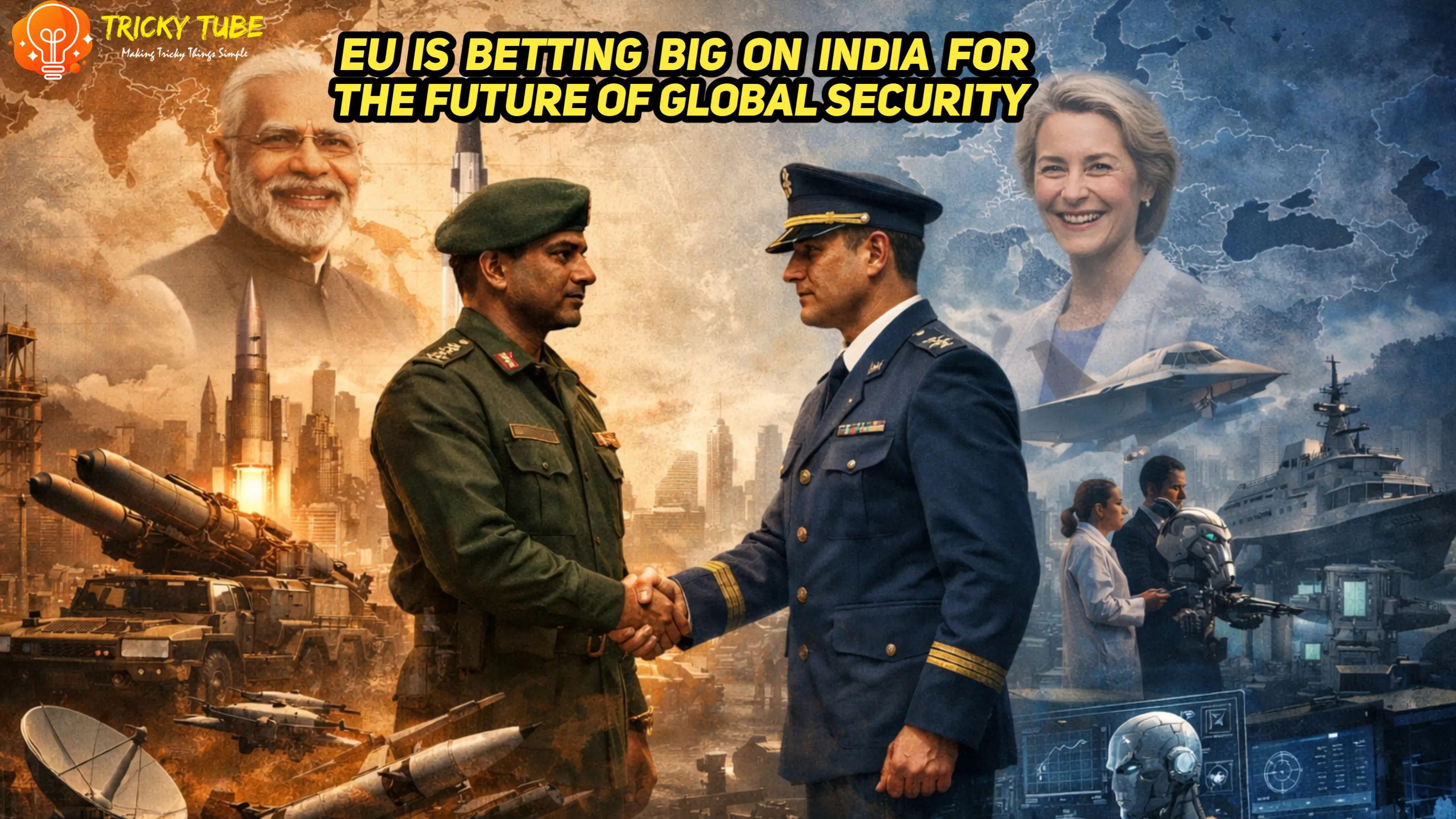
Europe’s defense rethink after Ukraine has turned India into a key strategic partner. From co-production to technology transfer, here’s why this partnership could reshape global power dynamics.
TrickyTube’s Quick Summary
Europe’s defense rethink has opened a rare strategic window for India. Moving beyond arms sales, the EU wants India as a co-developer, co-producer, and long-term security partner. If executed well, this partnership could reshape defense manufacturing, Indo-Pacific security, and global power equations.
Europe Is Re-Arming—and India Is Suddenly at the Center of the Plan
What if I told you that Europe’s biggest defense rethink since the Cold War might quietly reshape India’s military future—and the global balance of power? This isn’t a routine arms deal or another diplomatic handshake photo-op. What’s unfolding between India and the European Union feels more like a strategic reset, driven by fear, urgency, and a hard realization in Brussels: Europe can’t depend on old certainties anymore.
The EU’s new defense posture—often described as a “defense reset”—is being pushed by three uncomfortable truths. First, the Ukraine war exposed Europe’s alarming ammunition shortages and industrial weaknesses. Second, U.S. politics has become unpredictable, especially with figures like Donald Trump openly questioning NATO-style security guarantees. And third, the tightening alignment between China and Russia has forced Europe to rethink who it can trust long-term.
In that rethink, India has emerged not as a backup option—but as a preferred partner.
From Arms Buyer to Strategic Co-Creator: A Quiet but Historic Shift
For decades, India–EU defense ties were transactional. Europe sold equipment; India bought it. Technology transfer was limited, guarded, and often reluctant. That model is now being challenged.
The new understanding between India and the European Union marks a qualitative leap—from a buyer–seller equation to co-development and co-production. In plain terms, this means joint design, shared intellectual property frameworks, and integrated supply chains rather than finished products shipped across borders.
That shift matters. It places Indian firms not at the end of the value chain, but inside Europe’s defense-industrial ecosystem.
Europe’s Strategic Autonomy Crisis
Europe’s push for “strategic autonomy” isn’t ideological—it’s reactive. The Ukraine war revealed how dependent Europe is on the U.S. for weapons, logistics, and even basic ammunition stockpiles. At the same time, U.S. domestic politics has injected doubt into long-term security commitments.
Europe doesn’t want to replace the U.S.—but it can’t afford to rely on only one pillar anymore.
This is where India fits perfectly. Not because India is cheap labor or a large market—but because it offers scale, political independence, and strategic credibility without the baggage that comes with other options.
Why India—and Not Someone Else?
Europe’s checklist for a new defense partner is brutal. Few countries qualify. India does—on multiple fronts.
Industrial Depth
India now has both public and private defense manufacturers capable of large-scale production.
Export Momentum
Indian defense exports are rising steadily, signaling reliability and competitiveness.
License Production Experience
India has decades of experience producing foreign platforms under license—crucial for joint ventures.
Strategic Trust
India isn’t aligned with China, hasn’t sanctioned Europe, and maintains diplomatic autonomy.
Democratic Stability
For Europe, governance predictability matters more than ideology.
Most importantly, India sits at the heart of Indo-Pacific security, a region Europe increasingly views as inseparable from its own future.
The Trade–Defense Link Most People Miss
Here’s a less glamorous but critical piece: the India–EU Free Trade Agreement (FTA). Defense cooperation at this level doesn’t survive without trade alignment. An FTA reduces tariffs on components, harmonizes technical standards, protects intellectual property, and encourages capital flow. Without it, cross-border defense supply chains collapse under regulation.
In short, guns don’t move without trade rules—and both sides know it.
What “Guns, Tech, and Trust” Really Means
This partnership is often summarized in three words—but each hides something deeper.
Guns (Hardware)
Europe needs ammunition and weapons manufacturing capacity fast. India offers production scale. Joint manufacturing isn’t just cost-effective—it’s strategically urgent.
Tech (Transfer)
Europe is prepared to share dual-use technologies—those applicable to both civilian and military domains. Europe brings design expertise; India brings manufacturing depth. This is where India moves from assembler to innovator.
Trust (Reliability)
The EU sees India as predictable, rule-abiding, and strategically autonomous. In defense partnerships, trust isn’t diplomatic—it’s existential.
opinion: This “trust” element is actually the rarest commodity here. Hardware can be built. Technology can be negotiated. Strategic trust takes decades—and India has earned it quietly.
The Geopolitical Picture
Zoom out, and the implications are massive:
- Europe reduces overdependence on the U.S.
- A non-NATO strategic pillar begins to take shape.
- The EU expands its footprint in the Indo-Pacific.
- India diversifies defense partners beyond Russia and the U.S.
- ‘Make in India’ gets real, not rhetorical.
- Global multipolarity strengthens, subtly counterbalancing China’s manufacturing dominance.
This isn’t just cooperation—it’s systemic rebalancing.
Challenges Nobody Should Ignore
This path isn’t frictionless. Europe itself is divided on defense policy. Export controls remain complex. Indian bureaucracy can slow execution. Environmental and regulatory clearances could delay projects. But momentum matters in geopolitics—and right now, momentum is strong.
FAQs
Why is the EU changing its defense policy now?
The Ukraine war, U.S. political uncertainty, and China–Russia alignment exposed Europe’s vulnerabilities.
Why did the EU choose India?
India offers industrial scale, strategic trust, democratic stability, and Indo-Pacific relevance.
Is this about weapons sales only?
No. It includes co-development, technology transfer, and supply-chain integration.
How important is the India–EU FTA?
Crucial. Without trade alignment, deep defense cooperation isn’t viable.
What does India gain long-term?
Technology access, diversified partnerships, stronger exports, and strategic leverage.