
International
March 17, 2026
Dubai Airport Attack Shocks UAE: Why It’s Not Retaliating Against Iran (And What It Really Means)
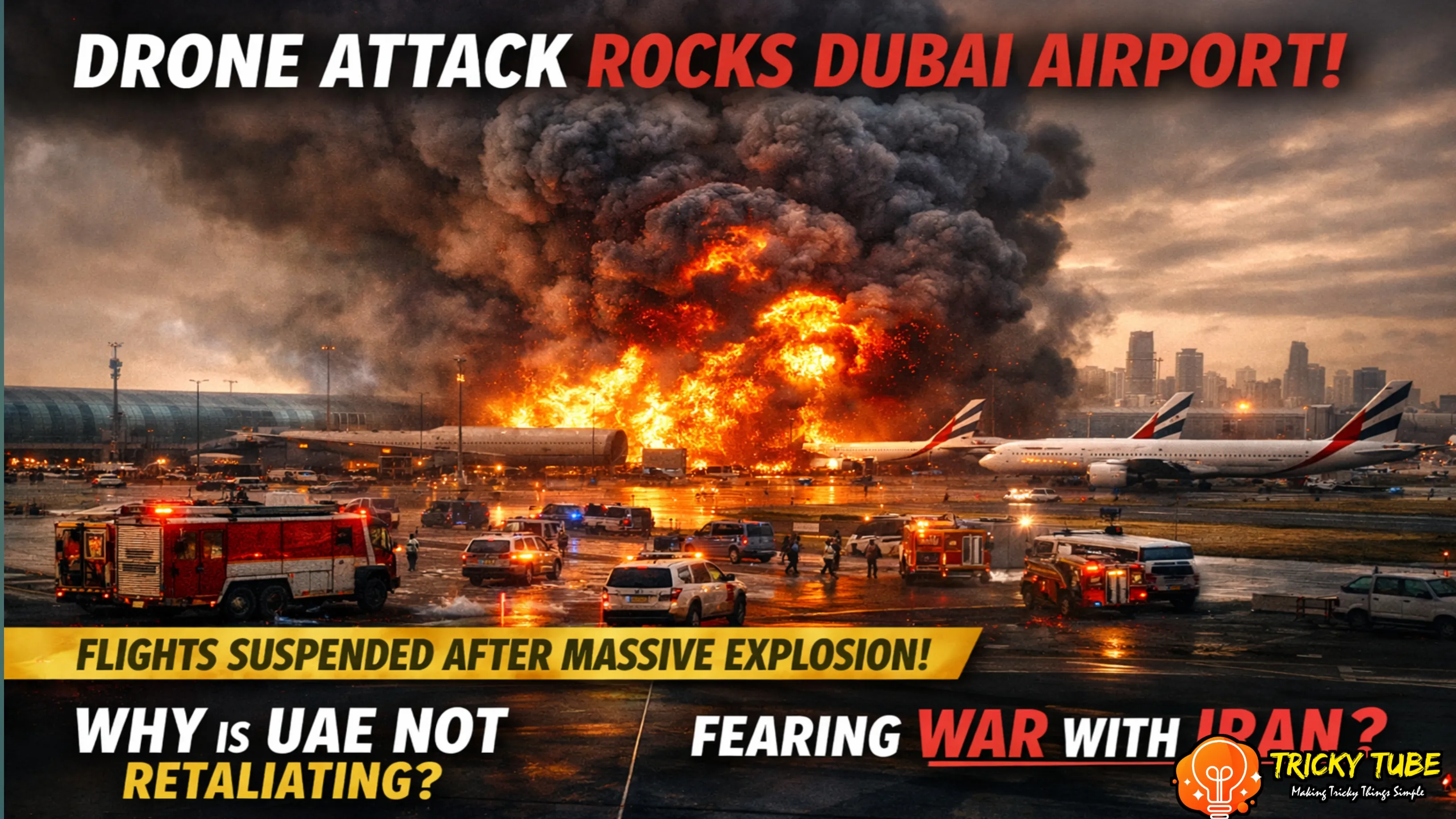
A shocking drone strike on Dubai International Airport disrupted global air travel and exposed a deeper geopolitical strategy-why the UAE is choosing restraint over retaliation against Iran.
Trickytube’s Quick Summary
- Drone attack hit Dubai International Airport fuel facility
- Massive fires led to suspension of international flights
- Airlines losing over $100 million daily
- UAE avoiding retaliation to prevent full-scale war
- Economy, not military dominance, drives decision-making
- Heavy reliance on US for regional security
- Signals shift toward strategic restraint in modern conflicts
What happens when one of the world’s busiest airports suddenly goes silent?
That’s exactly what unfolded in the UAE when a drone attack struck Dubai International Airport, sending shockwaves not just across the Middle East—but across global aviation.
The incident wasn’t just another regional flare-up. It was a calculated strike that exposed vulnerabilities in one of the most secure and economically critical hubs in the world.
A Strike That Brought Dubai to a Halt
The attack reportedly involved drones targeting a fuel storage facility near Dubai International Airport. Within moments, massive fires erupted, forcing authorities to suspend international flight operations.
For a city that thrives on seamless connectivity, luxury tourism, and global business traffic, even a few hours of disruption can translate into enormous financial damage.
Airlines were hit hard, with losses estimated to cross $100 million per day. Thousands of passengers were stranded. Flights were diverted. And perhaps most importantly-confidence was shaken.
This wasn’t just about infrastructure damage. It was about sending a message.
Why Isn’t UAE Striking Back?
At first glance, many expected a swift retaliation. But instead, the UAE chose restraint—and that decision is far more strategic than it appears.
1. Fear of Escalation: A War UAE Cannot Afford
A direct counterattack against Iran could spiral into a full-scale regional war. And in such a scenario, the UAE would become an immediate target.
Critical landmarks like the** Burj Khalifa**, oil facilities, and financial hubs could face retaliation. The risk isn’t theoretical—it’s immediate and potentially devastating.
In my opinion, this is where the UAE’s approach stands out. Rather than reacting emotionally, it’s calculating the long-term consequences-something many nations fail to do under pressure.
2. Economic Reality: Stability Is Everything
The UAE’s strength lies in its stability. Unlike countries that rely heavily on military dominance, the UAE has built its global reputation on:
- Aviation
- Tourism
- Finance
- Trade
A prolonged conflict would cripple all of these sectors overnight.
Just imagine: grounded flights, halted tourism, fleeing investors. The economic domino effect would be brutal.
Even this single attack has already exposed how fragile the system can be when disrupted.
3. A Defensive Military by Design
Another key reason is structural. The UAE’s military is primarily designed for defense, not aggressive large-scale warfare.
It relies heavily on systems like missile defense shields to intercept threats rather than project power beyond its borders.
This means launching a sustained offensive campaign against a country like Iran isn’t just risky—it’s operationally challenging.
4. The US Factor: Strategic Dependence
Perhaps the most crucial piece of the puzzle is the UAE’s reliance on the United States.
The UAE operates under a broader security umbrella where the US plays a central role in countering major threats in the region. Instead of escalating tensions directly, the UAE prefers to let larger powers handle confrontation with Iran.
This is a classic example of modern geopolitics—where influence and alliances often matter more than direct military action.
The Bigger Picture: A New Kind of Warfare
This attack highlights a growing trend-asymmetric warfare.
Drones, cyber tactics, and indirect strikes are replacing traditional battlefields. Smaller, targeted attacks can now create massive disruption without triggering full-scale wars.
And the Dubai incident fits perfectly into this pattern.
It’s not about destruction-it’s about disruption.
What This Means Going Forward
The UAE’s response (or lack of retaliation) signals a shift in how nations handle conflict:
- Prioritizing economic survival over military pride
- Avoiding escalation even after direct attacks
- Relying on alliances instead of solo action
- But this strategy also comes with risks.
If such attacks go unanswered repeatedly, it could embolden future aggressors. That’s the delicate balance the UAE is now navigating.
Final Thought
This wasn’t just an attack on an airport. It was a test-of resilience, strategy, and restraint.
And the UAE’s response tells us something important:
In today’s world, winning a conflict doesn’t always mean fighting it.
FAQs
Q1. What exactly happened at Dubai International Airport?
A drone strike targeted a fuel tank, causing fires and forcing flight suspensions.
Q2. Why didn’t UAE retaliate immediately?
Because retaliation could trigger a larger war and massive economic losses.
Q3. How much financial damage did the attack cause?
Airlines alone are estimated to lose over $100 million per day during disruptions.
Q4. Is UAE militarily weak?
Not weak, but primarily structured for defense rather than offensive warfare.
Q5. What role does the US play in this situation?
The UAE relies on US security support to counter major threats like Iran.