
International
January 28, 2026
Did the U.S Quietly Freeze India Out of a Trade Deal—and Push India to Look Elsewhere?
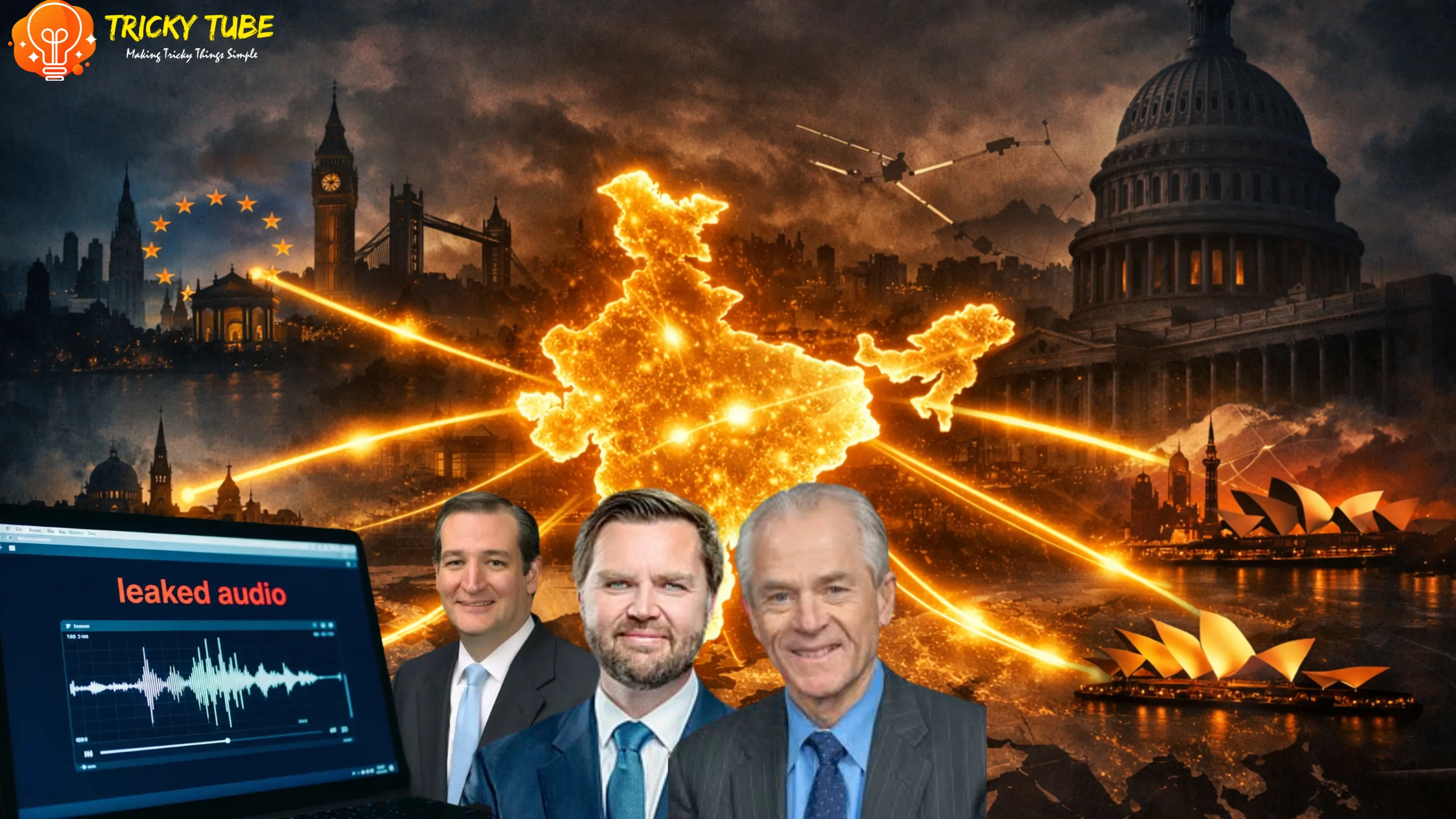
A leaked political audio from the U.S has reopened uncomfortable questions about India–U.S. trade relations. While official statements speak of partnership and the Indo-Pacific, behind closed doors a very different attitude may be shaping decisions. And the fallout is already visible in India’s fast-changing trade strategy.
TrickyTube’s Quick Summary
- A leaked U.S. political audio suggests internal resistance to an India–U.S. trade deal
- Concerns include tariffs, technology sharing, and India’s rapid economic rise
- India is responding by accelerating trade agreements with the EU, UK, Canada, and others
- The longer the delay continues, the more the U.S risks losing strategic economic leverage
When trade talks collapse silently, the damage is louder than tariffs
What if the biggest obstacle to India–U.S. trade is not economics, but perception?
In recent weeks, a leaked audio recording from a private donor meeting in the United States has triggered exactly this debate. The conversation, allegedly involving senior American political figures, paints a picture of hesitation, mistrust, and internal contradictions within US’s trade approach toward India. While no official document confirms a breakdown, the implications are hard to ignore—a trade agreement that should have been signed months ago appears to have been deliberately stalled. For India, this moment is not just about a delayed deal. It is about clarity. And in global trade, clarity often matters more than friendship.
A leak that exposes more than a meeting
According to reports, the leaked audio features U.S. Senator Ted Cruz, speaking candidly during a closed-door interaction with donors. His remarks reportedly mock the trade posture of the current U.S. administration and hint at deeper disagreements inside the US. More striking is the claim that Donald Trump, Vice President JD Vance, and trade advisor Peter Navarro personally intervened to block progress on a trade deal with India—despite negotiators on both sides being close to an agreement. If accurate, this suggests the issue was not technical but political.
Is India being viewed as the “next China”?
One of the most concerning themes emerging from the discussion is the perception of India itself. Instead of being seen purely as a strategic partner and counterbalance to china, India is allegedly being viewed as a future competitor—another China in the making. That mindset changes everything. Trade partnerships thrive on trust and long-term alignment, but suspicion breeds hesitation. This framing also explains why progress appears inconsistent. On one hand, the US publicly praises India’s role in the Indo-Pacific. On the other, trade concessions remain frozen.
Technology, AI, and a surprising line of resistance
The deadlock is not limited to tariffs. Technology has emerged as an unexpected fault line. Peter Navarro reportedly questioned why the U.S. should provide advanced AI services—such as large-scale computing platforms—to India. His concern, as described in the discussion, revolves around the high energy costs and infrastructure burden required to power these systems, especially when serving foreign markets.
This argument signals something deeper: a growing discomfort with India moving up the value chain. Access to AI, cloud computing, and digital infrastructure is no longer seen as neutral trade—it is now strategic. If technology becomes a gatekeeping tool, trade talks will inevitably slow.
Tariffs, unpredictability, and policy whiplash
Despite India being widely described as a natural economic ally, high tariffs on Indian goods remain in place. The inconsistency becomes sharper when viewed alongside recent U.S. actions elsewhere—such as the sudden threat of a 100% tariff against Canada.
That unpredictability is not just a diplomatic issue; it is a business risk. From India’s perspective, negotiating a comprehensive trade agreement under such conditions becomes difficult. A deal signed today could be undermined tomorrow by a political statement, an election cycle, or a shift in internal power dynamics. At some point, diversification becomes not just smart—but necessary.
India’s quiet but decisive pivot
Instead of waiting indefinitely, India appears to have made a strategic choice: move forward without the US. Over the past year, India has accelerated trade negotiations with multiple partners. Talks with the European Union, the UK, Australia, the UAE, and Israel are either advancing rapidly or nearing completion. This is not a rejection of the U.S.—it is risk management. By spreading its trade exposure, India reduces dependency on any single partner and strengthens its negotiating position globally.
Canada: a surprising reset
One of the most interesting developments is India’s renewed engagement with Canada. Following the exit of Justin Trudeau, India has signaled openness to rebuilding ties under new leadership, including discussions around a potential free trade agreement with Mark Carney-led political influence. If India finalizes an FTA with Canada before the U.S., it would be more than symbolic. It would signal that India values predictability over rhetoric.
Why the EU deal could change everything
Among all alternatives, the European Union stands out. A comprehensive India-EU trade agreement could dramatically lower prices of European cars in India, while also reducing tariffs on Indian exports ranging from pharmaceuticals to textiles. For Indian manufacturers, this opens access to one of the world’s largest consumer markets. More importantly, the EU offers stability. Trade policy in Brussels is slow—but predictable. For businesses, that reliability is invaluable.
Who loses more?
There is a temptation to frame this story as India versus the United States. That would be a mistake.
In reality, stalled trade hurts both sides. American companies looking to scale manufacturing beyond China lose a natural partner. Indian exporters lose faster access to the U.S. market. And the broader Indo-Pacific strategy—often described as a long-term counterweight to China—loses coherence. Here’s the uncomfortable truth: economic partnerships cannot survive on strategic slogans alone.
What happens next?
India is unlikely to slam the door on the U.S. Trade channels remain open, and political equations can change quickly in the U.S. But India has clearly recalibrated its expectations. If and when an India–U.S. trade deal happens, it will now be on more cautious terms—and likely from a position where India already has alternatives in place. That shift, once made, is hard to reverse.
FAQ
Is the India–U.S. trade deal officially cancelled?
No. Talks are stalled, not terminated, but progress has slowed significantly.
Why is technology becoming a trade issue?
AI and digital infrastructure are now seen as strategic assets, not neutral services.
Will India stop engaging with the U.S.?
Unlikely. India is diversifying, not disengaging.
Which trade deal matters most for India right now?
The EU deal could have the largest immediate economic impact.