
International
January 25, 2026
A “Board of Peace” That Divides the World: Why Trump’s New Global Club Is Facing Silent Rejection
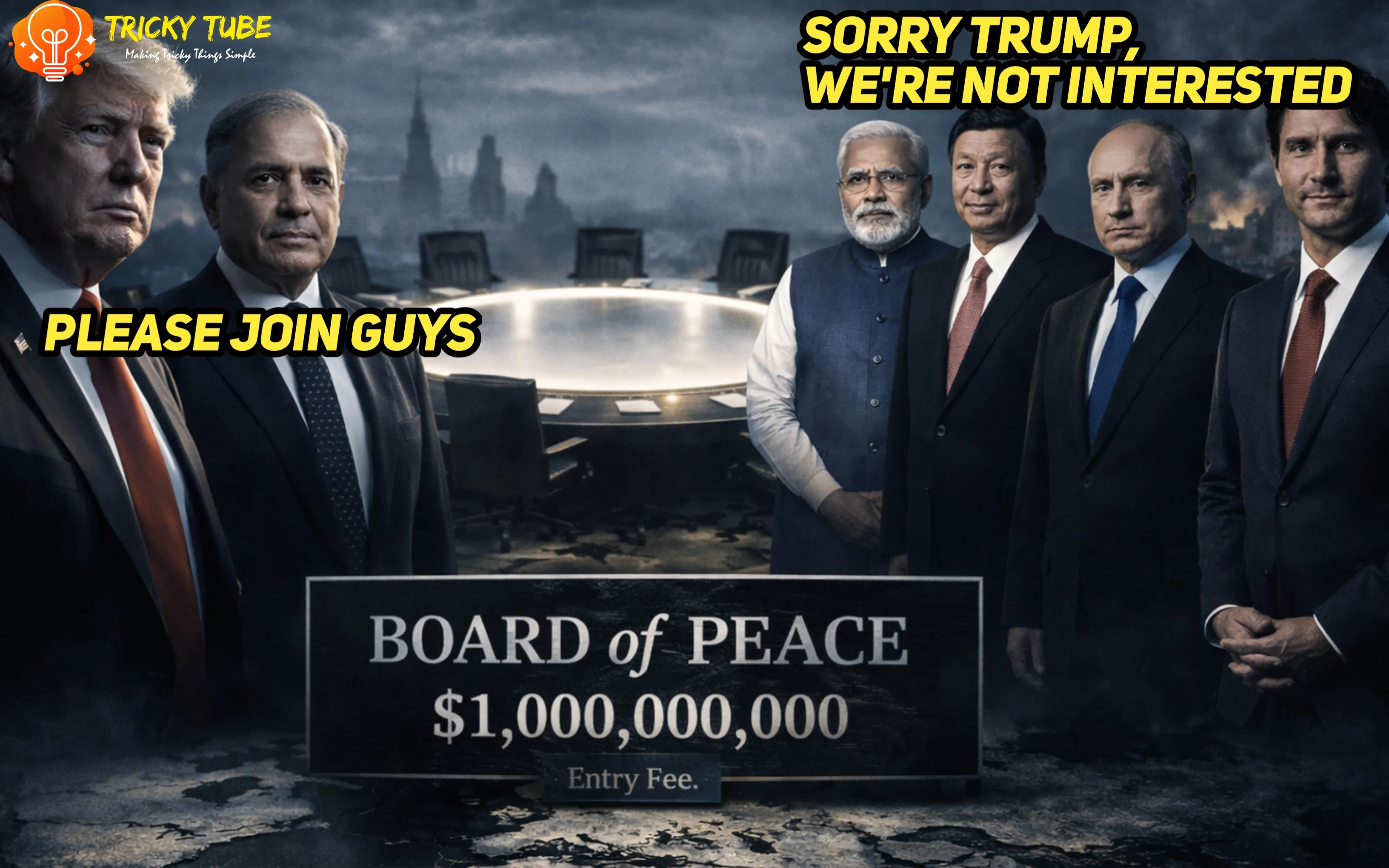
What happens when a “peace initiative” launches without the world’s biggest powers? Donald Trump’s newly announced Board of Peace claims to reshape global order—but the absence of India, China, Russia, and Europe raises uncomfortable questions. Is this diplomacy, or power politics wearing a peace badge?
Trickytube’s Quick Summary
- Trump launches the Board of Peace as a new global body
- Pakistan joins, triggering domestic backlash
- Gaza governance emerges as a core agenda
- India, China, Russia, and Europe stay away
- Critics see it as a UN-alternative driven by power, not consensus
The Day Peace Became Conditional What if peace now comes with an entry fee—and a political price tag? That is the uncomfortable question echoing through global capitals after Donald Trump unveiled his latest geopolitical experiment: the Board of Peace. Announced with much fanfare and positioned as a bold alternative to traditional multilateral institutions, this new body claims to bring order, mediation, and stability to conflict zones like Gaza. But the real story isn’t who joined. It’s who didn’t.
What Exactly Is the Board of Peace?
The Board of Peace has been introduced as an international organization with 19 countries attending its first major meeting. Trump’s pitch is straightforward: global conflicts need faster decisions, fewer vetoes, and “committed stakeholders” rather than slow UN-style consensus. On paper, it sounds efficient. In reality, it looks selective. Membership reportedly involves a billion-dollar financial commitment for a permanent seat—something closer to a corporate board than a democratic global forum. This alone has made many countries uneasy, especially those who see peacekeeping as a collective responsibility, not a paid privilege.
Pakistan’s Enthusiastic Entry—and the Price It Pays
One of the most striking developments is Pakistan emerging as a founding participant. Around 35 countries have reportedly agreed to join, but Pakistan’s role stands out due to both its visibility and its financial commitment. Domestically, this move has triggered backlash. Opposition parties argue that joining the Board—especially given its perceived tilt toward Israel—is morally incorrect, particularly in the context of Gaza. Interestingly, former PM Imran Khan had predicted back in 2022 that Pakistan’s geopolitical alignment with US would deepen under future global shifts. That statement, once dismissed, now feels eerily accurate. Implication: Pakistan may be gaining short-term diplomatic access, but at the cost of internal political legitimacy.
Gaza, Hamas, and the Real Agenda
The Board’s most controversial objective appears tied to Gaza. Hamas is allegedly under pressure to hand over Gaza’s administration to the Board of Peace. This raises a serious concern: Is the Board acting as a mediator—or as an enforcement mechanism aligned with specific strategic interests? If peace initiatives start dictating governance structures without local or regional consensus, they risk being viewed not as solutions—but as impositions.
Why Major Powers Are Staying Away
The silence from global heavyweights is deafening.
- India has remained non-committal
- China hasn’t acknowledged the platform
- Russia has stayed away
- France and United Kingdom have openly rejected it European nations argue that the Board directly conflicts with the principles of the United Nations Charter—especially sovereign equality and multilateral legitimacy. Even Ukraine’s president Volodymyr Zelenskyy, who relies heavily on Western support, has not joined. Opinion: When even allies hesitate, it suggests the initiative lacks trust—not publicity.
Canada Says No—and That Matters
Canada’s outright rejection is another telling signal. Canada reportedly declined both the invitation and the associated costs, at a time when its relations with US are already tense due to a new trade agreement with China. This shows the Board of Peace isn’t just about conflict zones—it’s also becoming a litmus test of loyalty in an increasingly polarized world.
Why India Is Likely to Decline
From India’s perspective, joining the Board offers limited upside:
- It weakens commitment to UN-based multilateralism
- It risks alienating strategic partners
- It ties peacekeeping to financial and political conditions India’s silence likely reflects a calculated decision: strategic autonomy over symbolic participation.
Is the Board of Peace the Future—or a Fragment?
Trump’s Board of Peace may attract nations seeking proximity to US power. But peace built on selective inclusion, financial barriers, and ideological alignment rarely lasts. History shows that global legitimacy isn’t declared—it’s earned. If major powers remain absent, the Board risks becoming not a global platform, but a parallel club with limited reach.
FAQ
Is the Board of Peace an alternative to the UN?
Not officially—but its structure and objectives overlap significantly, causing concern among UN member states.
Why is Pakistan facing internal opposition?
Because many view the Board as biased toward Israel and morally problematic in the Gaza context.
Why are major powers rejecting it?
Due to concerns over legitimacy, financial entry barriers, and conflicts with international law.
Will India eventually join?
Highly unlikely, given India’s preference for strategic autonomy and UN-based diplomacy.