
international
March 17, 2026
400 Lives Lost in Seconds The Kabul Airstrike That Could Redefine South Asia’s Fragile Peace
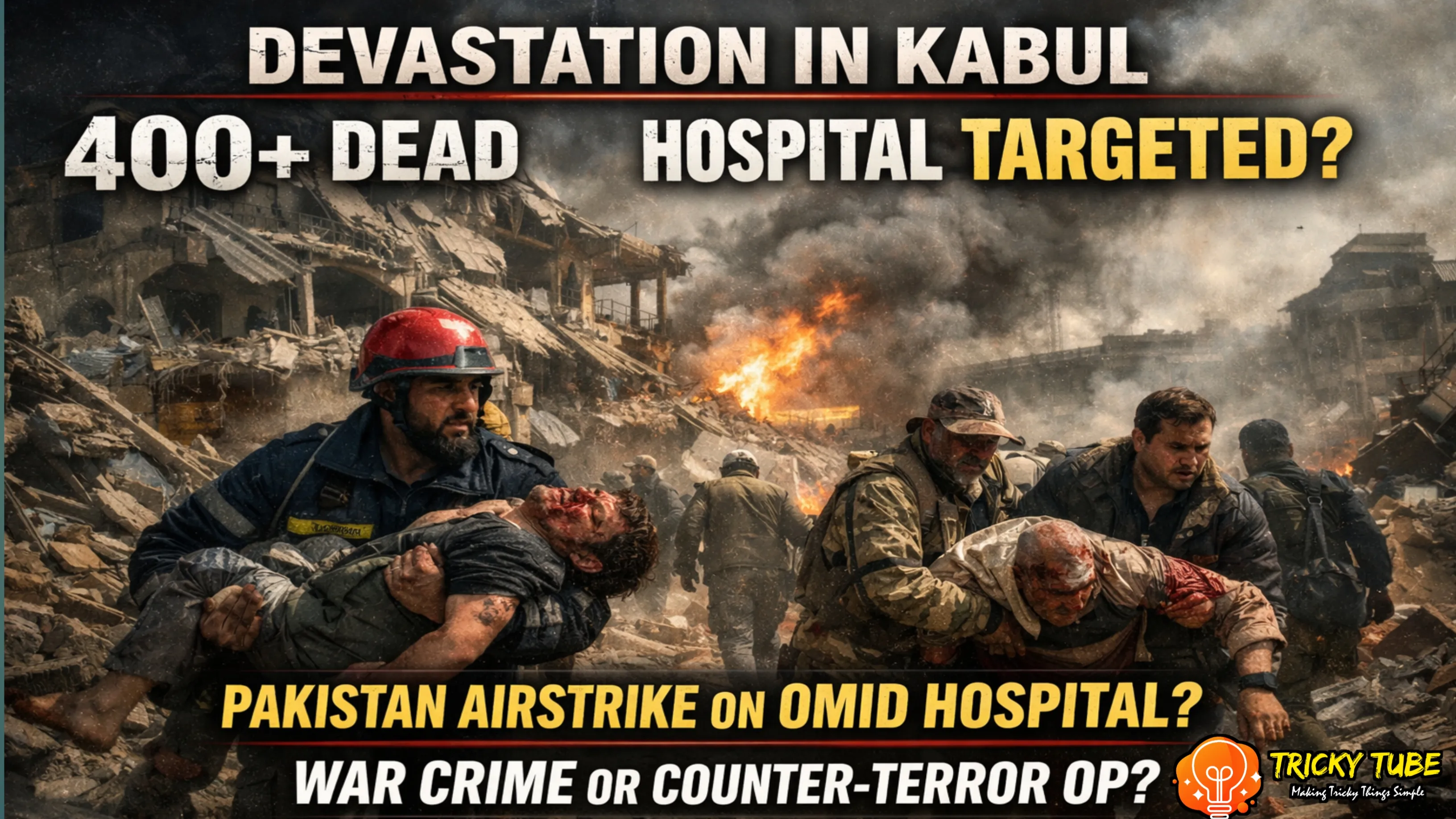
A devastating airstrike on Kabul’s Omid Drug Rehabilitation Hospital has reportedly killed over 400 people, sparking global outrage and intensifying tensions between Pakistan and Afghanistan. Here’s a deep dive into what really happened, why it matters, and what could come next.
TrickyTube’s Quick Summary
- Kabul’s Omid Rehab Hospital hit by alleged airstrike
- 400+ dead, 250 injured
- Pakistan claims strike targeted terrorists (TTP, ISIS-K)
- Taliban calls it a war crime, demands investigation
- Tensions rising over Durand Line & cross-border militancy
- Could trigger larger regional instability
What happens when a place meant for healing turns into ground zero of destruction?
In one of the most disturbing developments of 2026, Kabul witnessed a catastrophic airstrike that allegedly targeted the Omid Drug Rehabilitation Hospital-a facility known not just for its size but for its critical role in Afghanistan’s fragile healthcare system. Reports suggest that more than 400 people lost their lives, while another 250 were injured, making it one of the deadliest incidents in the region in recent years.
The sheer scale of devastation is difficult to comprehend. A hospital with a capacity of around 2,000 beds, meant to rehabilitate drug addicts, was partially reduced to rubble. Patients, staff, and vulnerable individuals—many already fighting personal battles-were caught in a nightmare they could never escape.
Why This Hospital Mattered More Than You Think
Afghanistan isn’t just another country struggling with drug addiction-it is central to the global narcotics landscape. The nation reportedly accounts for 80–90% of the world’s opium production, making drug rehabilitation facilities like Omid not just important, but absolutely essential.
Destroying such a facility doesn’t just mean loss of lives-it cripples an already overstretched system trying to tackle addiction at scale. Thousands who depended on this hospital for recovery now face an uncertain future.
In my opinion, this isn’t just collateral damage-it’s a long-term humanitarian setback that could worsen Afghanistan’s drug crisis dramatically.
Conflicting Narratives: Who’s Telling the Truth?
As expected, the incident has triggered sharply contrasting claims from both sides.
Pakistan’s Stand
Pakistan has stated that the airstrike was aimed at terrorist infrastructure, specifically targeting militant groups like:
- Tehrik-i-Taliban Pakistan (TTP)
- ISIS-K
According to their narrative, these groups were operating from within Afghan territory, posing direct threats to Pakistan’s internal security. Officials have denied any intentional targeting of civilians or medical infrastructure.
Taliban’s Response
On the other hand, the Taliban-led Afghan government has strongly condemned the attack, labeling it as:
- A violation of sovereignty
- A crime against humanity
They have demanded an independent international investigation, arguing that civilian lives were knowingly put at risk.
The truth likely lies somewhere in the fog of war—but one thing is clear: civilians paid the highest price.
The Bigger Picture: A Conflict Years in the Making
This isn’t an isolated event-it’s part of a much larger geopolitical puzzle.
The long-standing disagreement over the Durand Line, the border between Pakistan and Afghanistan, has been a constant source of friction. Afghanistan has historically refused to fully recognize it, leading to repeated tensions.
2. The TTP Factor
Pakistan has repeatedly accused Afghanistan of providing safe haven to the Tehrik-i-Taliban Pakistan (TTP), a militant group responsible for numerous attacks inside Pakistan.
From Pakistan’s perspective, cross-border strikes are seen as preemptive self-defense. From Afghanistan’s side, they are viewed as blatant violations of sovereignty.
This clash of narratives is what makes the situation so volatile.
Why This Incident Could Be a Turning Point
This airstrike may not just be another headline—it could mark a dangerous escalation in South Asia’s security dynamics.
Here’s why:
- Civilian Casualties at Scale: Incidents with such high death tolls tend to attract global attention and pressure.
- Diplomatic Fallout: Relations between Pakistan and Afghanistan could deteriorate further.
- International Involvement: Calls for investigation may bring global powers or organizations into the equation.
- Radicalization Risk: Such tragedies often fuel anger, potentially leading to more instability in the region.
If not handled carefully, this could spiral into a prolonged conflict.
A Hard Question We Can’t Ignore
Was this a tragic mistake in a war against terrorism or a reckless act with devastating consequences?
Because if hospitals are no longer safe zones, then where does humanity draw the line?
FAQs
Q1. What happened in Kabul in 2026?
A major airstrike reportedly hit the Omid Drug Rehabilitation Hospital, killing over 400 people and injuring hundreds more.
Q2. Who carried out the attack?
Pakistan is accused of conducting the airstrike, though it claims the target was terrorist infrastructure, not civilians.
Q3. Why is this incident significant?
It highlights rising tensions between Pakistan and Afghanistan and raises serious humanitarian and geopolitical concerns.
Q4. What is the TTP?
Tehrik-i-Taliban Pakistan (TTP) is a militant group responsible for attacks within Pakistan.
Q5. Could this lead to war?
While not certain, the escalation increases the risk of prolonged conflict or international involvement.