
Economy Geopolitics
February 17, 2026
India Surpasses China in Rice Production: A Historic Milestone With Hidden Trade-Offs
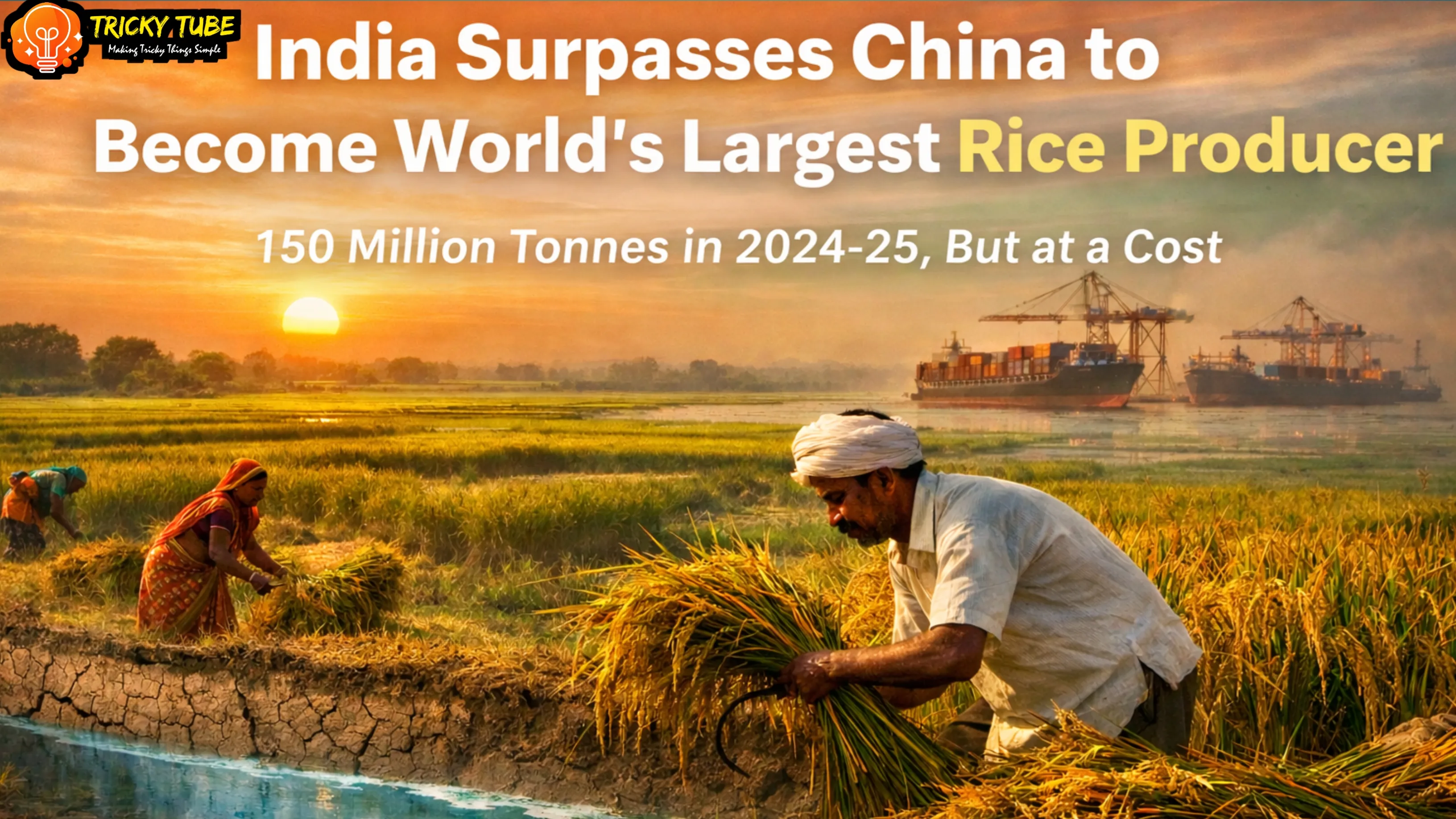
India has officially overtaken China in rice production, touching 150.18 million tonnes in FY 2024-25 and accounting for nearly 28% of global output. But behind this agricultural triumph lies a deeper story of subsidies, sustainability challenges, water stress, and policy shifts that could reshape India’s farming future.
TrickyTube’s Quick Summary
- India produced 150.18 million tonnes of rice in FY 2024-25.
- It now contributes around 28% of global rice output.
- MSP and Green Revolution infrastructure are key drivers.
- Water depletion and methane emissions pose major risks.
- Policy shifts are pushing toward diversification and sustainable practices.
“What happens when the world’s most populous country becomes the planet’s rice superpower?”
In FY 2024-25, India produced a staggering 150.18 million tonnes of rice, officially surpassing China and contributing roughly 28% of global rice output. That’s not just a statistic — it’s a structural shift in global agriculture.
As per various News report, this milestone places India firmly at the top of global rice production rankings. But while the headline screams triumph, the deeper story is far more layered.
Let’s unpack it.
Why India Is Dominating Rice Production
1. The Power of MSP: Zero Market Risk for Farmers
One of the strongest pillars behind India’s rice dominance is the** Minimum Support Price (MSP)** mechanism. The government guarantees a fixed price for paddy, meaning farmers face almost no market uncertainty.
In simple terms: grow rice, and you’re assured a buyer.
This safety net has made rice cultivation financially attractive — especially compared to crops like pulses or oilseeds, where price volatility is higher and procurement is less predictable.
It’s not just policy. It’s psychology. Farmers prefer certainty over risk.
2. The Green Revolution Legacy
The foundation was laid decades ago during the Green Revolution. High-yield seed varieties, fertilizer subsidies, and expansive irrigation networks — especially in states like Punjab and Haryana — transformed India’s agricultural landscape.
These states became rice powerhouses despite being semi-arid regions. Tube wells, canals, and electricity subsidies ensured water-intensive paddy farming could flourish even where nature didn’t originally intend it.
The result? Explosive production growth.
3. Food Security and Export Muscle
Rice is not just a crop in India — it’s survival infrastructure.
It feeds over half the population and forms the backbone of the Public Distribution System (PDS). Beyond domestic consumption, India is also the world’s largest rice exporter, supplying both premium basmati and non-basmati varieties across Asia, Africa, and the Middle East.
This dual role — feeding its own people while supplying the world — amplifies the strategic importance of rice in India’s economic and geopolitical framework.
But There’s a Catch: The Hidden Costs
Victory in volume does not always mean sustainability.
1. A Severe Water Crisis
Rice is one of the most water-intensive crops. Producing just one kilogram can require thousands of litres of water.
In states like Punjab, groundwater tables are falling at alarming rates. Decades of continuous paddy cultivation have pushed aquifers to dangerous depletion levels.
Here’s the uncomfortable truth: India grows massive quantities of rice in regions that are not naturally suited for it.
That model cannot continue indefinitely.
2. Environmental Damage and Methane Emissions
Flooded paddy fields emit methane — a greenhouse gas significantly more potent than carbon dioxide.
Add to that the continuous rice-wheat cropping cycle, which has degraded soil health in several northern states.
If production keeps rising without structural reforms, the environmental bill will eventually arrive.
3. Uneven Productivity Across States
While India leads in total output, yield per hectare varies dramatically between states. Some regions are highly efficient; others lag behind.
In contrast, China’s model focuses more on per-hectare productivity and water-use efficiency rather than sheer output quantity.
That’s a subtle but important distinction.
India’s approach has historically been volume-driven. China’s has leaned toward efficiency-driven.
4. Government Stock Burden
High procurement under MSP means the government buys massive quantities of rice. This leads to:
- High storage costs
- Risk of wastage
- Ballooning food subsidy bills
Maintaining buffer stocks is necessary for food security — but excessive accumulation strains fiscal resources.
5. Crowding Out Other Crops
When rice offers assured procurement, farmers logically prioritize it over pulses, oilseeds, or millets.
This has two consequences:
- India imports significant quantities of edible oils and certain pulses.
- Crop diversity declines, affecting long-term soil sustainability and nutritional balance.
In my view, this is the most under-discussed implication. Food security is not just about calories — it’s about balanced nutrition and agricultural resilience.
Is the Government Correcting Course?
There are early signs of re calibration.
Crop Diversification Incentives
Financial incentives are being offered to encourage farmers in water-stressed regions to shift away from paddy cultivation.
Focus on Pulses and Oil seeds
National missions are pushing production of pulses and oil seeds to reduce import dependency and improve nutritional security.
Regional Crop Planning
A more rational strategy is emerging: grow rice in water-abundant eastern states, and diversify crops in water-scarce northern regions.
Sustainable Rice Techniques
Techniques such as:
- Direct-Seeded Rice (DSR)
- Alternate Wetting and Drying (AWD)
are being promoted to conserve water and reduce methane emissions.
If implemented at scale, these could redefine India’s rice economy.
India vs China: Quantity vs Efficiency?
China’s agricultural model emphasizes higher per-hectare yields and better water-use management.
India, meanwhile, has focused on maximizing aggregate output to ensure food security and export dominance.
Now that India has achieved the top spot, the next battle isn’t about volume — it’s about sustainability.
And that will be the real test.
FAQs
Q1. How much rice did India produce in 2024-25?
India produced 150.18 million tonnes, surpassing China.
Q2. Why is rice production so high in India?
Government MSP support, irrigation infrastructure, high-yield seeds, and strong domestic demand.
Q3. Is rice farming sustainable in India?
Not entirely. Water depletion and methane emissions are significant concerns, particularly in northern states.
Q4. What is India doing to address sustainability issues?
Promoting crop diversification, pulses and oil seeds missions, and water-efficient rice techniques.
Q5. Why does India still import edible oils and pulses?
Because farmers prioritize MSP-backed rice over crops without assured procurement.