
Technology , National Affairs
February 16, 2026
India’s AI Moment: Why the 2026 AI Impact Summit Could Change the Global Tech Map
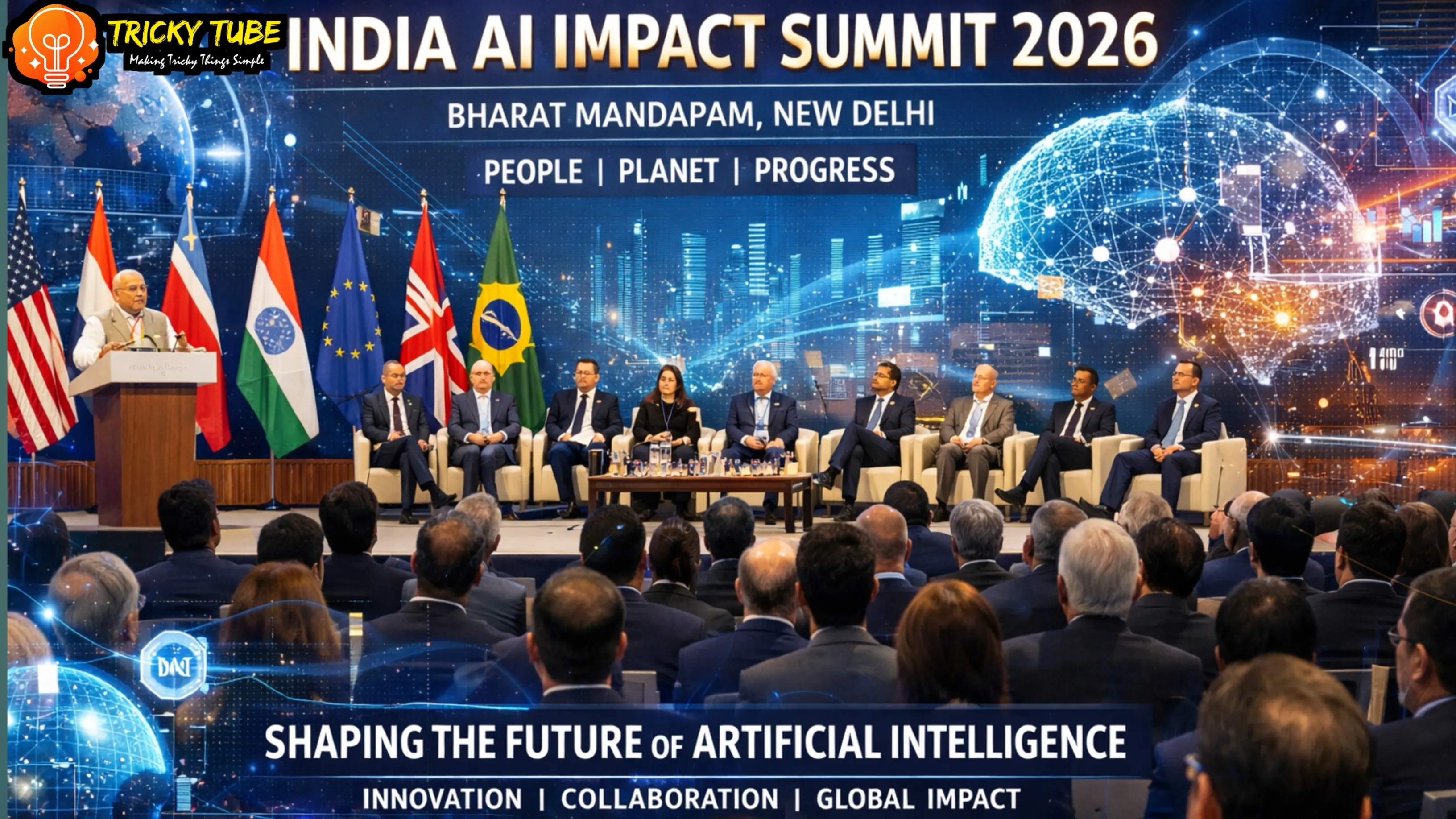
Is India finally ready to stop being just a consumer of AI and become a global architect of it? The 2026 India AI Impact Summit — the first of its kind in the Global South — is not just another tech event. It’s India’s bold bid to rewrite the rules of who shapes the future of artificial intelligence.
TrickyTube’s Quick Summary:
India is hosting the India AI Impact Summit 2026 in New Delhi from February 16 to 20, with participation from global leaders, major tech CEOs, and policymakers. Unlike past AI summits that focused on policy debates and existential risks, this one is deeply rooted in real-world impact — from education and jobs to climate resilience and inclusive growth. India also plans a massive AI Data City in Visakhapatnam and global challenges that attracted thousands of solutions worldwide. At its core, India wants to ensure AI benefits people, the planet, and progress, not just powerful corporations.
What if the next frontier of artificial intelligence isn’t US or China — but India? That’s not wishful thinking anymore. It’s now a strategic agenda being broadcast to the world from Bharat Mandapam, India’s sprawling event venue where the India AI Impact Summit 2026 is underway — and it may be the most consequential AI gathering the world has seen.
The Summit That’s Not Just Talk
For years, global AI discussions have revolved around ethical frameworks, existential threats, and regulation debates. But this summit is different. Instead of merely hypothesizing, India has positioned this event as an impact-driven forum — where ideas are tethered to measurable outcomes, practical applications, and scalable solutions.
Happening from February 16–20, 2026, the summit gathers world leaders, CEOs of major AI companies, and experts from 100+ countries — reflecting India’s ambition to be a global convenor, not a side player.
Three Pillars: People, Planet, Progress
What sets this summit apart is its three core themes: People, Planet, and Progress. This isn’t just policy jargon — it’s a blueprint for how AI should touch lives.
- People: Generating AI tools that improve education, employment opportunities, and equitable access.
- Planet: Using AI to fight climate change, improve agriculture, and support environmental resilience.
- Progress: Driving economic growth responsibly, with AI embedded in productivity and innovation.
Unlike international gatherings that often circle around risks or governance theory, this summit forces the conversation toward impact — how AI can tangibly change lives in emerging economies. That’s a subtle but powerful shift. In many ways, India is saying to the world: we want AI to solve problems we actually have, not just build tools for Fortune 500 companies.
Global Competitions and Real Solutions
Long before the summit began, India launched global impact challenges to crowdsource solutions. Over 4,650 applications poured in from 60+ countries, with 70 teams selected to showcase AI innovations in healthcare, climate, education, agriculture, and finance. This isn’t a showcase of theoretical demos — these are teams building deployable tools that can improve lives.
Visakhapatnam’s AI Data City: India’s Bold Bet
One announcement that stunned even tech insiders is India’s plan for a $175 billion “AI Data City” in Visakhapatnam. It’s not just a buzzword — this mega project aims to house data centers, AI training clusters, semiconductor infrastructure, and a full ecosystem that supports both research and industry scale-up.
This is more than infrastructure. If built as envisioned, it could transform India’s digital landscape — creating jobs, attracting foreign investment, and positioning India as an AI hub outside of the usual U.S.–China duopoly.
What the World Is Watching
This summit is also drawing serious global attention. Leaders from France, Brazil, and the UK, along with CEOs of tech giants like Google, OpenAI, Microsoft, and Qualcomm, are present, reinforcing that India’s AI agenda is now relevant on the world stage.
Even initiatives like the UPI One World wallet pilot, which lets international attendees use UPI without an Indian bank account or phone number, signal India’s intent to showcase its digital ecosystem to the world.
India’s Strategic Shift: From Consumer to Creator
For decades, India has been seen mainly as a consumer of global technology and a hub for outsourced tech services. But this summit pushes a strategic narrative: India wants a seat at the table where AI’s rules are written. From global governance frameworks to democratizing AI access, India’s vision is far broader than just export-led growth.
This shift has deep implications: it could influence how AI is regulated globally, who gets to power AI applications, and how technology is deployed in developing regions. In a world where innovation often follows wealth and power, India is pushing a new paradigm — one grounded in equity, inclusion, and real world progress.
Opinion: Why This Matters More Than You Think
This isn’t merely an event — it’s a declaration of intent. Whether you’re a student, developer, policymaker, or entrepreneur, this summit signals one thing: AI will increasingly be shaped outside traditional tech centers.
India’s focus on inclusivity and impact could redefine how technology scales in emerging markets. More importantly, it shows that AI’s future might not be decided only by corporate boardrooms or Western capitals — but through global collaboration that embraces diverse voices and real problems.
FAQs
Q: What is the AI Impact Summit?
A: It’s a global AI gathering held in New Delhi from Feb 16–20, 2026, focused on practical AI solutions and global cooperation.
Q: Why is India hosting this summit?
A: India wants to lead AI discussions that are impact-driven, promote inclusion, and democratize technology beyond developed nations.
Q: What is the AI Data City project?
A: A planned $175B AI ecosystem in Visakhapatnam — including data centers and semiconductor infrastructure — aimed at supercharging AI innovation in India.
Q: Who is attending the summit?
A: World leaders, global tech CEOs, policymakers, and over 100 countries are participating, reflecting wide international engagement.