
International
February 16, 2026
Did Bangladesh Just Flip Its Political Script? Inside the 2026 Election Shockwave
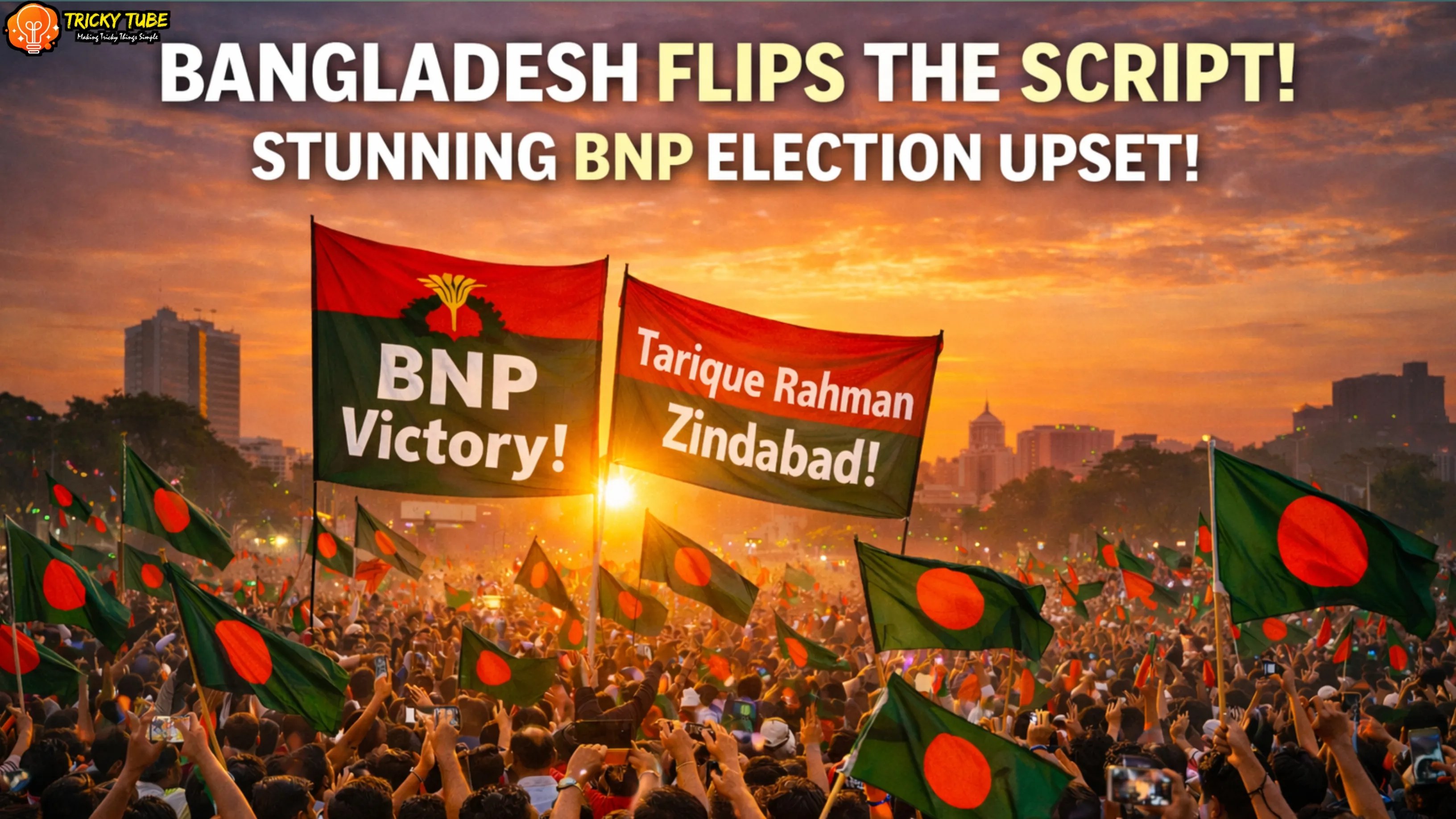
What looked impossible just months ago just happened: Bangladesh’s long-outlawed opposition, the Bangladesh Nationalist Party (BNP), appears poised to sweep to power in a historic 2026 election upset that could redraw the country’s political map and alter South Asia’s geopolitical balance forever.
TrickyTube’s Quick Summary:
In the 2026 Bangladesh general election, the Bangladesh Nationalist Party (BNP), led by Tarique Rahman, has confidently declared victory with a commanding majority — over 200 seats — even before the official tally was fully announced, casting aside the long-dominant Awami League era. Sheikh Hasina has denounced the polls as “deceptive,” pointing to reported violence and low turnout, while regional powers like India and the United States have already signaled diplomatic engagement with the incoming government. Across the country, voters backed not just a party, but a promise of political reset after years of turbulence.
A Nation Holds Its Breath — Then Changes Course
Ever wondered how a political underdog can rise so fast that even seasoned analysts are left scrambling? That’s the story unfolding in Bangladesh right now — a tectonic shift that has left South Asian geopolitics in flux.
After years under one dominant political leader, Bangladesh has seemingly flipped the script. The Bangladesh Nationalist Party (BNP) — long kept out of power and led by Tarique Rahman, the scion of a political dynasty — claims it has won a powerful mandate. Party officials say they’ve secured a two-thirds parliamentary majority in the 2026 election, comfortably surpassing the threshold needed to govern and usher in major reforms.
This isn’t just another election result. It feels like the reset button was hit on a nation that was yearning for change. For many voters, this election was about something bigger than party politics — it was about a break from polarized history and contested leadership.
Why This Win Is More Than Just Numbers
The BNP’s claimed victory — around 209–212 seats out of 300 — isn’t just a numerical majority, it’s a dramatic signal that Bangladesh’s political identity has transitioned. For two decades, the country was dominated by the Awami League under Sheikh Hasina’s leadership and a series of contested elections. But this time, with a fresh wave of voter impatience and demand for change, the BNP rode to the top.
What’s critical here is not just who won, but why voters turned out the way they did.
Tarique Rahman’s personal narrative — returning from 17 years in exile and taking charge of his party — gave this election a cinematic arc. It wasn’t just politics; it was redemption, symbolism, and the hope of a new chapter.
Yet, behind the celebrations, there are questions. Violence at polling stations and claims of suppressed turnout have been raised by opponents. Some observers say that these irregularities reflect deeper fault lines in Bangladeshi democracy — fault lines that don’t disappear simply because one party wins big.
Jamaat-e-Islami’s Role: Ally, Rival, and New Political Force
It wasn’t just a two-horse race. The Islamist Jamaat-e-Islami — long seen as a fringe group — won significantly more seats than many analysts expected, making it a substantial voice in the new parliament.
But hardline religious politics also energized voters who were afraid of instability. In some constituencies, vote splitting between Islamist and more secular parties may have inadvertently bolstered the BNP’s numbers — a reminder that in politics, every ballot can shift balance.
This surge in influence means that the new BNP government won’t govern in a vacuum — Jamaat’s increased representation will test both internal cohesion and external strategy.
This Election, a Referendum on Reform
Simultaneously with parliamentary polls, Bangladesh held a constitutional referendum on a package of deep reforms — including limits on prime ministerial terms and reinstatement of a caretaker government system. The “Yes” votes passed decisively, signaling that the electorate wasn’t just endorsing a leader, but demanding structural change.
This combination — sweeping a general election and backing constitutional reform — could usher Bangladesh into a new era, one where power is less centralized and institutions more accountable.
Global Reactions: Friends, Foes, and Neighbors Watching Closely
Even before the official results were final, international attention was intense. The United States Embassy reportedly congratulated the BNP and Tarique Rahman — a gesture that underscores global interest in Bangladesh’s democratic path.
In India, Indian Prime Minister Narendra Modi also extended congratulations, stressing continued commitment to a “democratic, progressive and inclusive Bangladesh.”
But it’s not all applause and friendship. Many in India and beyond are watching to see if the new government will reaffirm longstanding partnerships, or pivot toward new geopolitical alignments — especially regarding relations with Pakistan and China.
Opinion: A Victory or a Warning Sign?
This election is a celebration for many — a return to democratic choice after years of political tension. But it also raises pointed questions about governance, accountability, and how young democracies balance stability with freedom. Will the BNP deliver on promises of unity and reform? And can Bangladesh avoid polarized backlash now that the opposition is stronger, arguably more assertive?
Only time will tell — but this election undoubtedly marks a historic pivot.
FAQs
Q: Was this the first free election in Bangladesh?
A: Many observers consider the 2026 polls among the most competitive and transparent in decades, especially after the tumultuous 2024 political upheaval.
Q: Who is Tarique Rahman?
A: He’s the leader of the BNP, returning from nearly two decades in exile and now positioned to be Bangladesh’s next Prime Minister.
Q: How many seats did BNP win?
A: The BNP claims about 209–212 seats, enough for a strong majority.
Q: What’s the role of Jamaat-e-Islami?
A: While not in power, Jamaat gained a significant number of seats, which could make it an influential opposition voice.