
International
February 15, 2026
Why India’s New Highway Airstrip in Assam Could Change the Game Near China’s Border
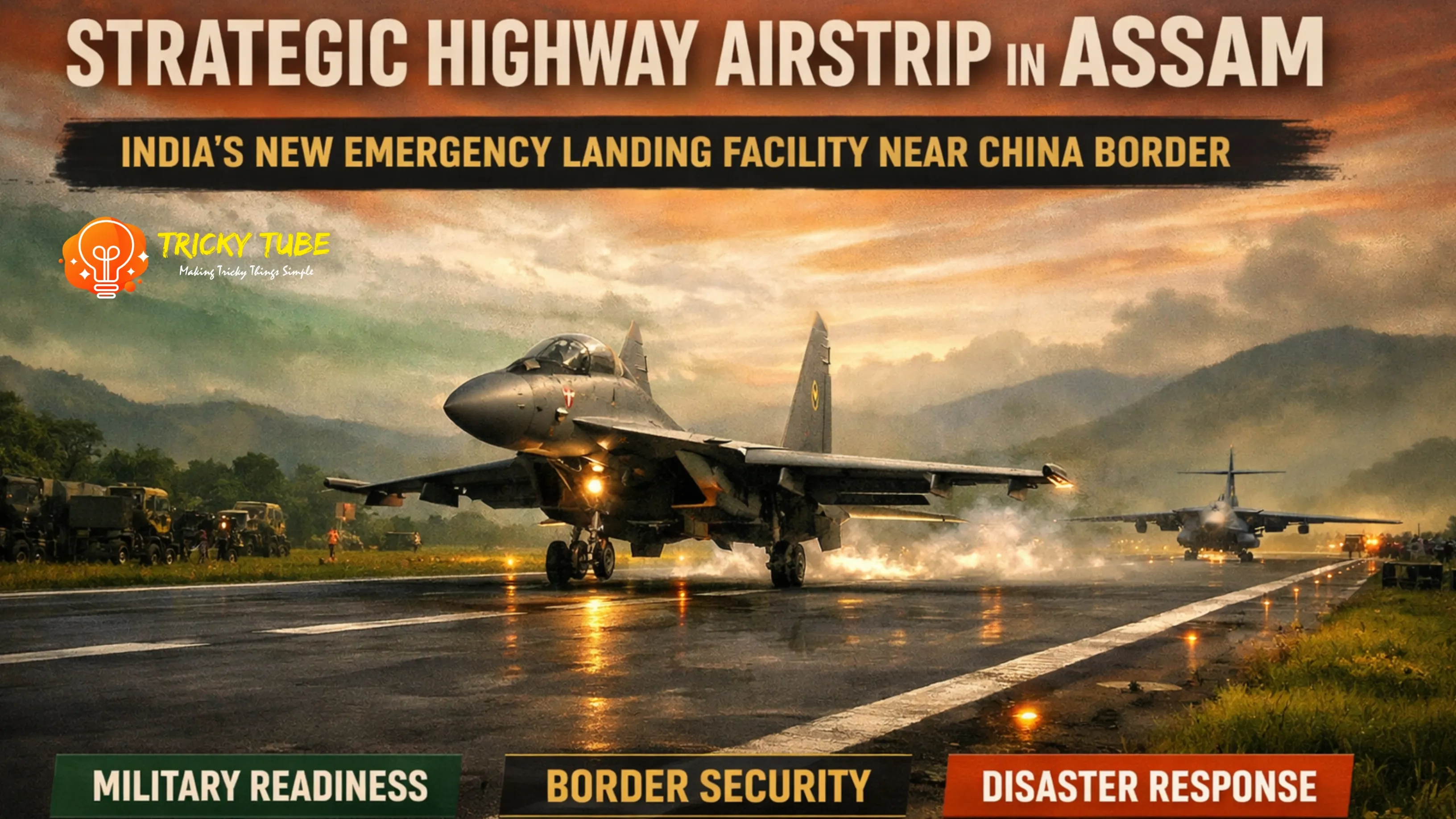
India’s new Emergency Landing Facility (ELF) on the Moran Bypass in Dibrugarh, Assam, is more than just a highway stretch. Strategically located near China, Myanmar, and Bangladesh, it signals a serious upgrade in India’s military readiness and disaster response capability.
TrickyTube’s Quick Summary
- India has developed a new Emergency Landing Facility (ELF) on the Moran Bypass in Dibrugarh, Assam.
- The highway stretch can function as a military airstrip during war or emergencies.
- It is strategically located near China, Myanmar, and Bangladesh.
- ELFs reduce dependence on fixed airbases vulnerable to drone or missile attacks.
- They also strengthen disaster relief operations in flood-prone Northeast India.
- The move signals India’s shift toward decentralized and resilient defense infrastructure.
What if the next war doesn’t begin in the skies—but on a highway?
That’s not a dramatic line. That’s exactly the strategic shift India is quietly preparing for.
When Prime Minister Narendra Modi landed on a freshly built Emergency Landing Facility (ELF) at Moran Bypass in Dibrugarh, Assam, it wasn’t just a photo-op. According to report, the landing was part of a larger push to strengthen India’s operational flexibility in sensitive border regions.
At first glance, it looks like a stretch of perfectly paved highway. But beneath that asphalt lies a strategic calculation.
What Exactly Is an Emergency Landing Facility?
An Emergency Landing Facility, or ELF, is essentially a section of national highway engineered to double up as a temporary airbase. These are not symbolic constructions. They are built to match the technical standards of military runways—same width, reinforced pavement strength, and sufficient length to handle heavy transport aircraft and fighter jets.
In simple terms: if a conventional airbase is damaged during war, missile strikes, or even a natural disaster, aircraft can still land, refuel, and operate from these alternative strips.
That redundancy matters more than ever.
Modern warfare is increasingly about disabling infrastructure first—radars, communication hubs, airbases. Fixed installations are vulnerable, especially with the rise of drones and precision-guided missiles. A dispersed network of ELFs reduces that risk dramatically. It complicates enemy targeting and increases survivability.
And that’s a serious strategic upgrade.
Why Assam? The Geography Tells the Story
Location is everything.
The Dibrugarh ELF sits in Upper Assam, not far from the borders of China, Myanmar, and Bangladesh. This is not accidental. It’s strategic geometry.
To the north lies China’s Tibet Autonomous Region, where China has rapidly expanded airstrips, railways, and military infrastructure over the past decade. To the west, Bangladesh’s political landscape has seen periodic shifts in alignment. To the east, Myanmar remains volatile.
In this context, an operational airstrip embedded in a highway is not just infrastructure—it’s a deterrent.
If tensions escalate along the Line of Actual Control, the Indian Air Force gains an additional forward operating option in the Northeast. Aircraft can disperse, operate unpredictably, and reduce reliance on a limited number of permanent bases.
Personally, this feels like India acknowledging a new reality: border tensions are not episodic anymore—they are structural. Preparing for that structurally makes sense.
It’s Not Just About War
There’s another dimension often overlooked.
North-East India is disaster-prone. Floods, landslides, and earthquakes frequently disrupt connectivity. When airports become inaccessible, relief operations slow down.
ELFs can bridge that gap.
Heavy transport aircraft carrying medical aid, food supplies, and rescue teams can land directly on reinforced highway strips. Evacuations can happen faster. Supplies can reach remote regions even when civilian infrastructure is compromised.
This dual-use model—military readiness plus disaster resilience—is what makes ELFs particularly smart policy.
It’s defense spending that also serves civilian protection.
A Broader Pattern Emerging
This isn’t an isolated project. India has been steadily developing similar facilities across different states. The logic is clear: decentralize air operations.
China has already embraced distributed military infrastructure in Tibet. High-altitude airfields, hardened shelters, rapid deployment corridors—the works.
India responding with ELFs suggests a shift from reactive to anticipatory strategy.
And here’s the implication: deterrence today is not about announcing strength loudly. It’s about quietly ensuring that even if the first strike happens, you remain fully operational.
That changes calculations on the other side of the border.
Political Signaling Matters Too
Prime Minister Modi personally landing at the facility sends a message beyond Assam. It signals confidence in the infrastructure and highlights national commitment to the Northeast.
For years, the region complained of neglect. Strategic projects like this indicate integration—not just economically but militarily.
In geopolitics, symbolism and capability often move together.
FAQs
1. What is an Emergency Landing Facility (ELF)?
An ELF is a specially reinforced section of highway designed to function as a temporary airstrip for military and emergency aircraft.
2. Why is the Assam ELF strategically important?
Its proximity to China, Myanmar, and Bangladesh enhances India’s ability to respond quickly in sensitive border regions.
3. Can civilian aircraft use these facilities?
Primarily designed for military use, but they can support civilian emergency operations during disasters.
4. How does this strengthen India’s defense?
By providing backup airstrips, ELFs reduce vulnerability if permanent airbases are targeted.
5. Is this part of a larger infrastructure plan?
Yes, India has been gradually developing similar facilities across different states to enhance operational flexibility.