
Economy
February 13, 2026
Is AI Eating Indian IT Alive? The ₹4 Trillion Market Shock That No One Saw Coming
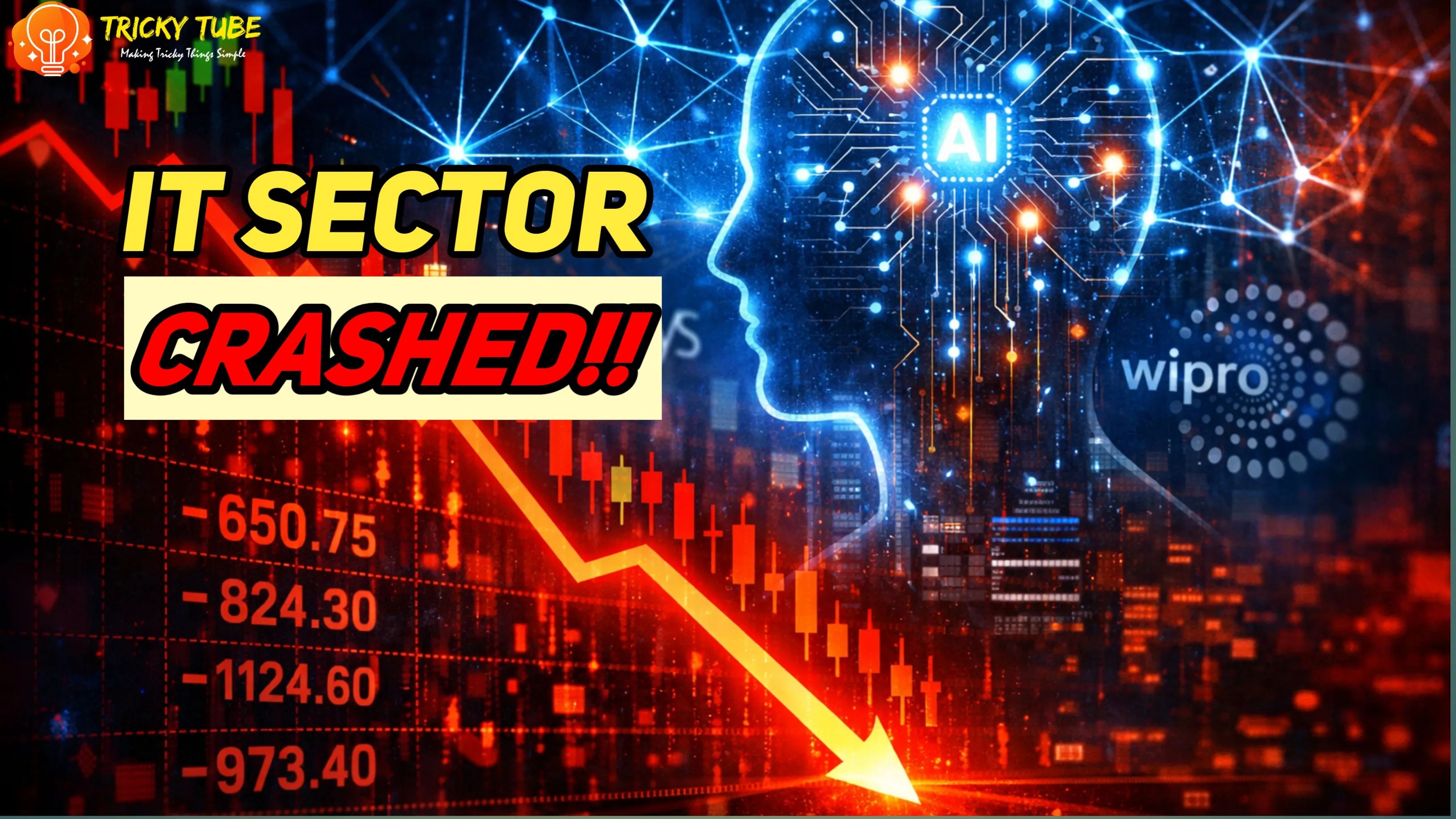
Indian IT stocks have crashed brutally — wiping out trillions in value while sowing fear across boardrooms and campus corridors. What’s driving this sell-off: genuine disruption or panic? And more importantly, what comes next for India’s tech backbone?
TrickyTube’s Quick Summary:
The Indian IT sector has plunged as investors fear artificial intelligence could replace traditional outsourcing services. ₹4+ trillion in market value has evaporated, major IT stocks are down sharply, and broader macro forces like strong U.S. jobs data have compounded the crisis. But while low-level coding jobs may face pressure, there’s a strategic pivot opportunity for Indian firms to become AI integrators and service pioneers rather than just labor exporters.
Show Me the Truth: The IT Sector Is in Real Trouble
What if I told you that a technology that’s supposed to create jobs could be on the brink of destroying thousands of them — and wiping out ₹4 trillion in wealth in the process? Sounds impossible just a few years ago, right? But that’s exactly what’s happening to India’s IT industry right now.
For decades, companies like TCS and Infosys have been the pride of Indian markets. They dominated with their labor-intensive outsourcing services — writing code, testing systems, managing legacy applications, and driving digital transformation all over the world. But today, the narrative has shifted dramatically.
AI Fears Rip Through Market Sentiment
Investors are panicking over the rise of cutting-edge artificial intelligence — especially tools that can automate tasks once done by large teams of engineers. These aren’t simple chatbots; they’re enterprise-grade AI agents that can write code, analyze data, automate workflows, and even handle certain compliance or back-office jobs.
The launch of sophisticated AI tools — particularly from major Western firms — triggered a sharp repricing of Indian IT stocks. Analysts have started talking about a potential 9–12% hit to sector revenue over the next few years because automation could shave away billable hours.
At the heart of it is a fear that’s hard to shake:
“If machines can do the work cheaper and faster than large outsourcing teams, why pay humans?”
That question alone has been enough to send ripples — now waves — through investor sentiment.
Beyond AI: Macro Forces Are Making Things Worse
If the fear of AI wasn’t enough, other economic realities have piled on.
One major external factor: strong U.S. job data. This may sound unrelated, but when the U.S. economy is tight and interest rates stay higher for longer, enterprises spend less on discretionary tech services. Since over half of India’s IT revenue comes from U.S. clients, this matters a lot.
Expectations of an early U.S. Federal Reserve rate cut evaporated as employment numbers surprised to the upside. That buffered demand for IT outsourcing — just when the sector needed spending to stay buoyant.
In simple terms:
AI threatens workloads, and slowing global tech budgets are tightening wallets.
Caught in the Crossfire: Valuations and Structural Weakness
Here’s the kicker — Indian IT stocks weren’t cheap to begin with.
Valuations had been running at premiums while actual growth was slowing to single digits. Combine that with fear of disruption, and you get a market that’s very willing to sell at the slightest bad news.
This isn’t just short-term volatility — it reflects deep questions about the traditional IT business model. For decades, Indian IT thrived on something called wage arbitrage: selling labor-intensive services at lower costs than Western firms. But when AI boosts efficiency and reduces the need for bodies on the ground, that model starts to crumble.
So, Is This Panic Rational or Overdone?
Here’s where opinions split — and where your takeaway as a reader becomes important.
Some analysts argue the market is overreacting. They say Indian IT firms aren’t going away — they’re just transitioning. For instance, JPMorgan has described Indian IT pros as the “plumbers of the tech world” — essential for tying together complex systems even in an AI era.
Others — like investment strategists — suggest this might be a buy-the-dip opportunity for long-term investors. These voices believe AI will expand the scope of service providers rather than eliminate them entirely.
My opinion?
This correction has both elements: panic and structural truth. Markets are often emotional beasts — and right now they’re overplaying their hand. But underlying the fear is a genuine transformation in how business services are delivered. Companies that adapt will thrive; those that cling to old models may fade.
The Human Impact (And Why This Matters to India)
This isn’t just numbers on a screen. The implications are real:
- Campus hiring is slowing as firms rethink large graduate intakes.
- Tier-one tech cities could see softer property demand as job growth cools.
- Urban consumption may dip if the confidence of tech workers wavers.
That’s a ripple effect — from the stock market all the way into everyday life.
But there’s hope too. Indian IT isn’t going extinct — it’s evolving.
Where Does Indian IT Go from Here?
The companies that will win are the ones that embrace AI instead of fearing it. That means:
- Integrating AI into service offerings
- Becoming managed AI service providers
- Investing in cloud, cybersecurity, and machine learning expertise
- Innovating beyond rote outsourcing
Upskilling, reskilling, and ecosystem transformation are not buzzwords here — they’re survival strategies.
FAQs
Q: Are Indian IT jobs about to disappear because of AI?
Not entirely. Low-end repetitive coding jobs are most at risk, but new roles in AI integration, cloud engineering, and cybersecurity are emerging.
Q: Will IT stocks recover soon?
Short-term volatility may continue, but recovery depends on how companies pivot to AI-enabled services.
Q: Is this sell-off only due to AI?
No. Market fears, U.S. economic data, and high valuations all play a role.
Q: Should investors buy now?
Some experts believe this is a dip worth buying — but only with a long-term horizon and industry-adaptation awareness.