
INTERNATIONAL
February 10, 2026
A Trade Advantage Disappears Overnight, Who Really Pays the Price? INDIA-US-BANGLADESH !
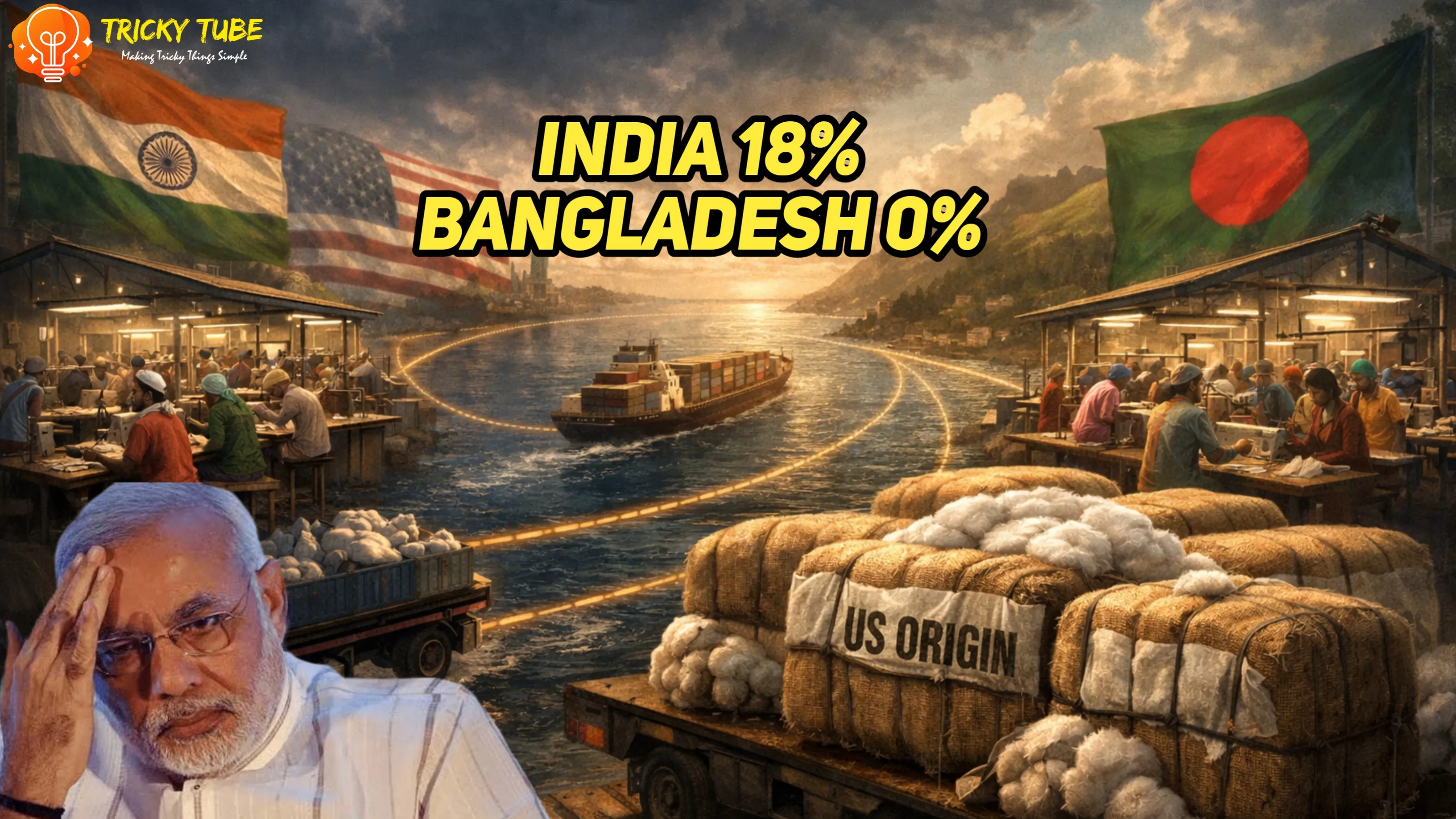
A quiet clause in a US–Bangladesh trade deal has wiped out India’s hard-won tariff advantage in the American textile market. Here’s how zero-tariff access, US-origin cotton, and shifting supply chains are reshaping South Asia’s garment industry-and what it means for India’s exporters going forwar-
TrickyTube’s Quick Summary
- India’s tariff advantage in the US dropped from a strong lead to near-zero overnight
- Bangladesh gained zero-tariff access for select textiles using US cotton
- Indian textile exports and cotton suppliers face dual pressure
- Stock markets reacted sharply to the new reality
- India is countering with diversification, especially through the EU deal
A Trade Advantage Disappears Overnight, Who Really Pays the Price?
What if a trade deal you were celebrating yesterday suddenly stopped making sense today? That’s exactly the position India’s textile industry finds itself in after a quiet but powerful shift in global trade equations involving the United States, India, and Bangladesh.
For months, Indian exporters believed they finally had an edge in the US market. Tariffs were cut. Orders were expected to rise. Stock prices reflected optimism. Then came a clause—almost invisible at first glance—that flipped the entire story.
From Celebration to Confusion: The India–US Tariff Reset
Not long ago, India secured a significant win in trade talks with the US. Tariffs on Indian exports—especially textiles and garments—were slashed from a steep 50% to a far more manageable 18%.
In practical terms, this mattered a lot. Competing exporters like Bangladesh and Pakistan were operating around the 19–20% range. India was suddenly cheaper, more competitive, and better positioned to attract US buyers looking to diversify supply chains away from China.
Textile hubs in Gujarat, Tamil Nadu, and Maharashtra expected increased orders. Exporters adjusted pricing. Investors bet on growth. The mood was cautiously optimistic.
And then, almost silently, the rules changed.
The Clause That Changed Everything: US–Bangladesh’s Quiet Move
The US and Bangladesh entered into a fresh trade understanding that didn’t make headlines immediately—but its implications are massive. Under this deal, general tariffs on Bangladeshi exports were brought down to 19%, matching the regional average.
But the real game-changer was buried deeper.
Certain Bangladeshi textile products would now enjoy zero tariff access to the US market—provided those garments are made using US-origin cotton or fibers.
This single condition reshapes incentives across the entire supply chain. Bangladesh gets cheaper access to the US market. The US secures a steady buyer for its cotton. And global buyers get competitively priced garments without tariff penalties.
From US’s perspective, it’s smart tradecraft. From India’s perspective, it’s a sudden erosion of advantage.
Why The Impact Lands Heaviest On India
India’s tariff edge didn’t just narrow—it effectively vanished overnight.
US buyers who had started shifting orders to Indian manufacturers now have a fresh alternative. Bangladeshi exporters, already known for scale and cost efficiency, can undercut prices even further with zero-duty access.
The ripple effects don’t stop there:
- Bangladesh is likely to reduce raw cotton imports from India, choosing US cotton instead to qualify for the zero-tariff benefit.
- Indian spinning mills and cotton exporters face indirect losses.
- Listed Indian textile companies saw sharp stock price declines, reflecting investor anxiety.
This isn’t just about one market or one season. It hits confidence, planning cycles, and long-term capacity decisions.
In my view, this is where trade policy stops being abstract and starts hurting real balance sheets.
Trade Under Uncertainty: The Trump Factor
A recurring theme in this entire episode is unpredictability. Trade decisions during Donald Trump’s presidency often came fast, transactional, and with little warning.
Deals were renegotiated. Allies were pressured. Clauses were weaponized to favor domestic industries. For countries like India, this means one uncomfortable truth: tariff certainty is no longer guaranteed, even after agreements are signed.
This forces exporters and governments alike to hedge their bets—and India seems to be doing exactly that.
India’s Countermove: Looking Beyond the US
While the US market remains critical, India isn’t standing still. New trade agreements with other major economies are clearly part of a diversification strategy.
The most notable among them is India’s evolving trade arrangement with the European Union. Under this deal, tariffs on several Indian goods—including textiles—are expected to fall to zero percent.
Why does this matter?
Until now, Bangladesh enjoyed near-zero tariffs in Europe due to its low-income country status. Indian exporters were at a disadvantage. With the EU deal, that imbalance disappears.
It doesn’t fully compensate for losses in the US market—but it does soften the blow and gives Indian manufacturers a credible alternative growth path.
Why Control Over Supply Chains Now Matters More Than Tariffs
Zoom out, and this episode reveals something deeper. Modern trade deals are no longer just about finished goods. They’re about controlling supply chains—from raw cotton to final garments.
The US isn’t just cutting tariffs for Bangladesh. It’s tying market access to American raw materials. That’s strategic, not accidental.
For India, the lesson is uncomfortable but clear: competitiveness today isn’t only about manufacturing strength. It’s about where your inputs come from, who controls logistics, and how quickly policies can shift.
What Comes Next For India’s Textile Exports?
In the short term, Indian textile exporters will feel pressure. Margins may tighten. Orders may slow. Some capacity expansion plans could be delayed.
In the long term, however, this could push India toward:
- Higher-value textiles instead of price-only competition
- Stronger bilateral deals beyond one dominant market
- Greater focus on integrated supply chains
Trade shocks hurt—but they also force adaptation.
FAQs
Why did India lose its tariff advantage so quickly?
Because the US introduced a zero-tariff clause for Bangladeshi textiles made with US-origin raw materials, neutralizing India’s lower tariff edge.
Does this mean Indian textile exports to the US will collapse?
Not collapse, but growth may slow. Price-sensitive segments will feel the most impact.
How does the US benefit from this deal?
It boosts demand for American cotton while keeping garment imports cheap.
Is the EU deal enough to offset US losses?
It helps significantly, but the US remains a larger and more complex market.