
National Security
March 12, 2026
120 Aircraft, One Message: How Exercise Vayu Shakti 2026 Showed the Real Power of the Indian Air Force
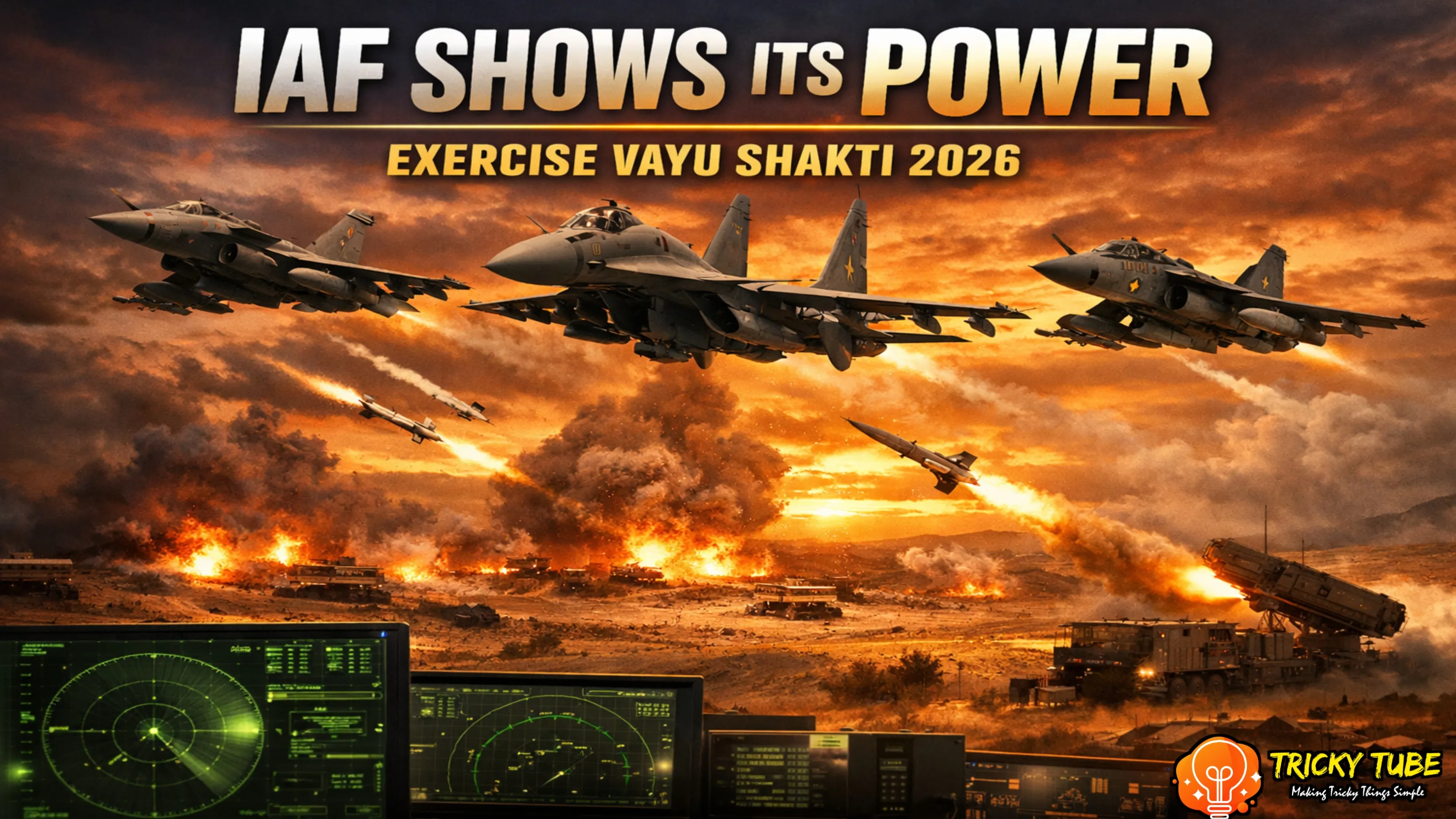
A massive airpower demonstration over the deserts of Rajasthan just sent a clear message to the world. With 120 aircraft, advanced missiles, and cutting-edge network warfare, Exercise Vayu Shakti 2026 revealed how the Indian Air Force is preparing for modern multi-domain battles.
TrickyTube’s Quick Summary
- Exercise Vayu Shakti 2026 took place at the Pokhran range in Rajasthan.
- Around 120 aircraft participated including fighters and helicopters.
- Major platforms included Rafale, Su-30 MKI, Tejas, Mirage 2000, MiG-29, Apache, Chinook, and Prachand.
- The exercise demonstrated precision strikes on enemy targets.
- Advanced air defence systems like Akash, SAMAR, and Sudarshan were showcased.
- Operations tested multi-domain warfare and network-centric combat capabilities.
- The drill highlighted the IAF’s readiness for modern high-tech warfare.
What happens when 120 aircraft take to the skies together for a live combat demonstration?
That’s exactly what the Indian Air Force (IAF) showcased during** Exercise Vayu Shakti 2026,** one of the most powerful displays of air dominance India has conducted in recent years. Held at the Pokhran air-to-ground firing range in Rajasthan, this massive military exercise was designed to prove one thing clearly: India’s air power is ready for fast, precise, and coordinated warfare.
Unlike routine drills, Vayu Shakti is a live-fire operational demonstration, meaning pilots, missiles, and weapons systems operate in real combat-like scenarios. Targets are destroyed in real time, aircraft fly complex missions, and multiple branches of the military coordinate simultaneously.
And this year’s exercise was bigger, louder, and far more technologically advanced.
A Sky Filled with Firepower
Exercise Vayu Shakti 2026 saw the participation of around 120 aircraft, making it one of the largest coordinated air demonstrations by the Indian Air Force.
Out of these, 77 were combat aircraft, while 43 were helicopters performing multiple operational roles. The aircraft lineup itself looked like a showcase of India’s evolving air power.
Frontline fighters such as the Rafale, Su-30 MKI, Mirage 2000, MiG-29, and the indigenous Tejas Light Combat Aircraft took center stage during the drills. Each of these platforms represents a different capability within the IAF’s combat doctrine.
The Rafale and Su-30 MKI demonstrated long-range precision strikes, while the Mirage 2000 and MiG-29 performed rapid attack missions against simulated enemy targets. Meanwhile, the Tejas aircraft symbolized India’s growing self-reliance in defence technology.
On the rotary-wing side, helicopters like the Apache attack helicopter, the heavy-lift Chinook, and India’s own Prachand Light Combat Helicopter (LCH) carried out close combat support and tactical transport missions.
Together, these aircraft simulated the kind of coordinated battlefield environment that modern wars demand.
Precision Strike Capabilities on Display
One of the central themes of Exercise Vayu Shakti was precision strike warfare.
During the demonstration, combat aircraft targeted simulated enemy infrastructure including runways, bunkers, radar installations, and strategic facilities. The focus was not just on firepower but on accuracy and speed.
Modern warfare demands surgical strikes rather than widespread destruction. The IAF’s ability to identify, track, and destroy high-value targets within minutes is becoming a key pillar of India’s defence strategy.
And the Pokhran range provided the perfect proving ground.
Jets performed high-speed attack runs, releasing guided bombs and missiles that struck targets with impressive precision. For defence analysts, exercises like these are important indicators of how quickly an air force can neutralize enemy capabilities during the early hours of a conflict.
Advanced Air Defence Systems
Air power today isn’t only about offensive capability. It’s equally about defending the skies.
During the exercise, several advanced air defence systems were also showcased. These included the SAMAR system, Sudarshan, and the indigenous Akash surface-to-air missile system.
These systems simulate how India would respond if hostile aircraft or missiles attempted to breach its airspace. By integrating radar detection, missile launch platforms, and real-time tracking systems, the exercise tested how effectively India’s layered air defence network could respond to threats.
The presence of these systems highlights an important shift in modern military thinking — air superiority now depends on both offense and defense working together seamlessly.
Support for Ground Forces
Another major aspect of the exercise focused on close air support and logistics operations.
Modern conflicts often require air forces to work closely with ground troops. In such situations, fighter jets and attack helicopters must provide immediate fire support while transport aircraft deliver equipment and reinforcements.
During Vayu Shakti, helicopters like the Apache and Prachand simulated battlefield support missions, while heavy-lift platforms such as the Chinook demonstrated rapid deployment of troops and equipment.
This capability becomes crucial in scenarios involving mountainous borders or rapid-response operations.
In fact, India’s geographic environment — particularly along the Himalayan frontier — makes air mobility and aerial logistics extremely important.
Multi-Domain Warfare: The Future of Combat
Perhaps the most significant takeaway from Exercise Vayu Shakti 2026 was the emphasis on multi-domain warfare.
Modern battles are no longer limited to land, sea, and air. Today’s conflicts involve space systems, cyber networks, drones, and digital communication platforms working together.
The exercise tested the IAF’s ability to coordinate across these multiple domains. Aircraft, drones, radar systems, and command centers operated through an integrated network-centric warfare system, allowing real-time information sharing.
This kind of digital battlefield integration allows commanders to make faster decisions and coordinate attacks with incredible precision.
In simple terms, it turns the entire military into one connected system rather than isolated units.
A Strategic Message Beyond the Exercise
While Exercise Vayu Shakti is officially a training drill, its implications go far beyond routine practice.
Large-scale demonstrations like this send a strategic message to both allies and potential adversaries. They show that India’s air force is not only equipped with modern platforms but is also capable of executing complex, high-intensity operations.
In my view, exercises like these also play a psychological role. They boost the morale of armed forces personnel while simultaneously reinforcing deterrence.
And as geopolitical tensions continue to evolve in the Indo-Pacific region, maintaining credible air power will remain a key pillar of India’s national security strategy.
FAQs
What is Exercise Vayu Shakti?
Exercise Vayu Shakti is a large-scale live firepower demonstration conducted by the Indian Air Force to showcase its operational capabilities and combat readiness.
Where was Exercise Vayu Shakti 2026 conducted?
The exercise was conducted at the Pokhran air-to-ground firing range in Rajasthan.
Which aircraft participated in the exercise?
Major aircraft included Rafale, Su-30 MKI, Tejas, Mirage 2000, MiG-29, Apache helicopters, Chinook helicopters, and the indigenous Prachand LCH.
What was the main objective of the exercise?
The main objective was to demonstrate precision strike capability, air defence readiness, and multi-domain warfare coordination.
Why are such military exercises important?
They help armed forces test real combat strategies, improve coordination between units, and send a strong deterrence message to potential adversaries.