
International
January 21, 2026
World Peace at stake-Trump's Crazy 10% Tariff on NATO Alliances-Over Greenland
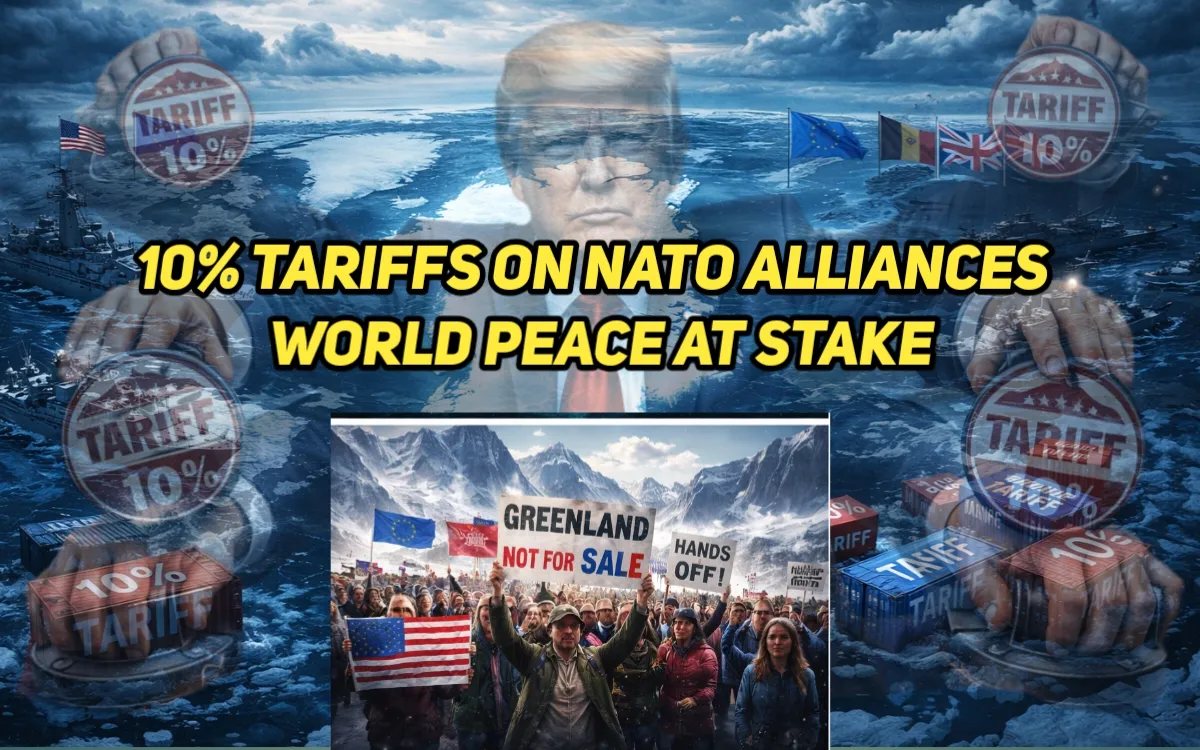
A frozen island with barely 60,000 people has suddenly become the epicenter of global tension. From shock tariffs on Europe to military posturing in the Arctic, Donald Trump’s Greenland obsession is no longer a joke-it’s a geopolitical stress test for NATO, international law, and the future of global order.
TrickyTube’s Quick Summary
US imposed 10% tariffs on European allies over Greenland dispute Threat of 25% tariffs by June if demands aren’t met Greenland is strategically vital for Arctic security and minerals Europe rejects the move on legal and moral grounds NATO unity faces one of its biggest internal stress tests India is being quietly urged to take a position
The Shocking Statement from US President
What if I told you that Europe’s economy, NATO’s unity, and global trade rules are shaking-not because of a war, but because of a territorial obsession over Greenland? In early February, the United States dropped a bombshell: 10% tariffs on major European economies, with a blunt warning-sell Greenland or face 25% tariffs by June. This wasn’t a trade dispute over steel or cars. This was economic pressure tied directly to geography, power, and control of the Arctic. And suddenly, a silent, icy landmass became the loudest topic in global geopolitics.
Trump’s Tariff Weapon: Trade as a Pressure Tool
US President Donald Trump justified sweeping tariffs on Denmark, Germany, France, the UK, and other European allies by linking them to opposition against his Greenland plan. His logic was simple-and dangerous:
[!important] If Europe blocks America’s Arctic ambitions, America will hit Europe where it hurts most: trade.
This is not diplomacy. This is economic coercion, a strategy where tariffs are used like sanctions-but against allies.
[!important] From a global perspective, this marks a worrying shift. If trade rules can be weaponized for territorial ambitions, no alliance is safe anymore.
Why Greenland Suddenly Matters So Much
At first glance, Greenland looks irrelevant-ice, snow, and isolation. But beneath that ice lies the future.
Greenland’s real value:
- Missile early-warning systems against Russia and China
- Arctic military dominance, controlling new shipping lanes
- Rare minerals, gold, copper, now accessible due to melting ice
- Space surveillance and ballistic missile defense
Trump’s argument is that whoever controls Greenland controls the Arctic—and whoever controls the Arctic controls the future balance of power. From a strategic lens, that fear isn’t entirely imaginary. Russia and China are expanding Arctic influence. But here’s the problem: control doesn’t require ownership.
The “World Peace” Argument: Genuine Fear or Political Cover?
Trump repeatedly claimed that Greenland is “essential for world peace.” According to him, US political control is the only way to stop Russia and China from militarizing the Arctic. But critics argue this is misleading. Under NATO, the US already had military bases, radar access, and defense cooperation in Greenland. In fact, the US voluntarily scaled back its presence—only to later argue that ownership was suddenly necessary. That contradiction raises a serious question:
[!question] Is this about security-or about power projection under a nationalist banner?
Europe Pushes Back: Law, Order, and Red Lines
Europe’s response has been unusually united. The European Union and NATO allies rejected the idea outright, citing:
- International law (Greenland cannot be sold without its people’s consent)
- Dangerous precedent (If land can be pressured into transfer, what’s next?)
- Threat to global stability France, backed quietly by Germany and the UK, even moved military assets closer to Greenland. Planned Arctic exercises like “Arctic Endurance” are no coincidence-they’re signals. Europe is saying: This far, and no further.
Greenland’s People Say It Loud and Clear: “Our land is Not For Sale”
Perhaps the most overlooked voice in this chaos is Greenland itself. Public protests, banners reading “Greenland Not For Sale”, and growing anti-American sentiment show one thing clearly: this isn’t just a chessboard-it’s home to real people. Ironically, while global powers debate ownership, Greenlanders are demanding more autonomy, not new masters. That disconnect-between power politics and local reality-could turn this from a diplomatic crisis into a long-term resentment problem for the US.
NATO at Risk: Alliance or Arrangement?
Here’s the uncomfortable truth: NATO was never designed to survive internal blackmail. Tariffs against allies weaken trust. Military pressure over territory fractures unity. If this spiral continues, NATO risks becoming a hollow shell-existing on paper but broken in spirit. Some European strategists are already preparing for a future where:
- Europe defends itself independently
- The US is seen as an unpredictable actor
- Russia and China exploit Western division If NATO cracks, history will remember Greenland not as an island-but as a fault line.
And Where Does India Fit In?
An interesting twist emerged when Greenlandic MPs reportedly urged India to take a stand. India now faces a delicate choice:
- Support international law and sovereignty
- Avoid antagonizing the US
- Maintain strategic balance in a multipolar world
My view? India should quietly but firmly support rule-based order, not land grabs disguised as security concerns. Silence here could normalize a precedent that one day turns toward Asia.
The Bigger Implication (My Opinion)
This is not about Greenland alone. This is about whether economic power can override international law, whether alliances survive when pressure replaces trust, and whether global order bends to the will of the strongest. If this gamble succeeds, tomorrow it won’t be Greenland-it could be Taiwan, the Arctic seabed, or resource-rich islands elsewhere. That’s why this moment matters.
FAQs
Why does the US want Greenland so badly?
Because of its strategic Arctic location, missile defense potential, and access to rare minerals.
Can Greenland legally be sold?
No. Greenland is autonomous, and any transfer requires the consent of its people and Denmark.
Will NATO really break because of this?
Not immediately-but trust erosion can cause long-term structural damage.
Is this a trade war or territorial dispute?
Both. Trade tools are being used to force geopolitical outcomes.
Should India take a stand?
India should support international law while maintaining strategic diplomacy with all sides.