
international
March 6, 2026
Pakistan Deploys Air Defenses to Saudi Arabia Amid Iran Tensions A Strategic Move With Big Regional Implications
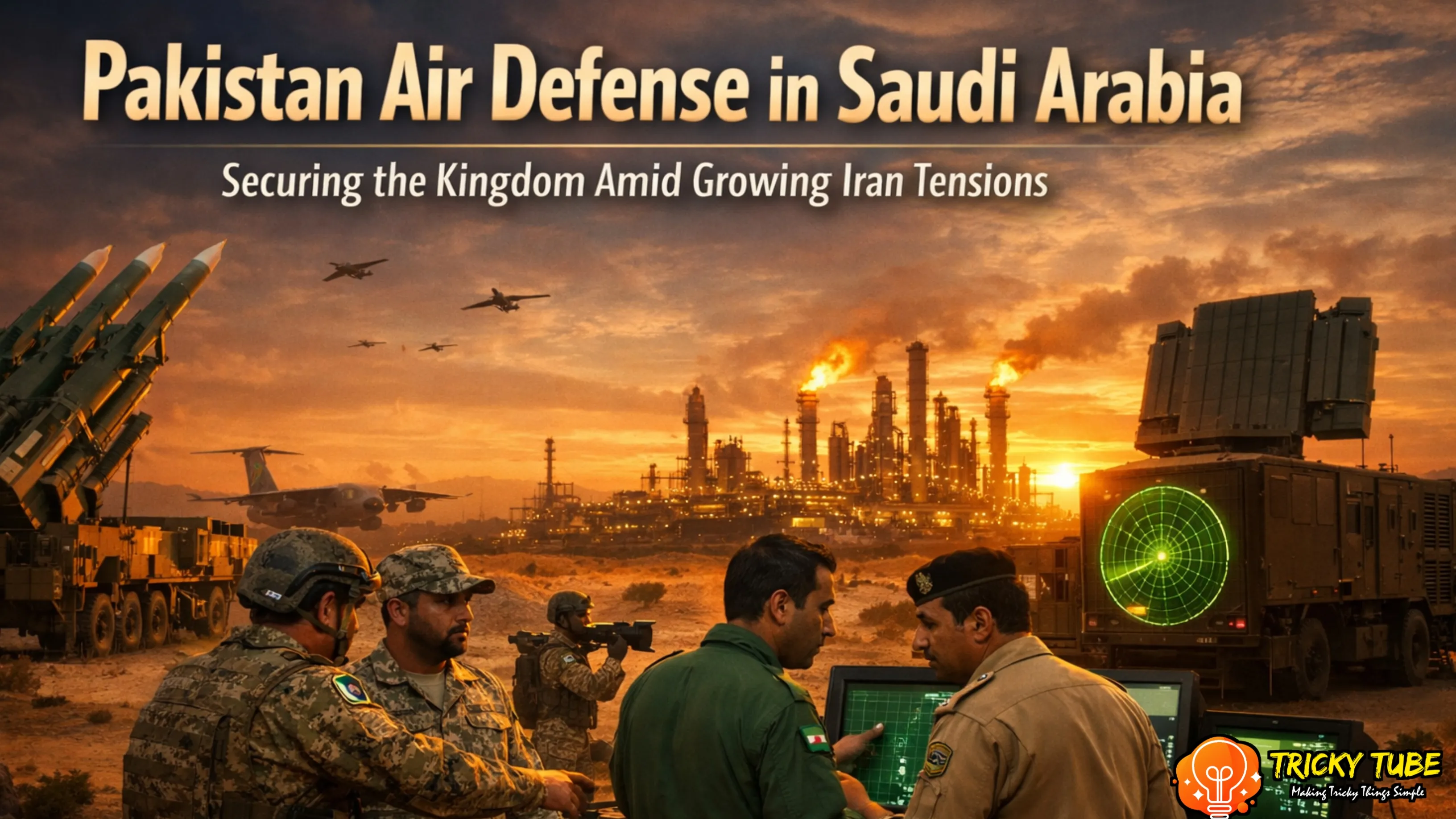
As tensions in the Middle East intensify following attacks on Saudi infrastructure, Pakistan has activated its strategic defense agreement with Saudi Arabia. From deploying advanced air defense systems to sending military specialists, Islamabad’s move highlights a delicate geopolitical balancing act between Riyadh and Tehran.
TrickyTube’s Quick Summary
- Pakistan activated its Strategic Mutual Defense Agreement with Saudi Arabia.
- Air defense systems including LY-80, FM-90, and Anza MANPADS were deployed.
- Pakistani military specialists are assisting Saudi defense units.
- Iran-linked attacks targeted Ras Tanura oil refinery and US Embassy in Riyadh.
- Pakistan is balancing its support for Saudi Arabia while maintaining diplomatic ties with Iran.
Pakistan Deploys Air Defenses to Saudi Arabia Amid Rising Iran Tensions
What happens when a regional conflict threatens to spiral into something much bigger? The answer may lie in Pakistan’s recent military moves in the Middle East.
In response to escalating tensions involving Iran and attacks targeting Saudi Arabia’s strategic infrastructure, Pakistan has quietly activated its Strategic Mutual Defense Agreement with Saudi Arabia, a development that could reshape the region’s already fragile security dynamics. While the move is framed as a defensive measure, it signals how rapidly the Middle East’s geopolitical landscape is shifting.
The deployment reflects not only Pakistan’s long-standing defense partnership with Saudi Arabia but also the complex balancing act Islamabad must perform while maintaining relations with neighboring Iran.
Pakistan’s Strategic Defense Activation
Recent attacks attributed to Iran and its allied groups have targeted critical facilities inside Saudi Arabia. These incidents raised alarms in Riyadh and prompted urgent discussions with its allies about strengthening defensive capabilities.
Pakistan, a long-time military partner of Saudi Arabia, responded by activating provisions of the 2025 Strategic Mutual Defense Agreement between the two countries. Under this agreement, Pakistan can provide military assistance in situations where Saudi Arabia’s territorial security or critical infrastructure is under threat.
The activation of this agreement marks a significant step because it transforms Pakistan’s role from a distant partner to an active participant in regional defense coordination.
While Pakistan’s leadership has emphasized that the deployment is strictly defensive, the move inevitably places Islamabad in the middle of one of the most sensitive geopolitical rivalries in the Middle East.
Advanced Air Defense Systems Deployed
One of the most important aspects of Pakistan’s response has been the deployment of multiple air defense systems designed to counter drones, cruise missiles, and aerial threats.
Among the systems deployed are the LY-80 medium-range surface-to-air missile system, which is capable of intercepting incoming aircraft and missiles at significant distances. This system significantly strengthens Saudi Arabia’s ability to defend critical infrastructure such as oil facilities, airports, and military installations.
Complementing the LY-80 system is the FM-90 short-range air defense platform, designed specifically to counter low-altitude threats including drones and tactical missiles. In modern conflicts, where drone warfare has become increasingly common, systems like the FM-90 play a crucial role in layered defense strategies.
Additionally, Pakistan has supplied Anza MANPADS (Man-Portable Air Defense Systems). These portable missile launchers provide flexible protection for ground units and key sites, allowing Saudi forces to respond quickly to sudden aerial threats.
Together, these systems create a multi-layered defensive shield, capable of intercepting threats at different ranges and altitudes.
Military Personnel and Operational Support
Beyond equipment, Pakistan is also contributing experienced military personnel to assist Saudi defense units. Specialists from Pakistan’s Army, Air Force, and Navy are reportedly being integrated into Saudi operational structures to help coordinate air defense operations.
Such cooperation is not entirely new. For decades, Pakistan has provided military training and advisory support to Saudi Arabia. However, the current deployment appears more structured and operationally integrated than previous missions.
Pakistan is also supporting logistical operations by providing airlift and aerial refueling assistance using IL-78 tanker aircraft. These aircraft enhance operational flexibility by allowing extended flight missions and rapid movement of personnel and equipment across the region.
This logistical support ensures that Saudi defense forces can maintain sustained readiness in case of prolonged tensions.
Attacks on Critical Infrastructure Raise Alarm
The urgency of these defensive measures stems from recent attacks that targeted key facilities inside Saudi Arabia.
Reports indicate that Iranian forces or their allied groups have struck important locations such as the Ras Tanura oil refinery, one of the largest oil processing facilities in the world. Any disruption at Ras Tanura can have ripple effects across global energy markets because the facility handles a substantial portion of Saudi crude exports.
Another alarming incident involved an attack near the US Embassy in Riyadh, highlighting the expanding scope of the security threat.
These attacks underscore a growing trend in modern conflict: targeting economic and diplomatic infrastructure to exert pressure without triggering full-scale war.
Pakistan’s Diplomatic Balancing Act
While Pakistan’s support for Saudi Arabia reflects strong strategic ties, it also creates diplomatic complications.
Pakistan shares a long border with Iran and maintains important economic and political relations with Tehran. Because of this, Islamabad must carefully manage the optics of its military cooperation with Saudi Arabia.
Reports suggest that Pakistan has simultaneously engaged in diplomatic outreach to Iran, attempting to reduce tensions and clarify that its deployment is purely defensive in nature.
This dual approach reveals the difficult position Pakistan faces. Supporting Saudi Arabia strengthens a critical alliance, but antagonizing Iran could destabilize Pakistan’s western border and disrupt regional diplomacy.
In many ways, Islamabad is walking a geopolitical tightrope.
Why This Development Matters
This situation highlights a broader shift in the Middle East’s security environment. Instead of traditional large-scale wars, modern conflicts increasingly involve proxy attacks, drone strikes, and infrastructure sabotage.
Pakistan’s involvement also reflects how regional conflicts are becoming more interconnected. A security crisis in the Persian Gulf can quickly draw in neighboring countries and long-standing allies.
In my view, the most important implication is the possibility of gradual escalation rather than sudden war. Each defensive move, retaliatory strike, or alliance activation adds another layer of complexity to the region’s already fragile balance of power.
If tensions continue to rise, more countries could find themselves indirectly involved in maintaining or challenging regional stability.
For now, Pakistan’s deployment is framed as a defensive precaution. But in a region as volatile as the Middle East, even defensive moves can have far-reaching consequences.
FAQs
Why did Pakistan deploy air defense systems to Saudi Arabia?
Pakistan activated its strategic defense agreement with Saudi Arabia after attacks targeted Saudi infrastructure and security installations.
What air defense systems were deployed?
Pakistan deployed the LY-80 medium-range missile system, FM-90 short-range system, and Anza MANPADS.
Is Pakistan directly involved in the conflict?
No, Pakistan describes its role as defensive support aimed at protecting Saudi infrastructure from missile and drone threats.
Why is Pakistan’s position sensitive?
Pakistan shares a border with Iran and maintains diplomatic relations with Tehran, making its support for Saudi Arabia geopolitically delicate.