
international
March 3, 2026
India’s 7.8% GDP Growth in Q3 FY26: Real Momentum or Statistical Boost? Here’s What It Really Means
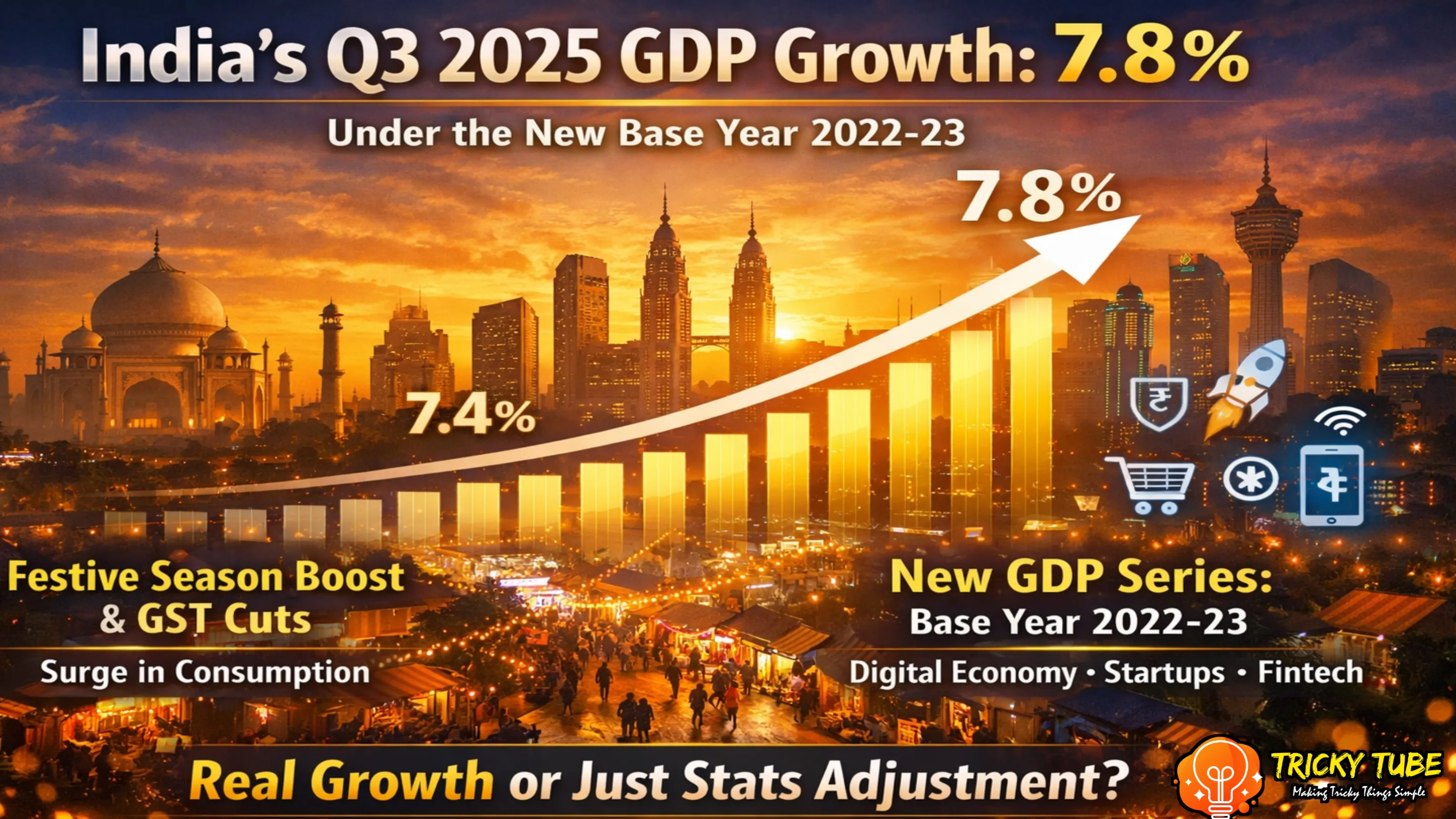
India’s economy expanded by 7.8% in Q3 FY2025-26 under the new 2022-23 GDP base year. Here’s a deep, human-focused breakdown of what’s driving growth, why the base year change matters, and what it means for India’s economic future.
TrickyTube’s Quick Summary
- India’s GDP grew 7.8% in Q3 FY2025-26.
- Growth improved from last year’s 7.4%.
- Festive season demand and GST cuts boosted consumption.
- New GDP base year (2022-23) better reflects the digital and startup economy.
- Full-year FY26 growth projected at 7.6% under new series.
- Revised base year enhances credibility but real sustainability depends on investment growth.
7.8%.
That’s not just a number — that’s the kind of growth rate that makes global investors pause and take notice. In the October–December quarter of FY2025-26, India posted a strong 7.8% GDP growth under its newly revised GDP series. But here’s the real question: Is this purely festive momentum, or are we witnessing something structurally bigger?
Let’s unpack this carefully.
A Stronger Quarter Than Last Year
Compared to the same quarter last year, when GDP growth stood at 7.4%, this 7.8% figure shows clear acceleration. On paper, the difference may look small — just 0.4 percentage points — but in macroeconomic terms, that represents billions of dollars in additional economic activity.
Even more interesting is the full-year projection. Under the new GDP base year of 2022-23, India’s growth for FY2025-26 is expected to come in at 7.6%, slightly higher than the 7.4% estimate calculated using the old 2011-12 base year. That adjustment alone tells us something important: how we measure the economy can change how we perceive its strength.
And perception matters — especially in global economics.
The Festive Season Effect: Consumption in Full Swing
The October–December quarter coincides with India’s biggest festive period — Diwali, Dussehra, and the wedding season. Historically, this quarter tends to boost consumption, but this time, the surge appears especially pronounced.
Vehicle sales jumped. Electronics and consumer durables saw healthy demand. Retail footfalls were visibly stronger. When households feel confident enough to spend on big-ticket items, it signals optimism.
Another key catalyst was the reduction in GST rates on several goods. Lower indirect taxes translated into more disposable income. And when people have more money left in their pockets, they tend to spend rather than save — particularly during festive months.
In my view, this shows something encouraging: India’s domestic demand engine remains resilient. In a world where many economies are struggling with stagnation or muted consumption, India’s internal market continues to provide stability.
Why Changing the Base Year Matters
Now comes the structural shift — the move from the 2011-12 base year to 2022-23.
GDP base years are periodically revised to reflect changes in economic structure, industry composition, and data quality. Think about it: in 2011, India’s digital economy was still emerging. Startups were not as mainstream. Platform-based businesses, gig work, fintech ecosystems — these were nowhere near today’s scale.
The 2022-23 base year better captures:
- The digital economy
- Startup ecosystems
- Platform and gig-based services
- Fintech expansion
- E-commerce growth
By updating the base year, statistical authorities ensure the economy’s measurement reflects its current reality. Otherwise, we’d be measuring a 2026 economy with a 2011 lens.
And that would be misleading.
Does the New Base Year Inflate Growth?
Let’s address the obvious skepticism.
Historically, revising the base year often leads to slightly higher GDP figures. That’s not necessarily manipulation — it’s usually a result of better data capture and inclusion of previously undercounted sectors.
But here’s the nuance: while the revision can lift headline numbers, it doesn’t create real factories, real jobs, or real productivity overnight. The fundamental health of the economy still depends on investment cycles, employment generation, and income growth.
In this case, the jump from 7.4% (old series) to 7.6% (new series projection) isn’t dramatic — which actually strengthens credibility. If the difference were massive, questions would naturally arise. The moderate revision suggests recalibration rather than cosmetic enhancement.
Policy and Global Implications
A revised GDP framework helps policymakers in three crucial ways:
- Better fiscal planning – Budget allocations can align more accurately with sectoral realities.
- Improved monetary decisions – Inflation-growth tradeoffs become clearer.
- Stronger global positioning – Investors trust transparent, updated statistical systems.
In an era where geopolitical uncertainty is high and global capital flows are cautious, credibility is currency. A modernized GDP series enhances India’s economic narrative internationally.
However, sustaining 7.8% growth won’t be easy. Festive demand is seasonal. The bigger test lies in capital expenditure, manufacturing competitiveness, and export resilience. If investment momentum picks up alongside consumption, India could maintain high growth for multiple quarters.
If not, growth may normalize closer to long-term averages.
The Bigger Picture
The 7.8% Q3 growth figure is not just about a good festive season. It signals three deeper trends:
Domestic demand remains India’s backbone.
Structural measurement reforms are aligning data with reality.
Policy support (like GST adjustments) can stimulate short-term momentum.
The real challenge now? Turning cyclical boosts into structural transformation.
Because ultimately, sustainable growth is not about one quarter — it’s about consistent trajectory.
FAQs
Q1: Why did India change its GDP base year?
To reflect changes in economic structure, include new industries like digital and platform services, and improve data accuracy.
Q2: Does changing the base year artificially increase GDP?
It can slightly adjust figures due to improved data coverage, but it does not create actual economic output.
Q3: What drove the 7.8% growth in Q3?
Strong festive season demand, higher consumer spending, and GST rate reductions.
Q4: Is 7.8% sustainable for future quarters?
Sustainability depends on investment growth, manufacturing expansion, and global economic conditions.