
Banking Awareness
March 27, 2026
₹160 Crore FD Scam Exposed: How “Non-Existent Deposits” Shocked India’s Banking System
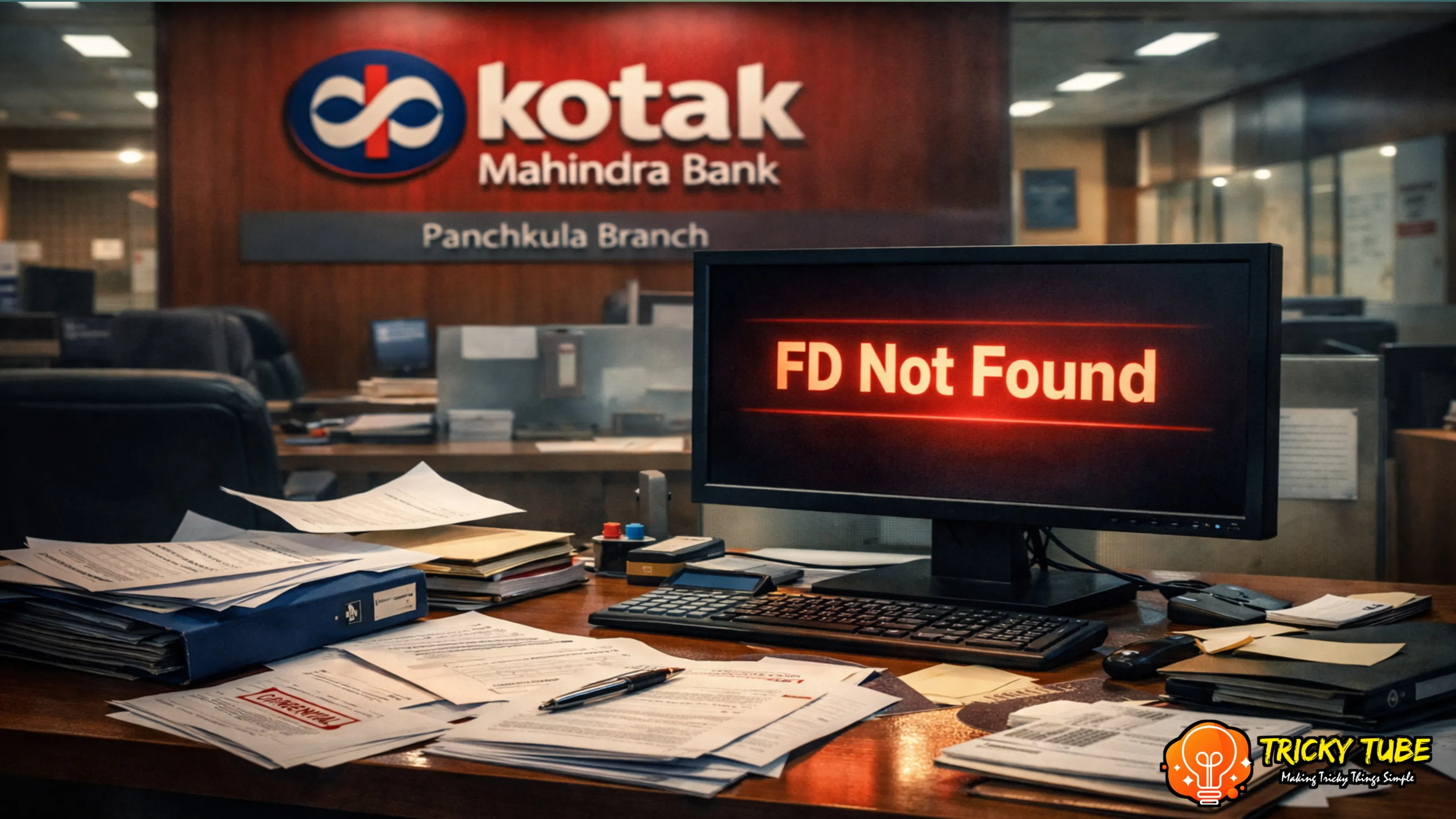
What if your “fixed deposit” never actually existed? A ₹160 crore fraud linked to Kotak Mahindra Bank and Panchkula Municipal Corporation exposes deep cracks in India’s financial system—raising serious questions about trust, audits, and digital verification.
Trickytube’s Quick Summary
- ₹160 crore FD scam linked to Kotak Mahindra Bank & Panchkula Municipal Corporation
- Fake FD receipts issued—no real deposits made
- Funds diverted into private shell accounts
- Scam exposed during ₹58 crore withdrawal attempt
- Possible insider involvement
- Similar case seen with IDFC First Bank
- Highlights major flaws in audits & verification systems
- Individuals protected (up to ₹5 lakh), institutions at higher risk
The Shocking Reality: What If Your Money Was Never There?
Imagine saving crores of public money in a fixed deposit… only to discover one day that the deposit itself never existed.
Sounds unreal? Yet, this is exactly what unfolded in a massive ₹160 crore fraud involving Panchkula Municipal Corporation and Kotak Mahindra Bank.
This isn’t just another financial scam. It’s a case that shakes the very foundation of trust people place in banks and institutions.
The Core of the Scam: Fake FDs That Looked Real
At first glance, everything seemed perfectly legitimate. Official-looking fixed deposit receipts were issued, documents were in place, and the funds were believed to be safely invested.
But here’s the twist—these FDs were completely fabricated.
Instead of actually placing the money into genuine fixed deposit accounts, fake receipts were created to give the illusion of investment. The funds never entered the bank’s core system.
In simple terms:
The money was shown as invested, but the investment never happened.
This is what makes the scam particularly dangerous—it wasn’t mismanagement, it was deliberate financial engineering and deception.
How the Money Was Diverted
So where did the money go?
Investigations suggest that instead of being deposited into legitimate FD accounts, the funds were diverted into private shell accounts. These accounts acted as temporary holding zones, making it easier to siphon off the money without immediate detection.
This kind of setup typically involves:
- Layered transactions
- Fake documentation
- Insider access to banking systems
And that brings us to the most concerning part…
Insider Involvement: The Real Threat
Frauds of this scale rarely happen without internal access.
In this case, individuals with access to the bank’s internal systems are suspected to be involved—possibly working in coordination with external networks.
This raises a critical question:
If insiders can manipulate records, how secure are institutional funds really?
In my view, this is the most alarming aspect of the entire case. Technology alone isn’t enough—trust in human systems remains the weakest link.
How the Scam Was Finally Discovered
Interestingly, the fraud went unnoticed for a long time.
It only came to light when the Panchkula Municipal Corporation tried to withdraw a ₹58 crore maturity amount.
Instead of receiving the funds, they were met with a shocking response:
No such FD existed in the bank’s core system.
This moment exposed the entire scam—and revealed how deep the manipulation had gone.
Not an Isolated Case: A Pattern Emerging
What makes this even more concerning is that a similar fraud had already surfaced involving** IDFC First Bank and the Haryana government.**
Two large-scale scams, same region, similar pattern.
This suggests that the issue isn’t just about one bank or one institution—it points toward systemic vulnerabilities in handling government funds.
Systemic Failures Behind the Scam
The incident highlights several major weaknesses:
1. Weak Internal Controls
Banks failed to detect fake FD creation within their own systems.
2. Audit Failures
Regular audits did not catch discrepancies in time.
3. Lack of Real-Time Verification
Government bodies relied on physical receipts instead of verifying deposits digitally.
This combination created a perfect environment for fraud to thrive.
Are Regular Depositors at Risk?
Here’s some relief for individuals.
Under Reserve Bank of India regulations, deposits up to ₹5 lakh are insured.
However, institutional funds—like government money—don’t enjoy the same level of protection.
This creates a paradox:
While individuals are relatively safe, large public funds are more exposed.
What This Means for the Future
This case is more than just a scam—it’s a wake-up call.
If fake deposits can exist within regulated banking systems, then the focus must shift to:
- Stronger digital verification
- Independent audit systems
- Reduced reliance on paper-based confirmations
In my opinion, unless real-time transparency becomes mandatory, similar frauds could happen again—just in more sophisticated ways.
FAQs
1. What is the ₹160 crore FD scam about?
It involves fake fixed deposit receipts issued without actually depositing money, leading to massive financial loss.
2. How was the fraud detected?
When authorities attempted to withdraw maturity funds, they discovered no such FD existed in the bank’s system.
3. Who is responsible for the scam?
Investigations suggest insider involvement along with external networks.
4. Are normal bank customers affected?
No major risk—individual deposits up to ₹5 lakh are insured by RBI.
5. What lesson does this scam teach?
It highlights the urgent need for real-time digital verification and stronger internal controls in banking.